
The correct answer is "Chokri."
The complete dialogue is:
"22 tak padhai, 25 pe naukri, 26 pe chokri, 30 pe bachche, 60 pe retirement... aur phir maut ka intezaar. Dhat! Aisi ghisi-piti life thodi jeena chahta hoon."
This iconic dialogue is spoken by Bunny (Ranbir Kapoor) in the 2013 Bollywood film Yeh Jawaani Hai Deewani. Over the years, it has become one of the most quoted movie dialogues among Indian youth because it humorously questions the idea of following a fixed life timeline.
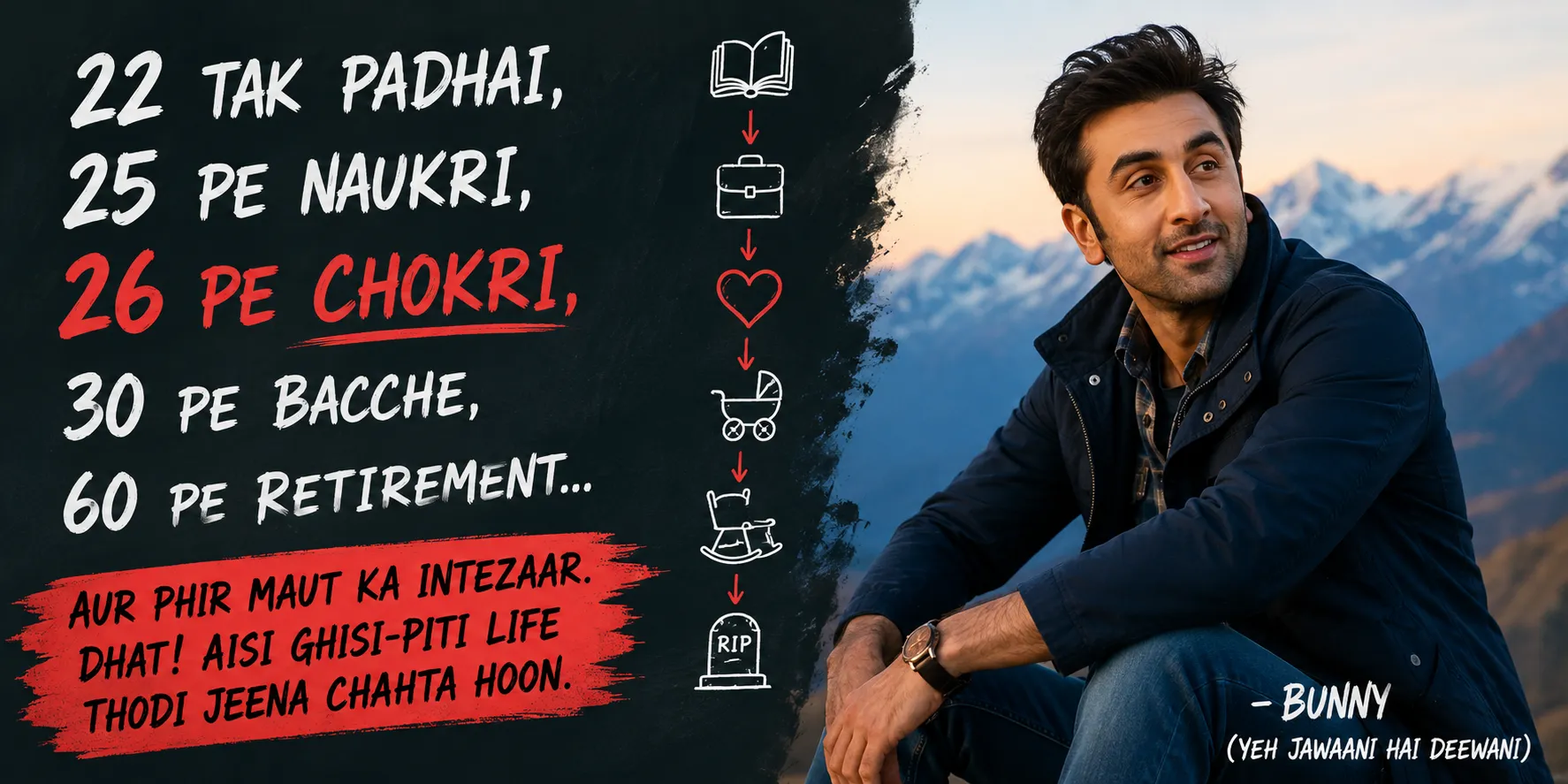
The conversation sounds humorous at first, but it is actually a more profound conversation about life.
This is where we get what many consider the “default” life plan:
• Study until you are in your early 20s.
• Get a regular job.
• Marry.
• Have kids.
• Work till you retire.
• Just grow old, then.
Bunny isn’t saying these milestones are evil. But rather, he is asking whether it is necessary for all to feel obliged to take the same way.
The Birth of Dialogue
This dialogue is from Yeh Jawaani Hai Deewani directed by Ayan Mukerji and starring Ranbir Kapoor and Deepika Padukone.
In the movie Bunny is the guy who wants to go across the world, go to new locations, take chances, and live life on his own terms. In this chat he is expressing his worry of a routine life and not living his desires.
This is one of the most memorable lines even more than a decade after the movie came out. Many young people can relate to the pressure of societal expectations.
What is the meaning of the dialogue?
Note that the debate is not a criticism of education, employment, marriage, or family.
It’s a critique of the concept that there is one right timeline for everyone.
Some people really desire to:
• College graduate.
• Make a career.
• Get married!
• Create a family.
And there is nothing wrong with that at all.
Some may choose to:
• Travel first, settle down later.
• Create a company.
• Go abroad.
• Consider other careers.
• Deferring marriage.
• Focus on self-improvement.
The exchange is a reminder that life doesn’t have to be a checklist just because everyone else is doing it.
Why Did This Dialogue Get So Popular?
There are several reasons why it still resonates.
First, virtually everyone has heard questions such as:
“When does the work start?”
"When are you going to get married?" "You ought to marry now.
These expectations might be daunting for many young people.
Secondly, the discussion captured a transition between generations. The highest value of past generations was frequently stability. Stability is still appreciated by this generation, but so is experience, travel, creativity, entrepreneurship, mental wellness, and meaningful work.
That’s why this one conversation keeps popping up on social media, motivational pages, and travel groups long after the movie’s premiere.
Is Bunny Correct?
The intriguing thing is that there is no proper response.
To many youngsters watching the movie for the first time, Bunny’s ideology seemed thrilling and motivating. The concept of not following society's timeline but instead travelling the world sounded like full independence.
But as people grow older, many find that steadiness has its importance too. A career gives you financial independence, relationships give you emotional support, and duties are part of adulthood.
Today many conversations regarding this debate observe that Bunny’s desire is motivating but often in real life needs a balance between dreams and obligations.
Maybe that’s why the dialogue continues to inspire conversations. It does not provide an answer. It does pose an essential question.
Common Misconceptions
"Sometimes people assume the play argues marriage or jobs are bad."
Not quite.
It doesn't challenge the milestones but the idea of blindly following a set timeline.
"Everyone should live like Bunny."
No.
Eventually, the film itself displays Bunny maturing emotionally and understanding that relationships and objectives don’t have to compete all the time.
“There is only one definition of success."
The dialogue implies the converse.
For some, success means building a firm. For others it is traveling around the world. Someone else is raising a happy family. None of these paths are better than others, generally.
Frequently Asked Questions (FAQ’s)
1. What happens after “22 tak padhai, 25 pe naukri, 26 pe…”?
Answer: Chokri.
2. Which film is this dialogue from?
It’s from the movie Yeh Jawaani Hai Deewani (2013) and is said by Bunny, played by Ranbir Kapoor.
3. What is “chokri”?
“Chokri” is an informal Hindi word for a girl or, in the context of the discourse, a prospective life partner.
4. What makes this discussion so famous?
It’s relatable for many young people because it mocks society’s expectation that everyone should follow the same life timeline.
5. Is the discourse still valid today?
Yes.
Even now, most individuals keep talking about work-life balance, professional options, travel, marriage, and personal independence, which makes the talk as relevant as it was when the movie was published.
Must Read: Which Hindi movies teach you the best life lesson?