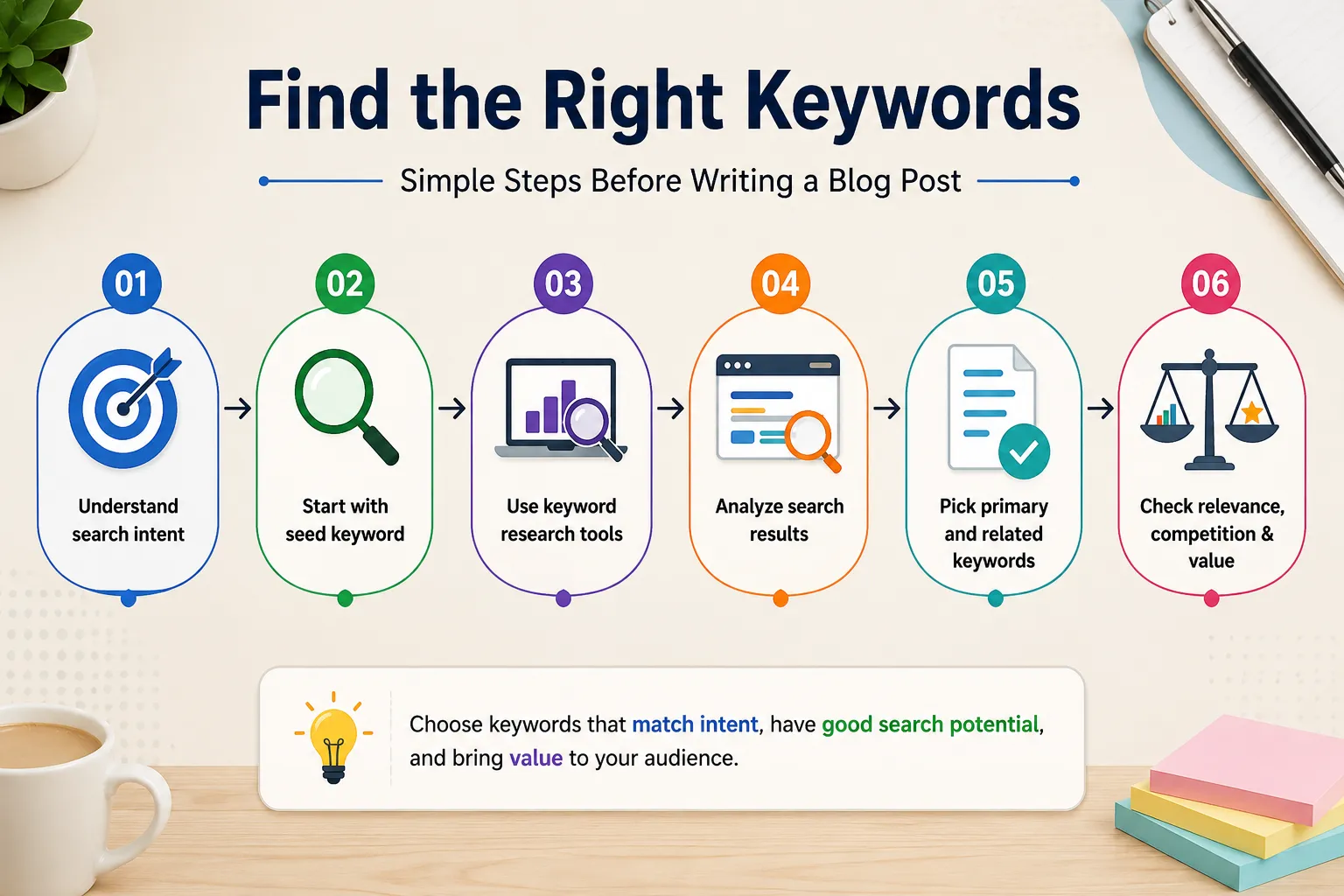
Well, before you write your blog post, you need to find keywords that have a high search volume. But that’s not all there is to finding the right keywords. The real goal is to understand what your audience is looking for, why they are looking for it, and what kind of content will best answer their question.
A good keyword research process integrates SEO, AEO, GEO, and EEAT principles to create content that is useful for people and modern search engines.

1. Start With Your Main Point
Define the topic you want to write about first, explicitly. What is the main problem your content will solve?
Say your topic is keyword research. Some potential primary keywords could be:
Blog keyword research
Finding keywords
Blog keyword research
Researching keywords for SEO
Choose one main keyword that is most relevant to your topic and the search intent of your audience.
2. Grasp Search Intent
What is the person looking to know or do when they search for this keyword? Ask yourself this before you choose a keyword.
Generally, there are 4 types of search intent:
Informative: The user is asking for information.
Commercial: The user is researching products/services.
Transactional: The user is ready to take action or make a purchase.
Navigational: The user is looking for a specific website, brand, or page.
It’s not so much about picking a keyword because it has a high search volume, but rather about matching your content to search intent.
3. Search for Related Questions and Keywords
With your main keyword in hand, search for closely related keywords, topics, and questions.
For example, if your main keyword is "blog keyword research", some related terms might be:
Long-tail keywords
Search volume for keywords
Keyword difficulty
Search purpose
SEO keyword tools
Low-competition keywords
Competitor keyword analysis
Related keywords
You may also use common questions as headings or FAQ sections. This can make your content more reader-friendly and also more optimised for Answer Engine Optimisation (AEO).
4. Scan the Search Results
Search your main keyword and check out the pages already ranking.
See also:
Top-ranked pages' topics
Common headings and subheadings
People Also Ask questions
Related questions
Featured snippets
Content categories
Insights your competitors are lacking
The aim is not to duplicate competing articles. Instead, use the search results to understand what Google finds relevant and where you can provide something better or more useful.
5. Search for Long-Tail Keywords
Examples of long-tail keywords are:
How to find low-competition keywords for a new blog post
not just:
Keywords
Long-tail keywords can be useful as they tend to have more specific search intent and can be easier to target, especially for new websites.
But do not choose keywords just because they have low competition. Also, ensure they are relevant to your audience and your content.
6. Check Out Your Competitors
Read some competing articles to see:
The keywords they target
Conversation topics
Questions solved by them
Content holes
Lost examples
Bad or stale information
This will allow you to identify opportunities for creating content that is more comprehensive and truly helpful.
7. Build a Keyword Cluster
Make a cluster of related words. Don't repeat a word again and again in your article.
Like, for example:
Main keyword:
Blog keyword research
Keywords:
Keyword research for SEO
Long-tail keywords
Search intent by keyword
Keyword difficulty
Tools for keyword research
Low-competition keywords
This strategy helps you build topical authority while keeping the content natural and reader-friendly.
8. Optimise for GEO and AEO
Modern search optimisation is more than just SEO.
Answer Engine Optimisation (AEO) is about providing clear and direct answers to questions. Use descriptive headings, concise explanations, FAQs, lists, and well-structured information.
GEO (Generative Engine Optimisation) is the art of creating content that can be quickly digested and referred to by AI-powered search and answer engines. If your content has a clear structure, original insights, factual information, trustworthy sources, and strong topical coverage, it can be more useful in AI-driven search experiences.
9. Follow EEAT Guidelines
Good articles are more than keywords.
Add EEAT – Experience, Expertise, Authoritativeness, and Trustworthiness by adding:
First-hand experience
Examples in original language
Sources you can trust
Up-to-date, accurate information
As appropriate, expert comment
Easy explanations
Tips that help
It should always be the aim to create content that is genuinely useful to the reader, not content that is just written to rank.
10. Make Your Content Outline Prior to Writing
Once you’ve done your keyword research, organise your findings in a logical outline.
A simple routine is:
Primary topic → Primary keyword → User intent → LSI keywords → Queries → Competitor analysis → Content gaps → Keyword group → Content framework
Then you have a road to follow before you start writing.
Last Word
The best keyword research strategy is NOT to find one keyword and then keep on repeating it again and again in your blog post. It's about identifying your audience, search intent, related topics, competitors, and content gaps.
Combine keyword research with SEO, AEO, GEO, and EEAT and you can build content that is more discoverable, more understandable to search engines and artificial intelligence systems and, more importantly, more useful to real readers.
Also Read: How Does GEO Differ from Traditional SEO?
Source & Reference: