
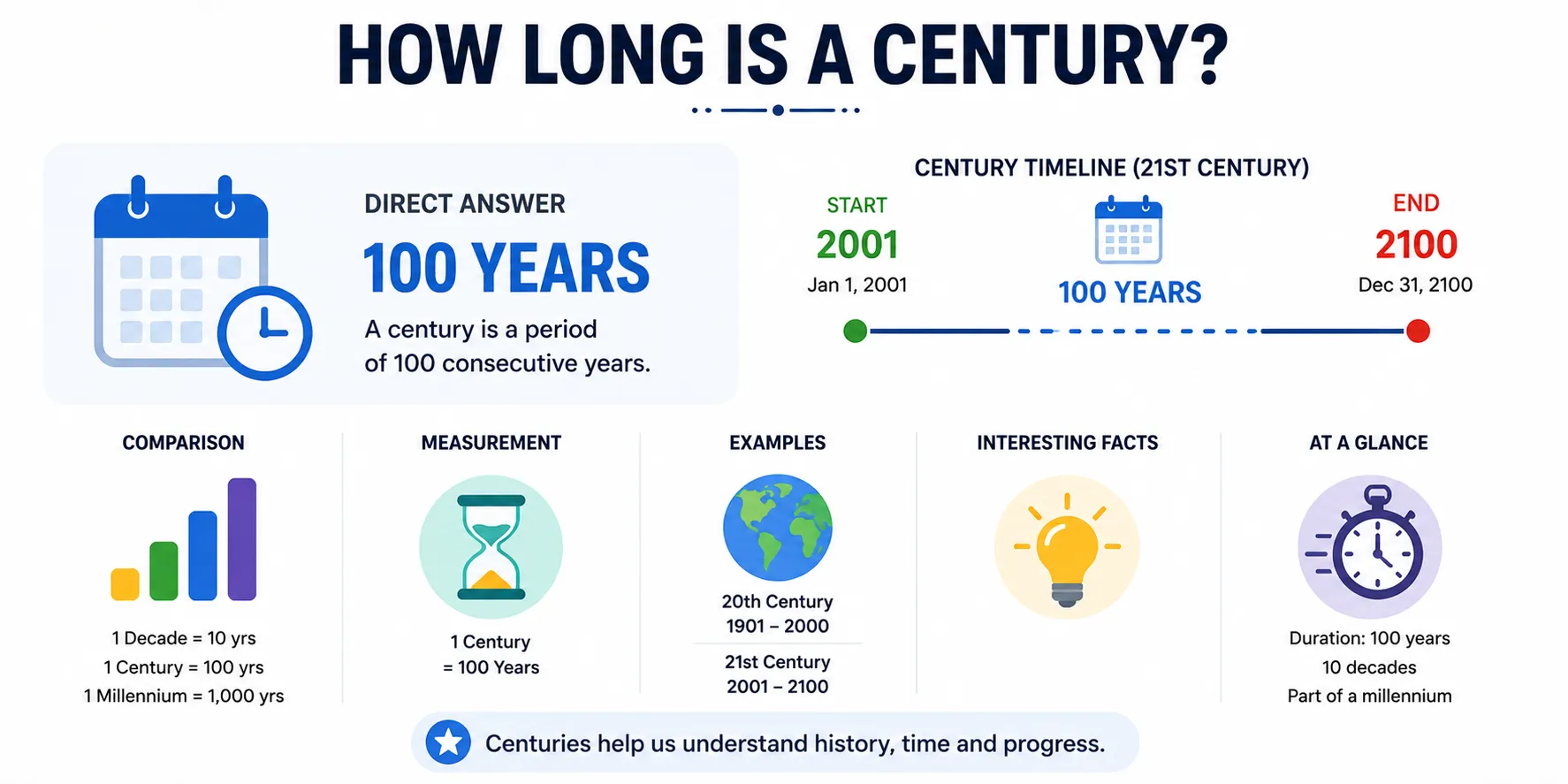
A century is a period of 100 years. It is one of the most commonly used units for measuring long periods of time in history, education, science, and everyday conversation. For example, the 21st century began on January 1, 2001, and will end on December 31, 2100.
I used to think centuries worked the same way as decades: that the year 2000 marked the beginning of the 21st century. Later, I learned that there's no Year 0 in the Gregorian calendar, which is why every century begins with a year ending in 01 and ends with a year ending in 00. It's a small detail, but it clears up one of the most common misconceptions about centuries.
How Is a Century Measured?
A century always consists of 100 consecutive years.
It can be measured in different ways depending on the context:
-
1 century = 100 years
-
10 decades
-
1,200 months
-
Approximately 36,525 days (including leap years)
-
876,600 hours (approximately)
While the exact number of days can vary slightly because of leap year rules, a century is universally defined as 100 years.
Why Do We Use Centuries?
Using individual years works well for recent events, but when discussing major historical periods, a century provides a much clearer time frame.
For example, historians often describe events as occurring in:
-
The 15th century.
-
The 18th century.
-
The 20th century.
This makes it easier to group historical developments, cultural changes, scientific discoveries, and political events into broader periods instead of listing individual years.
Centuries are also widely used in archaeology, literature, genealogy, and population studies because they provide a convenient way to describe long-term changes.
Century vs Other Time Units
Here's how a century compares with other common units of time.
| Time Unit | Equals |
|---|---|
| 1 Decade | 10 years |
| 1 Quarter Century | 25 years |
| 1 Half Century | 50 years |
| 1 Century | 100 years |
| 1 Millennium | 1,000 years (10 centuries) |
A simple way to remember it is:
10 decades = 1 century, and 10 centuries = 1 millennium.
Real-Life Examples
Centuries are used in many different contexts.
Some examples include:
-
The 20th century (1901–2000) witnessed the invention of airplanes, computers, and the internet.
-
The 21st century (2001–2100) is known for rapid advancements in artificial intelligence, smartphones, renewable energy, and space exploration.
-
If a building is described as centuries old, it means it has existed for hundreds of years.
Once you start noticing it, you'll find the word century used everywhere, from history books and museums to sports records and architecture.
Interesting Facts
Here are a few facts many people don't know:
- The 21st century officially began in 2001, not 2000.
- The word century comes from the Latin word centum, meaning one hundred.
- A person who lives to be 100 years old is called a centenarian.
- Every millennium contains 10 centuries.
- Historians often identify major eras by their century rather than specific years because it makes long-term trends easier to understand.
Century at a Glance
| Feature | Details |
|---|---|
| Definition | A period of 100 years |
| Equals | 10 decades |
| Part of a Millennium | 10 centuries = 1 millennium |
| Current Century | 21st Century (2001–2100) |
| Common Uses | History, education, science, genealogy, and everyday language |
A century is simply a period of 100 years, but it plays a much bigger role than just measuring time. It helps us organize history, understand long-term progress, and describe major events that shape civilizations. Whether you're studying world history, reading about ancient monuments, or following modern developments, understanding how centuries are counted makes timelines much easier to understand.
Frequently Asked Questions (FAQs)
1. How many years are there in a century?
A century always consists of exactly 100 years.
2. When did the 21st century begin?
The 21st century began on January 1, 2001, and will end on December 31, 2100.
3. How many decades make one century?
There are 10 decades in one century because each decade contains 10 years.
4. What is the difference between a century and a millennium?
A century equals 100 years, while a millennium equals 1,000 years, or 10 centuries.
5. Why didn't the 21st century start in the year 2000?
Because the Gregorian calendar has no Year 0. The first century began with Year 1, so each new century starts with a year ending in 01, not 00.
Must Read: Why do people still believe in religion in the 21st century?

