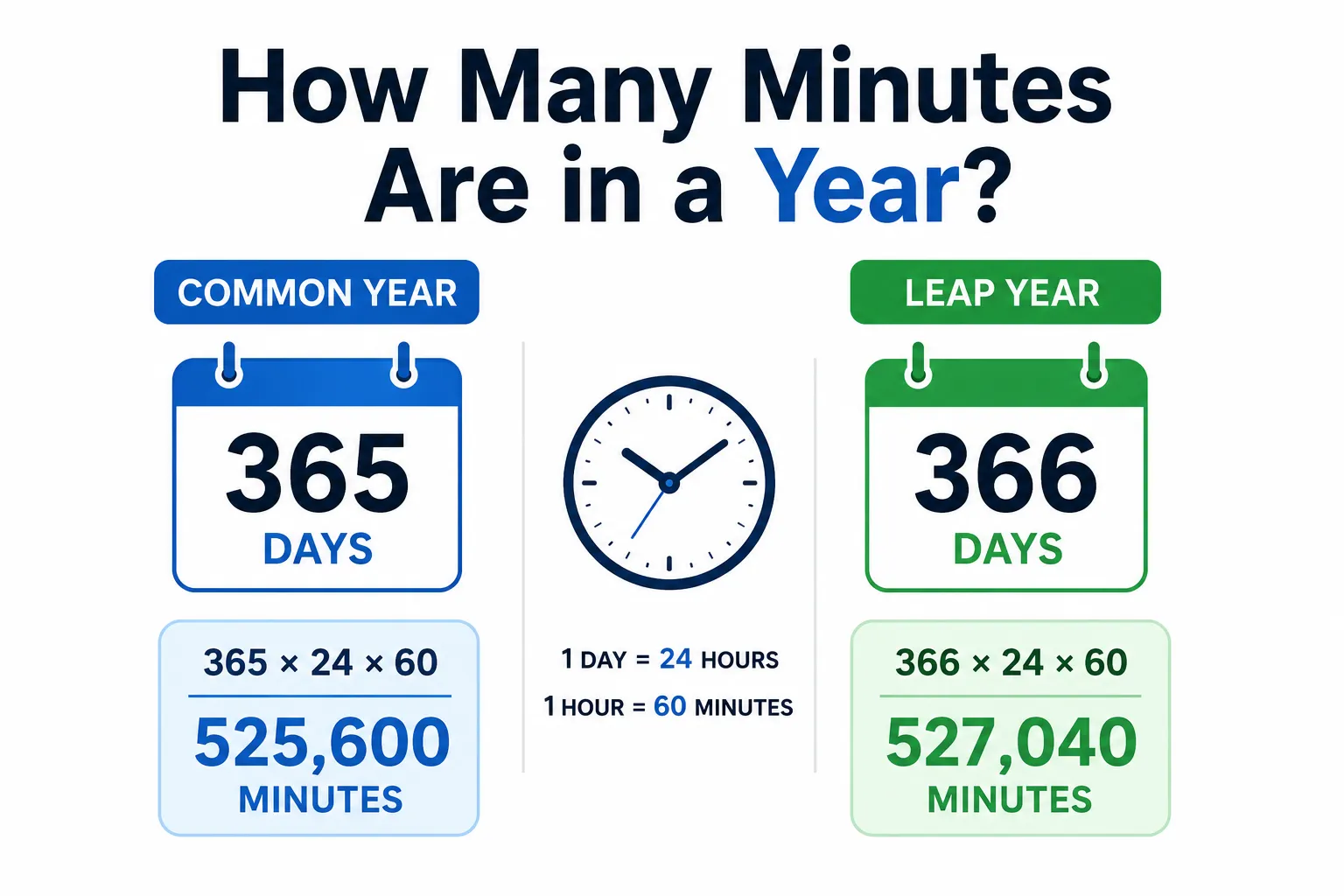
A common year has 525,600 minutes, while a leap year has 527,040 minutes.
The difference is 1,440 minutes, which equals one extra day added during a leap year.
Minutes in a Year at a Glance
| Year Type | Number of Days | Total Minutes |
|---|
| Common Year | 365 | 525,600 |
| Leap Year | 366 | 527,040 |
How Many Minutes Are in a Common Year?
A common year has 365 days.
Each day has 24 hours, and each hour has 60 minutes.
To find the total number of minutes, multiply the number of days by the number of hours in a day and then by the number of minutes in an hour.
365 × 24 × 60 = 525,600 minutes
So, there are 525,600 minutes in a common year.
This is the number most people refer to when they talk about the number of minutes in a year.
How Many Minutes Are in a Leap Year?
A leap year has 366 days instead of 365.
An extra day is added to the month of February, making it 29 days long instead of 28.
The calculation is:
366 × 24 × 60 = 527,040 minutes
That means a leap year contains 527,040 minutes.
Compared to a common year, a leap year has 1,440 extra minutes, which is exactly one full day.
How Do You Calculate the Number of Minutes in a Year?
The formula is very simple.
Days × Hours × Minutes
For a common year:
-
365 days
-
24 hours each day
-
60 minutes each hour
365 × 24 × 60 = 525,600 minutes
For a leap year:
-
366 days
-
24 hours each day
-
60 minutes each hour
366 × 24 × 60 = 527,040 minutes
This is the easiest way to calculate the total number of minutes in any year.
Common Year vs. Leap Year
The only difference between a common year and a leap year is one extra day.
| Feature | Common Year | Leap Year |
|---|
| Days | 365 | 366 |
| Hours | 8,760 | 8,784 |
| Minutes | 525,600 | 527,040 |
| Extra Minutes | — | 1,440 |
Although one day may not seem like much, it plays an important role in keeping our calendar accurate.
Why Do We Have Leap Years?
A year is not exactly 365 days long.
In reality, Earth takes about 365.2422 days to complete one trip around the Sun.
If we ignored those extra hours every year, our calendar would slowly move out of sync with the seasons.
To fix this, an extra day is added approximately every four years. This creates a leap year with 366 days.
Without leap years, holidays and seasons would slowly shift over time.
Why Is Knowing the Number of Minutes in a Year Useful?
Most people learn this fact out of curiosity, but it can also be useful in everyday life.
Knowing how many minutes are in a year can help with:
-
Planning long-term projects.
-
Setting yearly goals.
-
Calculating work or study schedules.
-
Understanding time-based calculations.
-
Solving math and science problems.
-
Learning about calendars and time measurement.
Many businesses, schools, and software applications also use yearly time calculations for planning and reporting.
Fun Fact
The number 525,600 became famous because of the song "Seasons of Love" from the popular musical Rent.
The song begins with the line:
"Five hundred twenty-five thousand six hundred minutes..."
Instead of measuring life by days or months, the song encourages people to measure life by love, kindness, and meaningful experiences.
Because of this, many people remember the number 525,600 even if they have never calculated the minutes in a year themselves.
Other Time Conversions
Here are some useful time conversions.
| Time Period | Minutes |
|---|
| 1 Hour | 60 |
| 1 Day | 1,440 |
| 1 Week | 10,080 |
| 30 Days | 43,200 |
| Common Year | 525,600 |
| Leap Year | 527,040 |
These numbers can be helpful when working with schedules, planning projects, or solving time-related questions.
Frequently Asked Questions
How many minutes are in a common year?
A common year has 525,600 minutes because it contains 365 days.
How many minutes are in a leap year?
A leap year has 527,040 minutes because it contains 366 days.
Why does a leap year have more minutes?
A leap year includes one extra day, which equals 24 hours or 1,440 minutes.
How many hours are in a year?
A common year has 8,760 hours, while a leap year has 8,784 hours.
How many seconds are in a year?
A common year has 31,536,000 seconds, and a leap year has 31,622,400 seconds.
Do all years have the same number of minutes?
No. Common years have 525,600 minutes, while leap years have 527,040 minutes because of the extra day.
Final Answer
A common year contains 525,600 minutes, while a leap year contains 527,040 minutes. The difference is 1,440 minutes, which comes from the extra day added during a leap year.
The calculation is simple:
-
365 × 24 × 60 = 525,600 minutes
-
366 × 24 × 60 = 527,040 minutes
Although the numbers are easy to calculate, they remind us how carefully our calendar is designed to match Earth's movement around the Sun. Whether you're solving a math problem, planning a project, studying for school, or simply satisfying your curiosity, knowing how many minutes are in a year is both useful and interesting.
Must Read : How Many Weeks are in a Year?