
Ethyl acetate is a moderately polar (or semi-polar) compound.
It is not completely polar like water, and it is not non-polar like hexane. Instead, it falls somewhere in between because its molecular structure contains both polar and non-polar regions. This intermediate polarity is exactly why ethyl acetate is one of the most widely used organic solvents in chemistry, pharmaceuticals, paints, fragrances, food processing, and laboratories.
If you've ever worked in a chemistry lab, you'll notice that ethyl acetate is often chosen because it can dissolve a surprisingly wide range of compounds. That's possible precisely because it isn't extremely polar or completely nonpolar; it's a balanced solvent.
Why Is Ethyl Acetate Polar?
The polarity of ethyl acetate comes from its ester functional group (-COO-), particularly the carbonyl (C=O) bond.
The oxygen atoms are much more electronegative than carbon, so they pull electron density toward themselves. This creates:
-
A partial negative charge (δ−) on the oxygen atoms.
-
A partial positive charge (δ+) near the carbonyl carbon.
As a result, the molecule has a net dipole moment, which makes it polar. Ethyl acetate has a dipole moment of approximately 1.78 Debye, confirming that it is a polar molecule rather than a non-polar one.
However, the molecule also contains an ethyl group (–CH₂CH₃), which is largely non-polar. Because both regions exist in the same molecule, chemists usually describe ethyl acetate as moderately polar rather than strongly polar.
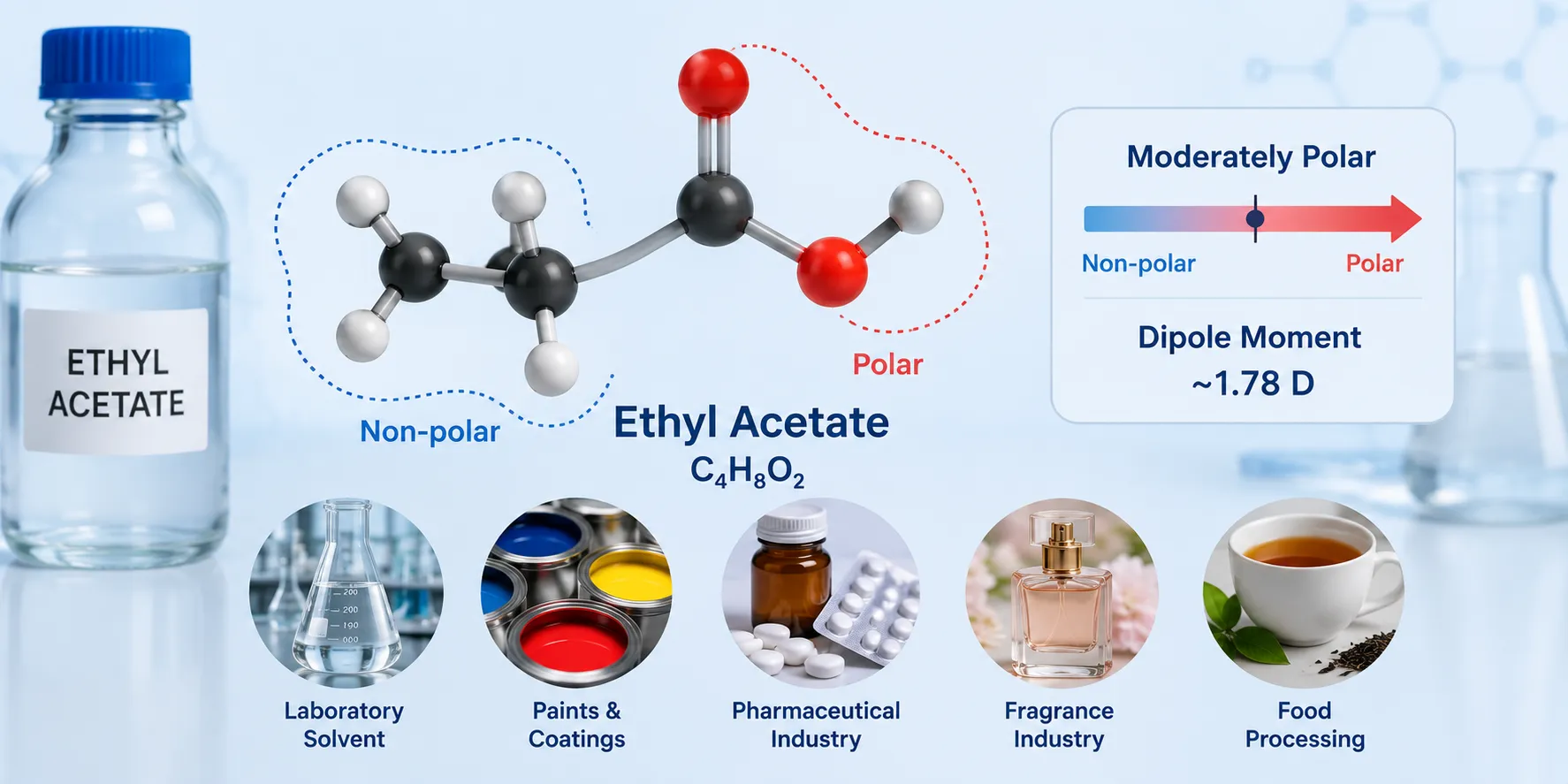
Molecular Structure
Ethyl acetate has the molecular formula:
C₄H₈O₂
Its structure consists of three important parts:
-
Carbonyl group (C=O) → Strongly polar
-
Ester oxygen (–O–) → Polar
-
Ethyl group (CH₂CH₃) → Non-polar
This combination gives ethyl acetate unique solvent properties.
Unlike water, whose polarity is distributed throughout the molecule, ethyl acetate has one highly polar end and one relatively non-polar end.
That's why it can interact with both polar and many non-polar organic compounds.
Physical & Chemical Properties
| Property | Ethyl Acetate |
|---|---|
| Chemical Formula | C₄H₈O₂ |
| Polarity | Moderately polar (semi-polar) |
| Functional Group | Ester |
| Boiling Point | ~77.1°C |
| Appearance | Colorless liquid |
| Odor | Sweet, fruity |
| Water Solubility | Slightly soluble |
| Dipole Moment | ~1.78 D |
One interesting characteristic is that ethyl acetate doesn't mix completely with water, but it mixes very well with many organic solvents such as ethanol, acetone, and chloroform. This behavior perfectly reflects its intermediate polarity.
Applications
Its moderate polarity makes ethyl acetate incredibly versatile.
Some of its most common applications include:
Laboratory Solvent
One of the most frequently used solvents in:
-
Organic synthesis
-
Liquid-liquid extraction
-
Thin-layer chromatography (TLC)
-
Column chromatography
Because it dissolves a broad range of compounds without being excessively reactive.
Paints & Coatings
Ethyl acetate is widely used in:
-
Paints
-
Varnishes
-
Printing inks
-
Adhesives
It evaporates quickly, leaving a smooth finish.
Pharmaceutical Industry
Used during:
-
Drug manufacturing
-
Purification processes
-
Extraction of active compounds
Food & Fragrance Industry
Ethyl acetate naturally occurs in some fruits and contributes to a pleasant fruity aroma.
It's also used in:
-
Flavorings
-
Perfumes
-
Food processing
-
Decaffeination of tea and coffee
Common Misconceptions
"Ethyl acetate is completely non-polar."
No.
Its carbonyl group creates a measurable dipole moment, making it a polar molecule.
"Ethyl acetate is as polar as water."
Not at all.
Water is strongly polar and forms extensive hydrogen bonds.
Ethyl acetate is only moderately polar and cannot donate hydrogen bonds like water does.
"Polar compounds only dissolve in water."
This is another common misunderstanding.
Many moderately polar solvents, including ethyl acetate, are valuable precisely because they dissolve substances that water cannot, while still interacting with many polar compounds.
Frequently Asked Questions (FAQs)
1. Is ethyl acetate polar or non-polar?
Ethyl acetate is moderately polar (semi-polar) because it contains a polar ester group and a non-polar ethyl group.
2. Why is ethyl acetate considered moderately polar?
Its carbonyl (C=O) and ester oxygen create a permanent dipole, while its hydrocarbon chain reduces the overall polarity, resulting in an intermediate or moderate polarity.
3. Is ethyl acetate soluble in water?
Only partially. It is slightly soluble in water but mixes well with many organic solvents because of its intermediate polarity.
4. Why is ethyl acetate used so often as a laboratory solvent?
Because its moderate polarity allows it to dissolve a wide variety of organic compounds, making it ideal for extraction, chromatography, and purification techniques.
5. Is ethyl acetate a polar protic or polar aprotic solvent?
Ethyl acetate is classified as a polar aprotic solvent. It has a permanent dipole but does not contain an O–H or N–H bond that can donate hydrogen atoms in hydrogen bonding.
Ethyl Acetate at a Glance
| Feature | Answer |
|---|---|
| Classification | Moderately polar (semi-polar) |
| Reason | Polar ester group + non-polar ethyl group |
| Functional Group | Ester (-COO-) |
| Dipole Moment | ~1.78 Debye |
| Water Solubility | Slightly soluble |
| Common Uses | Laboratory solvent, paints, pharmaceuticals, fragrances, food processing |
Must Read:Is BF₃ polar or nonpolar?
 Answered by