
Africa is home to several major deserts, each with its own unique landscape, climate, and ecosystem. The best-known deserts include:
-
Sahara Desert
-
Kalahari Desert
-
Namib Desert
-
Libyan Desert
-
Nubian Desert
-
Danakil Desert
-
Chalbi Desert
-
Ogaden Desert
-
Karoo Desert
-
Guban Desert
-
Ténéré Desert (part of the Sahara)
-
White Desert (part of the Sahara in Egypt)
While people usually think of Africa as being covered only by the Sahara, the continent actually contains multiple deserts ranging from vast hot deserts to coastal and semi-arid deserts, each supporting surprisingly diverse wildlife and cultures.
Comparison Table
| Desert | Main Countries | Notable Feature |
|---|---|---|
| Sahara Desert | Algeria, Egypt, Libya, Chad, Mali, Niger, Sudan and others | World's largest hot desert |
| Kalahari Desert | Botswana, Namibia, South Africa | Semi-arid desert with abundant wildlife |
| Namib Desert | Namibia, Angola, South Africa | One of the oldest deserts on Earth |
| Libyan Desert | Libya, Egypt, Sudan | Extremely dry region within the Sahara |
| Nubian Desert | Sudan, Egypt | Rocky desert east of the Nile |
| Danakil Desert | Ethiopia, Eritrea, Djibouti | One of the hottest places on Earth |
| Chalbi Desert | Kenya | Largest desert in Kenya |
| Ogaden Desert | Ethiopia, Somalia | Semi-arid desert in the Horn of Africa |
| Karoo Desert | South Africa | Semi-desert known for unique vegetation |
| Guban Desert | Somalia, Somaliland | Coastal desert with very low rainfall |
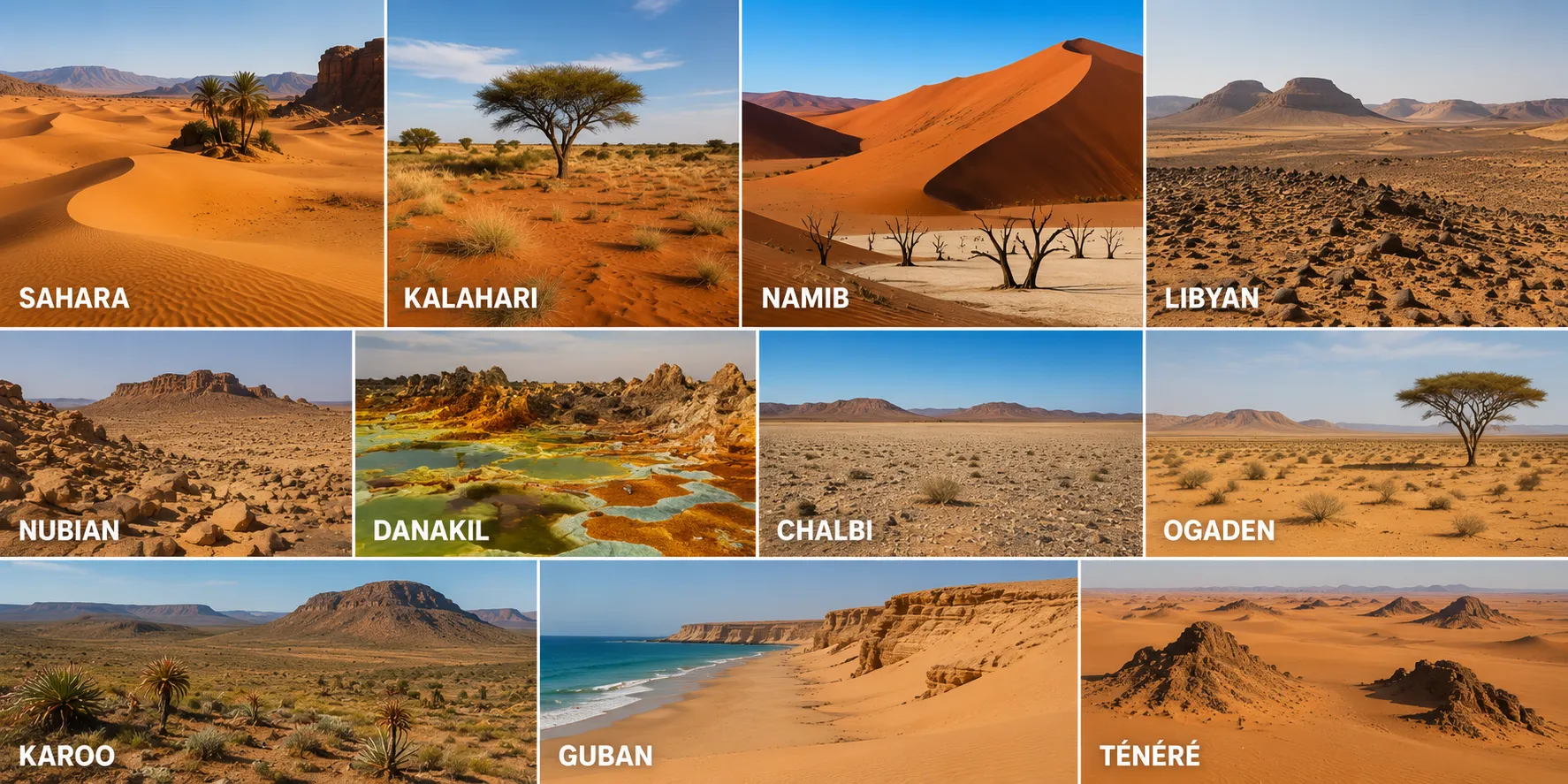
Largest & Most Important Deserts
1. Sahara Desert
The Sahara is by far Africa's most famous desert.
It covers approximately 9.2 million square kilometers, stretching across 11 countries, making it the largest hot desert in the world. Despite its reputation, the Sahara isn't made up entirely of sand dunes. It also contains rocky plateaus, gravel plains, mountains, and seasonal valleys.
2. Kalahari Desert
Unlike many deserts, the Kalahari receives enough rainfall to support grasses, shrubs, and diverse wildlife.
You'll find animals such as:
-
Lions
-
Meerkats
-
Giraffes
-
Antelopes
Because of this, many geographers describe it as a semi-arid sandy savanna rather than a true desert.
3. Namib Desert
The Namib Desert is famous for its towering red sand dunes and dramatic Atlantic coastline.
Scientists believe it's one of the oldest deserts on Earth, with some parts remaining dry for 55–80 million years. It is also home to remarkable species that have adapted to survive in one of the driest environments on the planet.
4. Danakil Desert
Located in northeastern Africa, the Danakil Desert is considered one of the hottest and most geologically active places on Earth.
Its landscape includes:
-
Salt flats
-
Sulfur springs
-
Lava fields
-
Active volcanoes
It's often described as one of the most extreme environments humans can visit.
Interesting Facts
When most of us hear the word Africa, the first image that comes to mind is usually the Sahara Desert.
I used to think exactly the same.
But while researching African geography, I was genuinely surprised to discover that Africa isn't home to just one famous desert. Instead, it has a remarkable variety of desert landscapes. Some are covered with massive sand dunes, others are rocky plateaus, some stretch along the coastline, and a few even support wildlife in ways you wouldn't normally associate with deserts.
A few fascinating facts:
-
The Sahara is larger than the continental United States.
-
The Namib Desert may be the oldest desert in the world.
-
The Kalahari supports large mammals despite its arid climate.
-
The Danakil Desert experiences some of the highest average temperatures ever recorded for inhabited regions.
-
Africa's deserts include sand seas, salt flats, rocky plains, volcanic landscapes, and coastal deserts—not just endless dunes.
Comparison
| Feature | Sahara | Kalahari | Namib |
|---|---|---|---|
| Type | Hot desert | Semi-arid desert | Coastal desert |
| Size | Largest | Second largest in Africa | Much smaller |
| Famous For | Vast sand dunes & rocky plateaus | Wildlife | Red dunes & Skeleton Coast |
| Age | Millions of years | Ancient | One of the oldest deserts on Earth |
| Countries | 11 | 3 | 3 |
Common Misconceptions
"Africa has only one desert."
No.
While the Sahara is the most famous, Africa has many significant deserts, each with distinct geography and ecosystems.
"Every African desert is covered in sand."
Not true.
Many deserts contain:
-
Rocky plateaus
-
Gravel plains
-
Salt flats
-
Mountains
-
Sparse grasslands
Some have surprisingly little sand.
"Nothing lives in African deserts."
Actually, African deserts support a wide variety of specially adapted plants and animals, from elephants in parts of the Namib to meerkats and lions in the Kalahari.
Frequently Asked Questions (FAQs)
1. What is the largest desert in Africa?
The Sahara Desert is the largest desert in Africa and the largest hot desert in the world, covering about 9.2 million square kilometers.
2. How many major deserts are there in Africa?
Depending on the classification, geographers recognize around 9–12 major deserts and semi-desert regions across the continent.
3. Which is the oldest desert in Africa?
The Namib Desert is widely considered one of the oldest deserts on Earth, with an estimated age of 55–80 million years.
4. Is the Kalahari a true desert?
Technically, it's classified as a semi-arid sandy savanna because it receives more rainfall than a typical desert and supports more vegetation.
5. Which African desert is the hottest?
The Danakil Desert is regarded as one of the hottest places on Earth due to its extremely high average temperatures and geothermal activity.
African Deserts at a Glance
| Desert | Best Known For |
|---|---|
| Sahara | Largest hot desert in the world |
| Kalahari | Wildlife-rich semi-arid landscape |
| Namib | Ancient red sand dunes |
| Libyan | Extremely dry Sahara region |
| Nubian | Rocky eastern Sahara |
| Danakil | Extreme heat and volcanic terrain |
| Chalbi | Kenya's largest desert |
| Ogaden | Horn of Africa's semi-arid region |
| Karoo | Unique South African semi-desert |
| Guban | Coastal desert in the Horn of Africa |
Africa's deserts are far more diverse than many people realize. While the Sahara dominates in size and global recognition, deserts like the Namib, Kalahari, and Danakil each offer completely different landscapes, climates, and ecosystems. Together, they showcase the extraordinary geographical diversity of Africa, from towering dunes and ancient coastlines to volcanic plains and wildlife-rich semi-arid regions. Understanding these deserts isn't just about memorizing names; it's about appreciating how one continent can contain some of the most extreme and fascinating environments on Earth.
Must Read:Name the two large deserts of africa?


