
Gurgaon has remained NCR's most closely watched residential market through 2025 and into 2026, and the outlook for the next few years is being shaped by four forces at once: sustained corporate demand, a supply pipeline tilted toward luxury and ultra-luxury housing, continued infrastructure investment, and growing buyer selectivity after several years of rapid price growth.
As per ANAROCK's tracking, average residential prices in Gurgaon climbed from around ₹6,150 per sq ft in Q1 2020 to ₹11,300 per sq ft in Q1 2025, an increase of roughly 84% over five years. It is expected that this pace will moderate rather than reverse, with the market shifting from broad-based appreciation toward a more corridor-by-corridor and project-by-project story.
Quick Answer
|
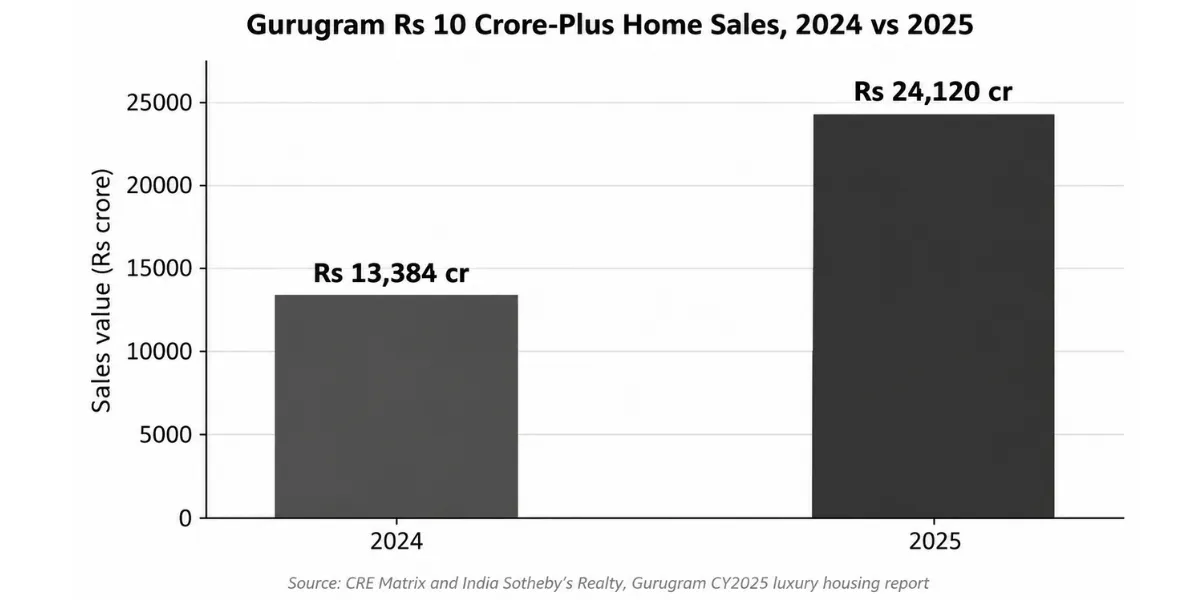
Gurugram average residential price trend (ANAROCK via Storyboard18)
Gurgaon Real Estate Market Forecast: 2026 Overview
As per ANAROCK's Q1 2026 residential viewpoints, Gurugram accounted for 62% of NCR's residential launches and 43% of its residential sales during the quarter, a concentration of both supply and demand that provides an important starting point for the near-term forecast. Read alongside the wider picture for the next few years, this points to a market that is maturing rather than cooling.
It is expected that the forecast period will be defined less by a single city-wide price trend and more by a widening gap between well-located, RERA-compliant, corporate-linked projects and secondary locations carrying older or oversupplied inventory. This divergence, rather than a uniform slowdown, is the central theme running through this forecast.
Gurgaon (Gurugram) Real Estate Market: Current State
Gurugram's residential inventory represented around 45% of NCR's available stock in Q1 2026, according to ANAROCK, against an NCR-wide inventory overhang of 18 months, an improvement on the 19 months recorded the previous quarter. On the demand side, this leaves Gurgaon entering the forecast period from a position of considerable strength.
On the commercial side, JLL's Q2 2026 office market data shows Delhi NCR accounted for 21.6% of India's total office leasing volume in the quarter, with Gurugram remaining the dominant office market within that region, as per Cushman & Wakefield. This corporate employment base is the single largest structural support behind the residential forecast, because it anchors end-user demand in a way that purely speculative capital cannot.
Gurugram Property Market Trends 2026
Four shifts stand out this year: continued premiumisation, a move toward more end-user-led demand, a stronger preference for established and RERA-compliant developers, and increasing emphasis on livability alongside appreciation.
On premiumisation:
- High-end and luxury units together accounted for 60% of NCR's launch supply in Q1 2026, while Gurugram separately accounted for 62% of NCR's overall residential launches.
On buyer profile:
- Demand has shifted from short-hold speculative capital toward end-users, NRIs and long-term investors seeking livability alongside appreciation.
On developer preference:
- Projects with strong RERA compliance records and delivery track records are commanding a clear premium over less-established peers. This is a trend we expect to strengthen rather than fade.
On livability:
- Buyers are increasingly weighing integrated townships, retail and social infrastructure alongside price and location, rather than treating price alone as the deciding factor.
Additional data point:
- According to ANAROCK,over 80% of Gurugram's new launches in the first nine months of 2025 were priced above ₹2.5 crore.
- This underscores how far the market's centre of gravity has moved toward the premium segment, even as infrastructure concerns have drawn public criticism.
Gurgaon Property Price Trends
The past five years show a sustained upward trajectory rather than a series of short-lived spikes. Average residential prices rose from ₹6,150 per sq ft in Q1 2020 to ₹11,300 per sq ft in Q1 2025, an increase of roughly 84%. The Storyboard18 report puts the average at around ₹12,250 per sq ft by September 2025, a further 29% year-on-year rise from ₹9,500 per sq ft in September 2024.
Note: We would caution against reading these two data points as evidence of accelerating appreciation. They are measured over different periods and by different methodologies, and quarterly appreciation has, as per market commentary, tapered to the low single digits through the second half of 2025. The direction of the trend is clear; the pace is moderating.
Gurgaon Real Estate Correction 2025 Explained
The so-called correction is best understood as segmented rather than city-wide. A narrative about market weakness circulated through property media and social platforms throughout the year, concentrated in two places: secondary micro-markets with weaker connectivity, and the ultra-luxury bracket, where a wave of near-simultaneous launches created more supply than the immediate end-user pool could absorb.
On the affordability side, the pressure is better documented. Homes priced up to ₹45 lakh accounted for just 18% of sales across India's top seven cities in the first half of 2025, down from 38% in 2019, and sales in Gurugram and Faridabad specifically fell by around 15% in this segment, prompting some builders to delay launches. This is a genuine, data-backed slowdown, but it sits within the affordable segment rather than across the market as a whole.
We do not read this as the start of a broad price decline. Gurugram's premium and corporate-linked corridors continued to show comparatively resilient demand through the same period, which points to a market recalibrating around end-user affordability rather than one losing its underlying demand base.
Gurgaon Property Price Forecast: Next 5 Years
Important to Note: Any forecast over this horizon, including ours, needs to separate what is reasonably foreseeable from what is genuinely uncertain. This blog is not financial advice, and no consultancy can forecast exact prices five years out with confidence; interest rates, construction costs, infrastructure delivery and broader economic conditions can all move faster or slower than expected.
What we can say with more confidence is directional:
- Corporate employment growth, the completion of Dwarka Expressway and associated road works, continued institutionalisation of the developer base, with more RERA-compliant, branded projects reaching completion, and sustained end-user demand are structural supports that are unlikely to disappear over a five-year horizon. Against that, the affordability gap documented in the previous section, elevated construction costs, and a very large pipeline of premium launches all argue for appreciation that is slower and more selective than the 2021 to 2025 period.
- We can expect annual appreciation in well-located, established corridors to moderate materially from the strongest years of the previous cycle, with weaker or oversupplied micro-markets likely to underperform.
- While single-digit to low-double-digit annual appreciation in well-located, established corridors is not something that can be guaranteed, it appears to be a more realistic scenario than a repeat of the sharpest years of the previous cycle, although actual outcomes could vary considerably by project and by prevailing market conditions.
Gurugram Housing Market, 2026 to 2030
Looking out to 2030, what we can expect is a change in buyer character to matter as much as price. Earlier cycles were driven substantially by short-hold investors seeking quick appreciation; the coming phase looks set to be driven more by professionals, families, NRIs and institutional capital seeking stability and livability alongside long-term value, a shift that tends to produce steadier, more sustainable price behaviour than a speculation-led market.
Large infrastructure projects due for completion within this window include:
- Further phases of Dwarka Expressway
- Metro extensions
- The wider Delhi-Mumbai Expressway network
- Associated road infrastructure
These should continue to open up new residential corridors on a rolling basis. We expect each new corridor to broadly repeat the pattern already visible on Dwarka Expressway:
- Announced connectivity draws early investor interest well before the infrastructure is complete.
- This is followed by a second, steadier wave of end-user demand once it is operational.
Expected Property Rates in Gurugram Over 10 Years
There is no single, reliable source that publishes a verified citywide property-rate forecast for Gurugram over a 10-year horizon. Based on structural drivers such as corporate demand, infrastructure delivery, the shift toward end-user buying and continued urbanisation, well-located, established Gurugram corridors could continue to see meaningful price growth over the next decade, although the pace is likely to be steadier than during the strongest years of the previous cycle.
Sohna has attracted some more optimistic forecasts. According to Storyboard18's report citing Colliers, property prices in the area could reach around 1.6 times current levels by 2030. That figure should be viewed as an estimate for Sohna rather than a forecast for Gurugram as a whole, since the outcome will depend on infrastructure, demand and how quickly the area develops
Note: This is a directional read based on current structural trends, not a guaranteed outcome, and actual results will vary considerably by project and corridor.
Gurgaon Property Rates Per Sq Ft by Corridor
Rates vary considerably by corridor, and this variation, more than any single citywide average, is what should guide a buying decision.
| Corridor | Approximate positioning | Q1 2026 quoted rate |
|---|---|---|
| Dwarka Expressway | Infrastructure-led, rapidly maturing | ₹14,000/sq ft |
| New Gurugram | Large-scale, mid-to-premium residential | ₹13,300/sq ft |
| Golf Course Road | Established ultra-premium and luxury | Resale reports place select projects well above ₹50,000/sq ft |
| Sohna Road | Emerging, infrastructure-dependent | Among the more affordable corridors tracked by brokers |
Note: ANAROCK's quoted base rates are only published for select micro-markets each quarter. Where no ANAROCK figure is available, we have described the general positioning rather than citing a single precise rate, since broker-reported figures for these corridors vary considerably by project.
Gurgaon Growth Corridors
The corridors worth tracking through this forecast period are Dwarka Expressway, Southern Peripheral Road, Golf Course Extension Road, Sohna Road and New Gurugram. Each is at a different stage of infrastructure maturity, and we expect that stage, more than any other single factor, to determine near-term price behaviour.
Most advanced (connectivity largely operational, social infrastructure catching up):
- Dwarka Expressway
- Southern Peripheral Road
Earlier in the cycle (higher upside, higher execution risk):
- Sohna Road
- The further reaches of New Gurugram
This is precisely why these two carry both the higher upside cited by some analysts and the higher execution risk if planned infrastructure slips.
Best Areas to Invest in Gurgaon
There is no single right answer here; the right corridor depends on whether the buyer is prioritising rental income, capital appreciation, or end-use.
| Corridor | Best suited for | What to watch |
|---|---|---|
| Dwarka Expressway | Capital appreciation, end-use near new offices | Exact sector and pace of surrounding development |
| Golf Course Road / Extension | Established luxury, rental depth | Entry price and resale liquidity at the top end |
| Sohna Road | Longer-horizon appreciation plays | Infrastructure delivery timelines |
| New Gurugram | Mid-segment end-use and rental | Competing supply and civic infrastructure |
Dwarka Expressway Property Price Forecast 2026
The Q1 2026 base rate for this corridor stands at ₹14,000 per sq ft, up around 4% quarter on quarter. As per market commentary, this corridor has been among the more resilient in Gurugram through the broader 2025 slowdown, supported by the near-completion of the expressway itself and a steady pipeline of corporate and retail development along it.
Dwarka Expressway is expected to remain one of the stronger-performing corridors through 2026, although the rate of gain should moderate from the sharpest quarters of 2023 and 2024 as more supply reaches completion and buyers become more selective between individual sectors along the corridor.
New Gurgaon vs Sohna Road: Investment Comparison
At its core, this comes down to maturity versus upside. New Gurugram, quoted at ₹13,300 per sq ft in Q1 2026, offers a larger, more established base of completed and under-construction supply, with civic infrastructure that is further along than in Sohna.
Sohna Road remains earlier in its development cycle, which is exactly why it appears in more bullish long-range commentary, including the expectation of up to 1.6 times appreciation by 2030. We would treat New Gurugram as the lower-risk, more liquid option today, and Sohna as a higher-risk, higher-potential corridor better suited to buyers with a longer holding period and tolerance for execution risk on the infrastructure side.
Which Gurgaon Sector Has the Highest Rental Yield?
Sectors close to established employment hubs, such as those along Golf Course Road, Golf Course Extension Road, and parts of Udyog Vihar and NH8, tend to see steadier rental demand because tenants value the shorter commute.
Investors focused on rental income should treat any sector-level yield figure they encounter as indicative at best, and should instead compare actual achieved rents for comparable units in the specific project they are considering against the full acquisition cost.
Which Is the Richest Part of Gurgaon?
Golf Course Road, and specifically Sector 42, is home to DLF's Camellias, Aralias, Magnolias and Dahlias developments, often referred to collectively as DLF Phase 5. The project was reported to have a revenue potential of around ₹34,000 crore, roughly 2.5 times that of the neighbouring Camellias. By residential property values and concentration of ultra-luxury developments, this corridor is generally regarded as the richest part of Gurgaon.
This corridor's premium rests on scarcity of land, mature social infrastructure, direct Rapid Metro access to Cyber Hub, and a long track record of trophy transactions among senior executives and industrialists. Its positioning is likely to remain difficult for other Gurugram corridors to match during the forecast period, given the limited availability of comparable land and ultra-luxury development.
Gurgaon Luxury Real Estate Market
2025 was a landmark year at the top end of the market. Sales of Gurugram homes priced at ₹10 crore and above reached ₹24,120 crore in CY2025, up from ₹13,384 crore in 2024, with the number of such units sold nearly tripling to 1,494 from 519. On this specific measure, Gurugram overtook Mumbai in total ₹10 crore-plus residential sales value for the year.
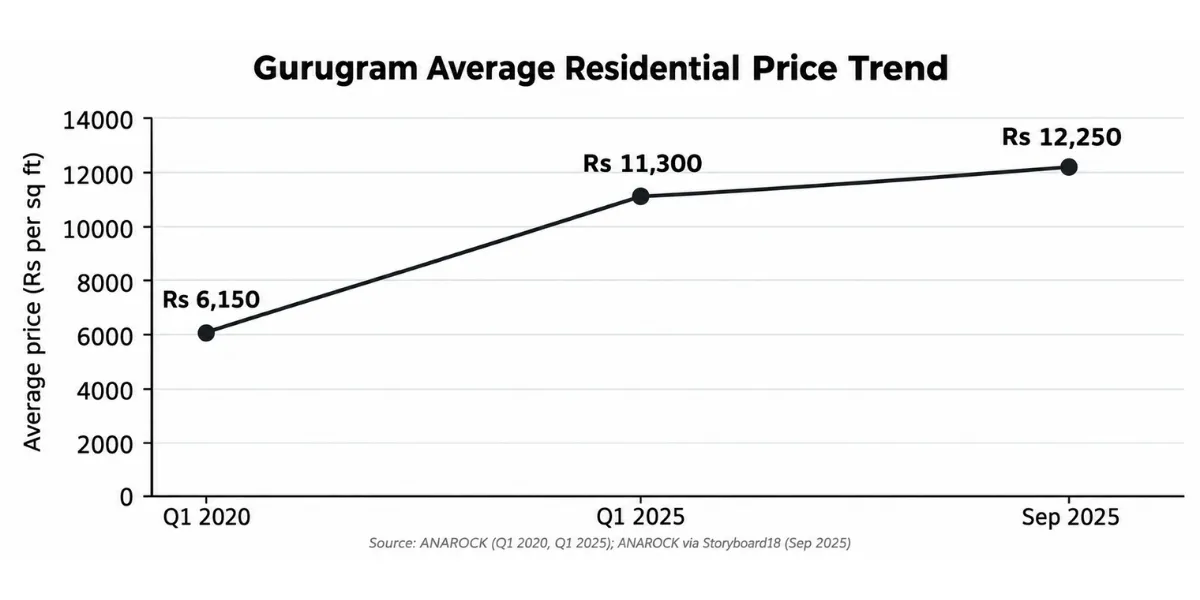
Gurugram Rs 10 crore-plus home sales value, 2024 vs 2025 (CRE Matrix and India Sotheby's Realty)
Note: We would caution against treating this single measure as proof that Gurugram has overtaken Mumbai as India's largest luxury market overall.
Gurugram Residential Price Index
The broader NCR index rose 42 points year on year to September 2025, the sharpest annual rise among all the major cities tracked, ahead of Bengaluru and Hyderabad.
Homebuyers across India's metros, NCR included, are now spending a growing share of income on housing even as loan rates have eased.
Note: This is an NCR-level figure, not a Gurugram-specific one. Readers should treat it as a directional guide rather than a precise citywide number, given how much variation exists beneath that regional average.
Gurgaon Real Estate Investment Outlook
The overall view for the next few years is constructive but selective. Corporate demand, a maturing developer base, continued infrastructure investment and sustained end-user interest support the case for holding or adding exposure to well-located Gurugram property, while the concentration of new supply in the luxury bracket, a documented affordability gap in lower price bands, and the sheer scale of recent price gains argue against assuming that every project or corridor will perform equally.
We can expect the outlook to reward investors who underwrite specific projects and corridors on their own fundamentals, rather than those who rely on a citywide appreciation story to carry a weak individual asset.
Is Gurgaon Real Estate a Good Investment in 2026?
Conditionally, yes, for buyers focused on well-located, RERA-compliant projects with a long-term holding period. The main risk for new entrants is entry valuation after several years of strong appreciation, particularly in the luxury bracket, rather than any fundamental weakness in underlying demand.
Gurgaon vs Noida: Real Estate Investment Comparison
The balance between the two markets has shifted somewhat over the past five years. Greater Noida recorded the highest average price rise of any NCR market over the preceding five years, ahead of Gurugram's still-substantial 84% gain, helped by lower entry prices, the Jewar airport project and metro expansion.
| Factor | Gurgaon | Noida |
|---|---|---|
| Demand base | Corporate, luxury, NRI | IT, corporate, mid-segment |
| Recent price momentum | Very strong, luxury-led | Very strong, airport and metro-led |
| Entry price | Higher on average | Generally lower on average |
| Key catalyst ahead | Dwarka Expressway, further luxury launches | Jewar airport, Noida metro extension |
Neither of the markets can be described as categorically better. Gurugram offers deeper corporate and luxury demand today; Noida currently offers a lower entry price and a large, specific infrastructure catalyst in the Jewar airport project. The individual project and its entry valuation should carry more weight in the decision than which city it is in.
Future of Gurgaon Real Estate
Four shifts, more than any single price trend, set to define what comes next for Gurugram's housing market over the next several years.
- End-user and institutional demand: a continued move away from speculative, short-hold buying toward buyers who intend to occupy or hold the property long term.
- Preference for RERA-compliant developers: greater dominance of organised, RERA-compliant developers as buyers increasingly price in delivery risk.
- Emphasis on livability: integrated townships, retail, schools and healthcare within a project's immediate vicinity becoming as important a differentiator as location alone.
- Corridor-specific price differentiation: a widening gap in performance between established, well-connected corridors and secondary locations, rather than uniform citywide movement.
Gurgaon Property Appreciation: What the Data Shows
Prices rose roughly 84% between Q1 2020 and Q1 2025, with a further 29% year-on-year gain to September 2025. The picture across the last five years has therefore been substantial by any measure, and within that headline trend, the luxury segment has appreciated fastest, with ₹10 crore-plus sales value nearly doubling in a single year between 2024 and 2025.
Note: This confirms strong historical appreciation, not a promise that it will continue at the same pace. Quarterly appreciation had, by the second half of 2025, slowed to low single digits according to market commentary, consistent with a market moving from a rapid growth phase into a more mature, selective one.
Is It the Right Time to Buy Property in Gurgaon?
It depends far more on the specific project and the buyer's own horizon than on market timing. Buying may make more sense when the property meets a genuine end-use need, the price is competitive against comparable projects in the same corridor, the developer has a clean RERA and delivery record, and the buyer can comfortably sustain the financing and ownership costs.
Waiting may make more sense when the purchase depends entirely on future appreciation rather than current fundamentals, when several comparable projects are competing for the same buyer, which may give buyers more room to negotiate, or when a specific project carries unresolved delivery or approval concerns. It is not advised to try to time the broader market, given how much the outcome depends on the individual asset rather than the citywide trend.
Risks to the Gurgaon Forecast
Any forecast carries risk, and buyers should weigh the following factors before treating this outlook as a certainty:
- Luxury oversupply: with over 80% of recent launches priced above ₹2.5 crore, a slower-than-expected absorption rate in this bracket could weigh on prices in specific projects and sectors.
- Affordability strain: rising prices relative to income growth could dampen end-user demand in the mid and affordable segments, as already reflected in the 2025 sales data.
- Infrastructure delivery timing: much of the bullish case for corridors such as Sohna Road and the newer sectors of Dwarka Expressway depends on infrastructure being delivered on schedule, which has not always been the case historically.
- Interest rate and macro shocks: a sharp rise in borrowing costs, or a broader economic slowdown, would affect both affordability and investor sentiment across the market.
- Execution risk at the project level: developer delays, approval disputes or construction quality issues remain the single biggest risk to any individual buyer, regardless of the citywide forecast.
Who Should Consider Buying in Gurgaon Right Now?
Everything in this forecast is ultimately filtered through one question: does it fit the buyer in front of it? A corridor, a price band or a timing decision that makes sense for one type of buyer can be entirely wrong for another, regardless of where the broader market is headed.
Generally well suited to buying now
- End users relocating for work or family reasons, who plan to live in the property rather than hold it purely as an investment, and who therefore care more about commute, schools, healthcare access and daily convenience than about short-term price movement.
- Long-term investors with a multi-year horizon, who are comfortable holding through ordinary market cycles and are not depending on quick resale to make the numbers work.
- NRIs seeking a foothold in the NCR market, provided they are prepared to do the extra legal and documentation work that buying from abroad typically involves.
- Buyers upgrading from an existing Gurgaon home, who already understand the local market, have a realistic sense of resale value in their own micro-market, and are not entering completely fresh.
- Buyers with a clear end-use plan and a comfortable financing position, who are not stretching their budget to the point where a delay or a rate change would cause real strain.
Better served by extra caution
- Short-term, quick-flip buyers, whose plan depends on reselling within a year or two rather than on rental income or genuine use.
- First-time buyers unfamiliar with the local market, who have not yet visited multiple projects, compared resale prices in the area, or spoken to residents about a specific corridor.
- Buyers relying entirely on future price appreciation, rather than on the property making sense today on its own merits.
- Buyers stretching their budget to the limit, leaving little room for the ordinary extra costs of ownership or for a change in personal financial circumstances.
- Buyers who have not independently verified a project's approvals and developer track record, and are relying solely on what a broker or sales team has told them.
Frequently Asked Questions (FAQ)
Is Gurgaon property prices falling?
Will Gurgaon property rates increase?
What is the future of Gurgaon real estate?
Is it the right time to buy property in Gurgaon?
Is it a good time to buy property in Gurgaon?
Which is the richest part of Gurgaon?
What are the expected property rates in Gurugram over 10 years?
Are property prices going to fall in Gurgaon?
Is Gurgaon real estate a good investment in 2026?
Which Gurgaon sector has the highest rental yield?
Gurgaon vs Noida, which is better for real estate investment?
Key Takeaways
- Gurugram accounted for 62% of NCR's residential launches and 43% of its sales in Q1 2026, as per ANAROCK.
- Average Gurugram residential prices rose about 84% between Q1 2020 and Q1 2025, and a further 29% year on year to around ₹12,250 per sq ft by September 2025.
- Gurugram overtook Mumbai in total ₹10 crore-plus home sales value in 2025, at ₹24,120 crore, though Mumbai remains ahead on other luxury market measures.
- The much-discussed 2025 correction is best understood as segmented, concentrated in oversupplied luxury launches and the affordable segment, rather than a citywide decline.
- Dwarka Expressway and New Gurugram carried ANAROCK-quoted Q1 2026 rates of ₹14,000 and ₹13,300 per sq ft respectively.
- Golf Course Road, and Sector 42 in particular, remains Gurgaon's most expensive and prestigious residential corridor.
- No reliable source publishes a verified 5-year or 10-year price forecast for Gurgaon; treat any specific long-range number with caution.
- The strongest structural supports for the forecast are corporate employment, infrastructure delivery, premium housing demand and a shift toward end-user and institutional demand.
- The clearest risks are luxury oversupply, affordability strain in lower price bands, and execution risk at the individual project level.