How to check Andhra Pradesh land records in the mee bhoomi website

0
1.6K

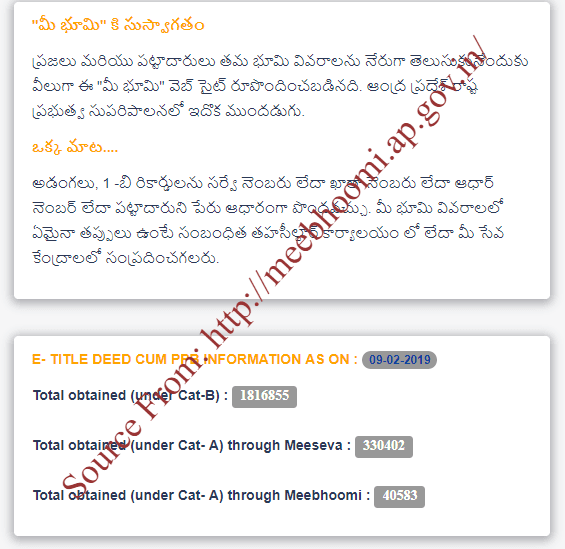
Mee –Bhoomi is an official land record website officiated by the AP government to ease the hassle of record tracking. The portal comes in handy for the Andhra Pradesh citizens as they don’t have to visit land offices. This also caters for the recovery of all documents thus curbing cases of lost documents. As same as West Bengal Government also running to check WB Land Records in Banglarbhumi website.

AP citizens can get their encumbrance certificate and land records fast. The portal gives transparency and eases the paper work. Citizens don’t need vast knowledge on IT to open the site. Mee-Bhoomi portal contains information about villages, districts and Mandals.
Article image

Services provided in the Mee-Bhoomi website

The portal contains details about Andhra Pradesh land records. Citizens from the state can check through the site about their land, owner of the land and other significant details as follows:

  1. Citizens can get full information about the land using their local languages. This helps citizens learn every detail about their land.
  2. The website can officially provide real land records which can be downloaded with secured emblem.
  3. The site will also give alerts to the applicant if any changes happen.
  4. Citizens can state their grievances which can be retrieved if need be.
  5. One can view all the AP land maps from the website page.

How to check AP Adangal in Mee-Bhoomi .ap.gov.in

Attaining the land records is fast and easy, one needs to have all the right details in place. Below we have few steps to follow:

  • Navigate to the official Mee-Bhoomi official page: www.meebhoomi.ap.gov.in
  • Landing on the page check for the option Adangal
  • Here one has the choice of personal Adangal or village Adangal. Click on what suits your need to proceed.
  • Next pick on either of the choices: Survey number , Account number, Aadhaar number and Name holder.
  • Proceed by selecting the district name plus the village name.
  • Here you’re to enter the document number you selected which was either survey number, account number etc.
  • Now key in the code number which will be shown on the screen.
  • Recheck the details enter and if correctly done you can now select the submit button.

The system will generate all information as per the request. This takes few seconds thus serving a lot of citizens within short time.

AP Adangal land records correction.

Mistakes are pound to happen; citizens don’t have to visit the land offices. Thanks to the Mee-Bhoomi portal where one can make changes. However, applicants can also visit the Mee-seva center for correction. This only takes a period of 15 days; below we have steps to correct errors using the website portal.

  • Visit the official page: www.meebhoomi.ap.gov.in
  • On the menu bar select the option “complaints”
  • From the same menu list select the option “register of complaints”
  • A new page containing a form will appear, enter all required details as follows: The complaint name, Official address, Aadhaar number, Enter the type of complaint and Give the village name
  • Proceed to select the submit tab, the system will generate an OTP which is to be entered on a given space.
  • The OTP number will be used to verify your identity.
C

Written By Charan P

Author|0 followers
View Profile
Please sign in to join the discussion.

Comments

No comments yet. Be the first to comment!

More from Charan P

View All
C
Charan PCreator | 4 followers

How to Setup and Configure Airtel 4G Wi-Fi Hotspot Router

Airtel Company has released a portable hotspot router that you can use in creating hotspots in order to access the internet. Owners of this hotspot router can make use of 2G, 3G or 4G internet speeds from any location of their choice. However, you will first have to setup and configure the hotspot router as per your requirements if it is to offer the best results. In this post, we are going to have a look at the steps that Airtel hotspot router owners have to follow before configuring Jiofi.local.html/index.htm settings . Steps to follow when setting up and configuring your Airtel 4G Wi-Fi Hotspot Router Below is a systematic guide that you can follow in order to setup and Configure the Airtel 4G Wi-Fi Hotspot Router. You will first have to open the back cover of your hotspot router, remove the battery and write down the information provided Next, switch on your Airtel hotspot router by pressing the power button. You will have to hold on to the button until the router is switched on. Connect the Airtel hotspot to your Personal Computer by selecting this option from the Wi-Fi settings. Correctly enter the default password of your hotspot after which it will be connected to the Personal Computer. Open the search bar of your installed browser and enter http://192.168.1.1 as the URL. Press the "'Enter" button on the keyboard of your Personal Computer or Desktop to access this site. You will be redirected to the user panel of the router from where you should click on "Login" button. Type in the Login credentials I.e. Username and Password in the spaces set aside for this information. You should make use of the default username and password to log in easily. After logging in successfully, you will have to click on the "Settings" option. This option can be easily identified on the homepage of Airtel Hotspot user panel. A new page will appear on the screen of your gadget. Here, you can configure the profile settings of your hotspot by clicking on this Option. Click on "WLAN" option which is the left hand of your current page. You will see an SSID option from where you should edit the default name and type in a new name. To change the password, you will have to click on "Pre-shared Key" option. Now type in the new password that you will rely on whenever you want to access the internet from your router. Finally, click on "Apply Setting" button to save the changes which you have just made. You will now have successfully configured your Airtel 4G Wi-Fi Hotspot Router. It is highly advisable that you configure your Airtel 4G Hotspot router as soon as you purchase it. This action is very important since it will help in keeping the router secure from any person who may want to use your internet without authorisation. Furthermore, you can enjoy faster browsing speeds since the number of people using your Airtel 4G Hotspot Router is limited.

January 8, 2019
0
02.3K
C
Charan PWriter | 4 followers

Nijapada Darshanam in Tirumala Tirupati Devasthanams

Nijapada Darshanam Seva is a weekly ritual for Lord Srinivasa in Tirumala Tirupati Devasthanams. This type of Seva attracts quite a number of devotees who come to see Lord Venkateswara Swamy Feet without any ornaments. In a normal situation, you will have to cover Lord’s feet with Tulsi leaves. However, the feet are left without Tulsi leaves after performing Abhishekam to Venkateswara. Any devotee who wants to take part in this ritual will have to pay by booking a ticket online in Tirumala Tirupati Devasthanams Website. Approximately 1000 devotees can take part in Nijapada Darshanam Seva at any particular point. It is therefore advisable that you book your ticket earlier if you are to make the list. Nijapada Darshanam Seva Timings Knowing the timings of Nijapada Darshanam Seva is very important since it gives you the chance to make prior planning. Most devotees who take part in Nijapada Darshanam Seva will tell you that it is usually performed on Friday. This ritual takes place as from 5:30 A.M to 6:30 A.M. However, you should gather at Supadham one hour (4:30 A.M) before Nijapada Darshanam Seva starts. Sticking to the time frame is important since it ensures that the ceremony does not encounter any delays. Nijapada Darshanam Tickets There are two places from where you can buy Nijapada Darshanam tickets i.e. Tirumala Tirupati Devasthanams Website Vagapadi office. Any devotee who wants to buy Nijapada Darshanam tickets online will have to follow the steps given below. Enter https://ttdsevaonline.com on the search bar of your browser as the official link for accessing Tirumala Tirupati Devasthanams Website. Press “Enter” on your keyboard after typing in the above link correctly. You will then have to log into your account using the Username and Password. Click on “Login” button after filling in the login credentials. Next, click on “Seva” option after which you should select “Nijapada Darshanam Seva”. Fill in all the mandatory details after which you should make the payments. A single Nijapada Seva ticket goes for Rs. 200. Unfortunately, you can only book a maximum of two tickets with your account. You will receive a notification email alert as soon as you make the payments. Now download your Nijapada Seva ticket. Finally, log out of your account by clicking on the “Logout” button. This is a security measure that is meant to prevent unauthorised access to you Tirumala Tirupati Devasthanams account. If you find online booking hard, then you will have to avail yourself physically in Vagapadi office from where you can get the ticket. This method can sometimes prove to be difficult especially if you are living far away from Vagapadi office. Devotees who are attending Nijapada Darshanam Seva should strict to the dressing code if they are to take part in this ritual. Men who are attending the ceremony will have to put on Kurta Pyjama or Pancha dhoti. Women on the other can decide to put on Half Saree, Punjabi, Saree or even a Chudidhar with Dupatta.

January 5, 2019
0
01.9K

Related Blogs

A
Amelia GarciaTen years translating financial complexity into writing that informs decisions — not just fills pages. | 1 followers

How to Start a US LLC from India: What to Actually Do First

For founders in India selling to global customers, a US company can open doors a local entity cannot — cleaner payments, more trust from overseas clients, and access to platforms that prefer a US business. The practical question is where to begin. If you are wondering how to start an LLC in America from India, the encouraging part is that you can do all of it from home; the important part is doing the steps in the right order. What to do first Before filing anything, get three decisions straight. They shape everything that follows. Confirm an LLC is the right entity: For most Indian founders running a software, services, or e-commerce business, a limited liability company is the natural fit: it protects your personal assets and, by default, is not taxed as a separate layer. Choose the state deliberately: You are not tied to any location, so pick on cost, privacy, and simplicity rather than a familiar name. Wyoming is a common choice for non-residents because it charges no state income tax on a normal small LLC, keeps fees low, and does not publish owner names. Line up the pieces you must have as a non-resident: A registered agent, a US business address, and an EIN from the IRS. The filing sequence Once those are settled, the order is straightforward: appoint your registered agent and US address, file the Articles of Organization with the state, and then apply for the EIN. Non-residents apply for the EIN using Form SS-4 without a Social Security Number, so a missing SSN is not a barrier — it just changes how the application is submitted. Do you need to fly to the US? No. Every step above is remote. You do not need a US visit, a US visa, or a US partner to own a US LLC as an Indian resident. What you do need is accurate paperwork and a reliable address for official mail, which is why the registered agent matters more than it first appears. Do it yourself or use a service? You can assemble the parts individually, but many founders would rather hand the mechanics to a US company formation service and keep their attention on the business. CORPBOLT is one such option built for non-resident founders: it forms Wyoming LLCs without an SSN or a US visit, with formation, a registered agent, and a US business address starting from $349 per year, or a complete package with the EIN included at $599 per year. Two honest caveats: a US bank account is a separate approval and not guaranteed, and a foreign-owned LLC carries its own annual IRS filing. The short answer Start with the decisions, not the paperwork: confirm the LLC, choose the state on merit, and get your registered agent, address, and EIN in the right sequence. Handle those cleanly — yourself or through a service — and starting a US LLC from India is a genuinely straightforward, fully remote process.

July 21, 2026
0
05
A
Amelia GarciaTen years translating financial complexity into writing that informs decisions — not just fills pages. | 1 followers

Why Banks Reject Crypto Companies: Global Approval Strategies

A payment processor gets flagged without explanation. Overnight, a trading platform's account freezes, and the compliance letter says only "risk appetite." Founders running crypto businesses face this outcome more often than almost any other sector in finance in 2026. Global rejection rates for VASP banking applications sit far above the average for traditional companies, and the pattern repeats across nearly every jurisdiction, not just the UK or the EU. This article skips that regional detour and breaks down why banks reject crypto companies worldwide, then hands founders a practical blueprint for building a compliance evidence package that actually gets accounts approved. The Global Shift in Traditional Banking Attitudes Traditional banks did not always distinguish between types of crypto businesses. A decade ago, most institutions applied a blanket ban: any company touching digital assets received an automatic decline, regardless of its real risk profile. That approach has shifted. FATF guidelines now push regulators worldwide toward a risk-based assessment model. Banks must evaluate each VASP banking applicant on its own merits instead of rejecting an entire sector outright. Well-documented, transparent crypto businesses now have a real path to approval that didn't exist five years ago. Fiat-to-crypto transactions still draw scrutiny, but scrutiny is not the same as an automatic no. Five Main Reasons Banks Deny Crypto Accounts Rejection letters rarely explain themselves, often citing vague phrases like risk appetite without naming the actual gap. The following five recurring issues account for most corporate account declines worldwide: Opaque corporate structures and hidden UBOs Missing or weak AML and KYC frameworks Unverified source of funds and liquidity gaps Exposure to high-risk jurisdictions and sanctions risk Absent or incomplete transaction monitoring systems None of these gaps are permanent. Each one is fixable well before an application reaches a bank's desk, and the sections below show exactly what closes them. Opaque Corporate Structures and Hidden UBOs Complex holding structures raise immediate red flags. When a crypto company routes ownership through three or four shell layers across different jurisdictions, compliance officers cannot verify who actually controls the business. Banks need one clear ownership chart tracing every Ultimate Beneficial Owner (UBO) back to a real person, never a nominee director or another shell entity. Any UBO holding more than 10-25% of the company, depending on jurisdiction, must also include full identification and source-of-wealth documentation. Incomplete charts remain the fastest route to a decline in corporate governance review. Missing or Weak AML and KYC Frameworks A basic identity-verification tool does not satisfy institutional due diligence. Banks expect a board-approved AML/CFT policy, complete with a documented risk-scoring methodology that assigns tiers based on jurisdiction, transaction volume, and product type. Active sanctions screening against current global lists must run continuously, not only at onboarding. Crypto-friendly banks look for evidence that KYC procedures extend past the initial signup. Ongoing monitoring, periodic re-verification, and clear escalation protocols signal a program built for scale rather than a one-time checkbox. Unverified Source of Funds and Liquidity Issues Financial institutions evaluate two separate funding questions: where the company's operating capital came from, and where customer deposits originate. Vague answers like "investor funds" rarely pass review. Three forms of proof consistently satisfy compliance teams: Audited financial statements covering the last two fiscal years Signed term sheets or shareholder agreements naming each investor Bank statements tracing the original transfer of seed capital Presenting any of these documents at the application stage removes the single biggest reason source-of-funds reviews stall for weeks. Exposure to High-Risk Jurisdictions and Sanctions Cross-border transaction volume tied to high-risk jurisdictions invites deeper scrutiny; it does not automatically block approval. What matters is documented evidence of enhanced due diligence for every counterparty flagged against FATF-referenced high-risk lists. A crypto business serving clients in restricted regions must show a clear escalation process, transaction caps, and sanctions screening tools that cross-reference OFAC, UN, and EU consolidated lists at once. Banks reject applications less for the exposure itself and more for the absence of a plan to manage it. Lack of Proper Transaction Monitoring Systems Ongoing surveillance separates approved accounts from declined ones. Banks want proof that a crypto business tracks patterns like structuring, rapid fund movement, and unusual counterparty behavior in real time. Implementing the Travel Rule correctly, so sender and receiver information travels with every qualifying transaction, demonstrates operational maturity to a reviewing institution. Setting clear escalation thresholds, where transactions above a defined value trigger manual review automatically, closes the final gap most applications leave open. How to Build Winning VASP Compliance Packages Compliance teams review applications faster when an applicant hands over one organized file covering all global institutional requirements. The table below outlines the essential documentation that belongs in a winning submission package: Document Global Purpose Importance Ownership chart with UBO details Verifies control structure and beneficial ownership Mandatory Board-approved AML/CFT policy Shows a documented, active compliance framework Mandatory Sanctions screening subscription proof Confirms ongoing checks against global lists Mandatory Audited financial statements Establishes the source of operating funds Mandatory Transaction monitoring documentation Demonstrates real-time risk detection Mandatory Legal opinion on regulatory status Clarifies VASP licensing position in each market Optional Sample customer risk-scoring matrix Shows practical use of the AML policy Optional None of these documents needs to be flawless on day one. A package missing more than one or two mandatory items signals an unprepared applicant before a compliance officer even opens the business plan. Best Global Alternatives to Traditional Crypto Banking Tier-1 banks reject even well-prepared applications, particularly from early-stage companies without an operating history. Three categories of institutions actively serve applicants that traditional banks decline: Digital-asset specialist banks: Built specifically as a digital asset service provider partner, though fees run higher and minimum balances can be steep EMI alternative platforms: Faster onboarding and lower fees, though they often cap fiat-to-crypto transaction volumes Fintech payment platforms: Flexible integration and multi-currency support, though they typically add their own layer of compliance requirements Each option trades one advantage for another, so the right choice depends on transaction volume, target jurisdiction, and how quickly the business needs an account live. Reducing Reliance on a Single Banking Relationship A rejected application is not the end of the story; it is a signal to diversify. Businesses depending on one banking relationship carry the same concentration risk that de-risking policies exist to flag in the first place. Therefore, spreading payment infrastructure across multiple rails, currencies, and providers protects a crypto business from the disruption that follows when any single relationship ends abruptly. For companies operating across Europe, adding region-specific rails alongside a primary bank account removes the single point of failure behind most sudden cash-flow emergencies. TODA Pay's European local methods give founders that redundancy directly, letting a business accept payments through local rails instead of depending entirely on one bank's willingness to keep an account open. Achieving Long-Term Stability in Crypto Banking Navigating the banking ecosystem in 2026 requires continuous adaptation, meticulous compliance preparation, and strategic infrastructure redundancy. By addressing systemic risks early and diversifying payment routes, crypto companies can secure the financial stability necessary for long-term global growth.

July 21, 2026
0
010

More Recommendations