
Medical Colleges in Gurugram | MBBS Fees & Admission 2026

Education#Top medical colleges in Gurugram#Best medical college in Gurgaon#Private medical colleges in Gurgaon#MBBS colleges in Gurgaon#Best MBBS colleges in Gurugram
0
49

Table of Contents

Choosing the right medical college in Gurgaon is a high-stakes decision that feels impossible with so many options. This guide simplifies the chaos, breaking down MBBS seats, fee structures, NEET cutoffs, and what campus life is actually like.

You won't believe this, but searching for the "top medical college in Gurgaon" is probably the one thing that can trigger a mid-day existential crisis for any fresher. Doesn't matter if you’re staring at a screen full of open tabs, obsessively checking your NEET score against last year’s cutoffs, or trying to explain to your parents why one college's "allied health" list is better than the other.
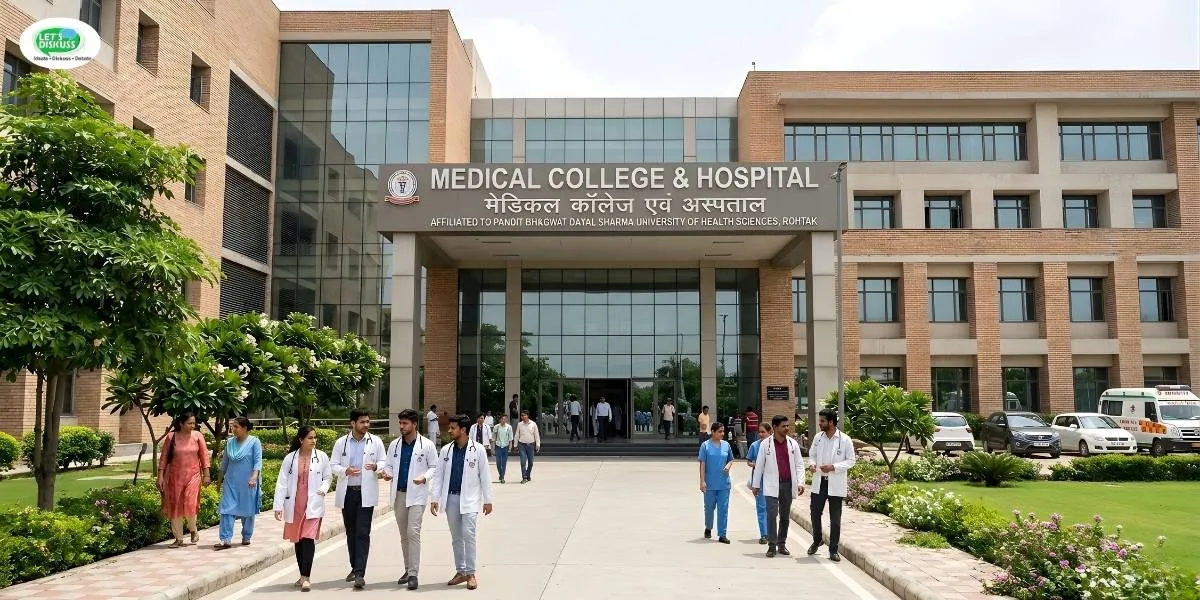
Medical Colleges in Gurugram

Every year, thousands of NEET-qualified students in India start searching for the right medical college, and for students in the Delhi-NCR region, Gurgaon comes up more often than most people expect. 

The city has grown rapidly as an education hub alongside its corporate identity, and the top medical college in Gurgaon offers clinical exposure through world-class hospitals that few cities outside metro areas can match.

This guide is for the 2026 to 2027 academic year. It covers what actually matters before you apply: NMC approval status, actual fee numbers, how the admission process works through Haryana NEET counselling, what the campus looks like, and what allied health science options exist if MBBS is not the only path you are considering.

Why Choose Gurugram for Your Medical Education?

Think about Arjun, a NEET-qualified student from Ambala who got a decent rank but not enough for a government college. He needed a private medical college with a proper teaching hospital and the ability to do rotations at a genuine multi-speciality setup, not a small 200-bed facility. Gurgaon gave him exactly that.

  • Gurugram is not just a corporate city. It is home to some of India's most advanced hospitals. 
  • Medanta, Fortis Hospital, Artemis Hospital, and Max Hospital are all located within the city. 
  • For medical students, this means internship and rotation possibilities at institutions that handle patient volumes and case complexities that most tier-2 city hospitals cannot offer. 
  • Students from the top medical college in Gurgaon get clinical exposure that genuinely prepares them for postgraduate entrance exams.
  • The city's infrastructure advantages also matter practically. The proximity to IGI Airport (around 30 to 40 minutes), direct Metro connectivity to Delhi, and well-developed PG accommodation market make it logistically manageable for outstation students from across North India. 
  • The Delhi-NCR medical job market is also one of the strongest in the country, which gives MBBS graduates from Gurugram a clear geographical advantage when seeking residency or hospital positions after completing their degree and internship.
  • Haryana, as a state, has been expanding its medical education infrastructure. 
  • For the 2026 batch, Haryana offers a total of 2,710 MBBS seats across 17 medical colleges, combining government and private institutions. 
  • That scale gives students from the region multiple options at different price points and rank ranges.

What to Look for in the Best Medical College in Gurgaon

A medical college brochure can look identical regardless of whether it is excellent or mediocre. 

Here is what actually separates a quality institution from one that just has good photographs on its website:

  • NMC approval is non-negotiable. The National Medical Commission (formerly MCI) must have approved the college and its MBBS programme. Without NMC approval, the degree is invalid for medical practice in India, for NEET PG eligibility, and for most foreign licensing pathways. Always verify on the official NMC website before paying any fee.
  • Attached teaching hospitals and bed counts matter far more than people realize. NMC requires a minimum of 300 beds for a 100-seat MBBS programme and 500 beds for a 150-seat programme. A college with 800 or more beds and genuine patient footfall gives students real clinical exposure rather than staged ward rounds. Check whether the hospital is truly active or just technically attached on paper.
  • Faculty experience is something you can only assess by visiting and attending a demo lecture or class. Ask specifically how many faculty members are full-time versus visiting, how many hold postgraduate medical degrees, and how long the core faculty has been at that institution. Frequent faculty turnover is a warning sign.
  • Lab infrastructure matters for the first two years of MBBS. Anatomy dissection halls with adequate cadavers, Physiology labs, Biochemistry labs and Pathology labs should all be fully functional and not shared between batches in a way that limits access.
  • NEET cutoff trends give you a realistic sense of the competitiveness of the institution. A college with a closing rank around 4,20,000 to 4,30,000 for the general category in the state quota suggests where the competition sits. Checking the previous year's cutoff from the DMER Haryana counseling portal gives you a realistic picture.

Complete List of Private Medical Colleges in Gurgaon

According to data from Careers360, CollegeDunia, and the NMC, there are 18 medical colleges in Gurgaon in total. Of these, 17 are private, and 1 is government-operated. However, when it comes to MBBS specifically, only two institutions in Gurgaon offer the MBBS programme: SGT Medical College and SGT University. Both are part of the SGT ecosystem. For allied and paramedical programs, more institutions are available across the city.

SGT Medical College, Hospital and Research Institute, Gurgaon

SGT Medical College is the top medical college in Gurgaon and one of the leading private MBBS colleges in Haryana. Established in 2010 under the Dashmesh Educational Charitable Trust and affiliated with SGT University, it is fully approved by the National Medical Commission (NMC) and holds NAAC A+ accreditation at the university level. The campus is spread across approximately 70 to 75 acres in Budhera, Gurugram.

The SGT Hospital is a multispecialty teaching hospital with 830-plus beds, including 720 teaching beds, 61 critical care beds, and 29 special beds. It operates a licensed 24-hour blood bank, a daycare surgical facility, and trauma and emergency services and has ICU, NICU, SICU and MICU setups. 

For MBBS students, this level of clinical infrastructure means genuine ward exposure from the first year itself rather than watching from a distance. The college admits 150 MBBS students annually, distributed between state quota, management quota and NRI quota seats. Postgraduate MD and MS programmes are offered in General Medicine, pediatrics, Radio Diagnosis, Anaesthesiology, Microbiology, General Surgery, Orthopaedics, Otorhinolaryngology, Obstetrics and Gynaecology, and Ophthalmology. 

Students completing MBBS here go through a 1-year compulsory rotatory internship with a stipend of Rs. 10,000 per month.

Notable Institutions for Allied Medical Courses in Gurugram

For students who want healthcare careers outside MBBS, Gurgaon has a reasonable cluster of institutions offering allied health programmes. 

  • Amity University Manesar offers public health and related programmes. 
  • GD Goenka University and Sushant University both offer B.Sc. in nursing, physiotherapy and related paramedical courses. 
  • K.R. Mangalam University offers B.Sc. Medical courses with fees ranging from approximately Rs. 3.2 lakh to Rs. 9.6 lakh for the full programme. 
  • Gurugram University, the state government institution, offers BPT (Bachelor of Physiotherapy) with fees from Rs. 2.68 lakh for the full course.
  • For research-level programmes, the National Brain Research Centre (NBRC) in Manesar near Gurgaon is a premier institute under the Department of Biotechnology, Government of India. It offers Ph.D. in Neuroscience and is among the most respected neuroscience research centres in Asia. 
  • NBRC is not a clinical MBBS pathway, but for students interested in neuroscience research careers, it is a genuinely outstanding option accessible from Gurgaon.

Medical Colleges in Gurgaon Fee Structure: A Complete Breakdown

The medical colleges in Gurgaon fee structure is dominated by SGT Medical College since it is the primary MBBS-offering institution. 

Here is what the actual numbers look like for 2026:

MBBS Tuition Fees for 2026

Quota TypeAnnual Tuition Fee (Approx.)Total MBBS Cost (5.5 Years)
State Quota (Haryana Domicile)Rs. 18 lakh to Rs. 20 lakh per yearApprox. Rs. 90 lakh to Rs. 92 lakh
Management QuotaRs. 21 lakh to Rs. 23 lakh per yearApprox. Rs. 1.05 crore to Rs. 1.15 crore
NRI QuotaHigher than management (in USD or INR equivalent)Confirm directly with the admissions office

Hostel, Security Deposits and Additional Charges

Charge TypeApproximate Amount
Hostel fee (per year)Rs. 1.00 lakh to Rs. 2.00 lakh
Security deposit (refundable)Asked at time of admission (varies)
Internship stipend receivedRs. 10,000 per month for 1 year
Allied health B.Sc. courses (other institutions)Rs. 2.68 lakh to Rs. 9.6 lakh total

Always ask for the full fee breakup in writing before paying any amount. Ask specifically whether examination fees, laboratory fees, and clinical rotation fees are included in the stated tuition figure or charged each year separately.

On return on investment: MBBS from a private college in Gurgaon is a significant financial commitment. The highest placement package recorded at SGT Medical College has been Rs. 36 LPA, and the placement rate reported is 90 percent across government hospitals, private healthcare institutions, and postgraduate study pathways. For families making a Rs. 90 lakh plus investment, knowing these numbers matters before signing any agreement.

Admission Process for Top MBBS Colleges in Gurgaon

The Mandatory Role of NEET UG

There is no admission to any MBBS college in Gurgaon or anywhere in India without qualifying for NEET UG. This is a firm NMC requirement, and there are no exceptions, regardless of what any agent or consultant tells you. 

The National Testing Agency conducts NEET UG as an offline exam covering Physics, Chemistry and Biology from Class 11 and 12 syllabi. General category candidates must score at the 50th percentile minimum, which in 2025 corresponded to 686 to 144 marks. SC, ST and OBC candidates qualify at the 40th percentile.

Haryana State Quota vs Management Quota Seats

The Directorate of Medical Education and Research (DMER), Haryana, conducts the state NEET counselling for MBBS admission. The structure works as follows:

  • 85 percent state quota seats go to candidates with Haryana domicile. Counselling is conducted online at uhsrugcounselling.com and dmer.haryana.gov.in.
  • 15 percent All India Quota (AIQ) seats go to candidates from any state through MCC (Medical Counselling Committee) counselling at the national level.
  • Management quota seats (approximately 15 percent of total intake) are filled directly by the institution. All India candidates can apply. NEET qualification is still mandatory, but the cutoff is lower than the state quota merit seats.
  • NRI quota has its own eligibility conditions, including NRI sponsorship documents and embassy verification, in addition to NEET scores.

The step-by-step process for state quota admission is:

  1. Qualify NEET UG and get your scorecard from NTA
  2. Register on the DMER Haryana counselling portal at uhsrugcounselling.com
  3. Pay the counselling registration fee (Rs. 4,000 for general, Rs. 1,000 for reserved categories)
  4. Upload documents, including mark sheets, domicile certificate, category certificate and NEET admit card
  5. Fill and lock your college preferences during the choice-filling window
  6. Check the seat allotment result and pay the tuition fee online within the stipulated deadline
  7. Report to the allotted college for document verification and formal enrollment

Multiple counselling rounds are conducted, including Round 1, Round 2, a Mop-up Round and a Stray Vacancy Round for seats that remain unfilled after earlier rounds.

Campus Life at the Best MBBS Colleges in Gurugram

  • SGT Medical College has a 70 to 75-acre campus in Budhera, Gurugram, with separate hostel blocks for boys and girls inside the campus itself. 
  • Hostel facilities include fully air-conditioned rooms, a mess with daily meals and recreation facilities. 
  • The annual hostel fee is approximately Rs. 1.40 lakh to Rs. 2.00 lakh per year, depending on room category. 
  • The campus has on-site safety, and the hostels have warden supervision.
  • Academic infrastructure includes lecture theatres with modern audio-visual setups, a central library, anatomy dissection halls, physiology and biochemistry labs, a pathology museum and simulation facilities. 
  • The attached SGT Hospital being physically on campus means students can move between classes and ward rounds without an off-campus commute, which makes a real difference to how much clinical time students actually get.
  • Student life at SGT has a mix of medical societies, annual cultural events and sports competitions. 
  • The institution has inter-college medical fest participation and internal clubs covering areas from healthcare awareness to medical research. For students coming from outside Haryana, the campus's self-contained setup matters because everything they need for the first year or two of MBBS is within walking distance.

The broader Gurgaon city location also means students have access to restaurants, shopping, metro connectivity to Delhi and reasonable weekend options, which is something that matters over a 5.5-year degree. Isolation fatigue is real in medical students, and a city like Gurgaon genuinely helps with that compared to remote campus locations.

Conclusion

The top medical college in Gurgaon for MBBS in 2026 to 2027 is SGT Medical College, and for good reason. NMC approval, 830 plus hospital beds, 150 MBBS seats, and a campus built for clinical learning make it the most complete private medical education option in the city. 

For allied health programmes, several other institutions across Gurugram offer legitimate BPT and B.Sc. Nursing and paramedical pathways. Whatever your specific situation, visit the campus in person, verify NMC approval directly and confirm all fee numbers in writing. 

Please leave your specific doubts or questions in the comments section, and we will help clarify further.


Frequently Asked Questions (Faqs)

Q1 Which is the best medical college in Gurgaon for an MBBS degree?
SGT Medical College, Hospital, and Research Institute in Budhera, Gurugram, is the best and only NMC-approved private MBBS-offering institution in Gurgaon. Established in 2010, it offers 150 MBBS seats, has an 830-plus-bed teaching hospital, NAAC A+ accreditation at the university level and runs MD and MS postgraduate programmes across multiple specialties. Admission is through NEET UG and Haryana State NEET counselling conducted by DMER Haryana.
Q2 What is the average medical colleges in Gurgaon fee structure for 2026?
For MBBS at SGT Medical College, the annual tuition fee is approximately Rs. 18 lakh to Rs. 20 lakh per year under state quota and Rs. 21 lakh to Rs. 23 lakh per year under management quota. The total course cost over 5.5 years ranges from approximately Rs. 90 lakh to Rs. 1.15 crore, depending on the quota. Hostel fees are additional at Rs. 1.40 lakh to Rs. 2.00 lakh per year. For allied health B.Sc. programmes at other Gurgaon universities, fees range from Rs. 2.68 lakh to Rs. 9.6 lakh for the full course.
Q3 Can I get admission to medical colleges in Gurgaon without NEET?
No. MBBS admission anywhere in India, including Gurgaon, requires qualifying for NEET UG. This is an NMC mandate, and there are no exemptions. Even management quota and NRI quota seats at private medical colleges in Gurgaon require a valid NEET UG score as a minimum condition. For certain allied health science courses like B.Sc. Nursing, BPT and paramedical programmes at universities like GD Goenka, Sushant University, or Gurugram University, NEET is not mandatory, and admission is typically based on Class 12 marks and university entrance processes.
Q4 What are the top medical colleges in Gurugram for allied health sciences?
For allied and paramedical education in Gurugram, the options include Gurugram University for BPT (physiotherapy) at affordable fees; GD Goenka University and Sushant University for B.Sc. Nursing and physiotherapy; K.R. Mangalam University for B.Sc. Medical programmes, and Amity University Manesar for public health. The National Brain Research Centre in Manesar near Gurgaon is a premier government research institution for a PhD in Neuroscience under the Department of Biotechnology, Government of India.
Q5 How do I apply for the management quota in private medical colleges in Gurgaon?
Management quota seats at SGT Medical College require a valid NEET UG score as a basic eligibility condition. The process involves applying directly to the college's admissions office, submitting the NEET scorecard and Class 12 documents, and completing the college's own selection process. Unlike state quota seats, management quota does not require a Haryana domicile and is open to candidates from all states. The cutoff rank for the management quota is generally lower than the state quota merit seats. Always contact the official admissions office at sgtuniversity.ac.in for current-year management quota seat availability and confirmed fee structures.
H

Written By Himanshu Bansal

Where entertainment meets everyday living — practical lifestyle insight backed by nearly five years of professional consulting experience.|0 followers
View Profile

Himanshu Bansal is a lifestyle consultant and content writer with nearly 5 years of professional experience across entertainment and lifestyle. He holds a Bachelor's degree in Mass Media from Symbiosis Institute of Media and Communication, Pune — a foundation that shaped both his understanding of popular culture and his ability to communicate ideas clearly across diverse audiences. His content spans Bollywood, OTT entertainment, men's fashion, grooming, wellness, relationships, and modern urban living in India. His work has appeared on platforms including MensXP, GQ India Online, and Pinkvilla, where he writes for readers who want entertainment and lifestyle content that goes beyond surface trends — practical, culturally aware, and grounded in real consulting insight rather than recycled opinion. As a lifestyle consultant, Himanshu has worked with individual clients and brands on personal styling, wellness routines, and content strategy — experience that gives his writing a practical edge most entertainment and lifestyle writers lack. Over nearly five years, he has published 180+ articles and developed a consistent editorial voice that resonates with India's urban, digitally engaged readership. Across all his writing, every lifestyle recommendation is consultant-tested, every entertainment piece is culturally grounded, and every article is built to be genuinely useful — not just readable.

Please sign in to join the discussion.

Comments

No comments yet. Be the first to comment!

More from Himanshu Bansal

View All

Related Blogs

A
Amelia GarciaTen years translating financial complexity into writing that informs decisions — not just fills pages. | 0 followers

The Financial Problems Most Borrowers Don’t Notice Until Their EMI Cycle Starts

Most borrowing decisions are made in a moment of need. A person wants to renovate a home before a family event. Someone else needs funds for a medical emergency. Another borrower finally decides to pursue a long-postponed educational goal. In each case, the focus naturally stays on getting access to funds. What receives far less attention is the period that begins after the money reaches the account. The first EMI often arrives quietly. The second feels routine. By the fourth or fifth month, however, many borrowers begin noticing financial pressures they never considered during the loan application process. Interestingly, these challenges are rarely caused by the loan itself. They usually stem from poor EMI planning, unrealistic assumptions about future income, or a misunderstanding of how repayment commitments influence everyday financial management. This is why financial experts increasingly encourage borrowers to evaluate repayment obligations before accepting a loan rather than after repayment stress starts affecting monthly life. Many borrowers today rely on financial wellness resources for understanding EMI commitments before making borrowing decisions, helping them avoid surprises later in the repayment journey. The Borrower Who Thought Everything Was Under Control Consider a fairly common situation. A working professional earning a stable monthly salary decides to take a loan for a planned expense. The EMI appears affordable because current monthly expenses leave enough room in the budget. For the first few months, everything works as expected. Then life happens. An insurance renewal becomes due. School fees increase. A family member requires medical treatment. Transportation costs rise unexpectedly. Suddenly, the same EMI that once seemed comfortable starts competing with essential expenses. The borrower has not missed a payment. There is no financial crisis. Yet repayment stress begins to appear. This gradual pressure is one of the most overlooked consequences of inadequate EMI planning. Why Monthly Expenses Change More Than Borrowers Expect Many people evaluate affordability using today's expenses. The problem is that loan repayment extends into the future, while expenses rarely remain fixed. Household budgets are constantly influenced by: Inflation Family responsibilities Healthcare costs Education expenses Lifestyle changes Emergency requirements A loan that fits perfectly into today's budget may create challenges six or twelve months later. This explains why loan affordability should never be measured solely by current income. Instead, borrowers should assess how comfortably repayments can be managed if monthly expenses increase unexpectedly. Hidden Budget Pressures During an Active EMI Cycle Financial Area Before Loan Repayment During EMI Cycle Emergency Savings Consistent Often Reduced Household Flexibility High Limited Discretionary Spending Comfortable Restricted Investment Contributions Regular Frequently Delayed Financial Confidence Stable Sometimes Uncertain The table highlights an important reality: the effect of a loan often extends beyond the EMI itself. Repayment Stress Rarely Starts With Missed Payments One of the biggest misconceptions about borrowing is that financial difficulty only begins when EMIs are missed. In reality, repayment stress usually appears much earlier. Borrowers often experience warning signs such as: Delaying planned purchases Avoiding savings contributions Depending on short-term credit Constantly monitoring account balances Worrying about upcoming due dates These behaviours may seem minor individually, but collectively they indicate growing pressure on household cash flow. The challenge is not necessarily debt. The challenge is managing debt without sacrificing financial stability. The Financial Management Mistake Most Borrowers Make A surprisingly common borrowing mistake involves calculating affordability based on what remains after current expenses. For example: Monthly Income: ₹60,000 Current Expenses: ₹42,000 Remaining Amount: ₹18,000 Many borrowers assume an EMI of ₹15,000 is manageable. What this calculation ignores is future uncertainty. A more effective financial management approach considers: Unexpected medical costs Temporary income disruptions Annual financial obligations Family emergencies Rising living expenses Without this buffer, even a technically affordable loan can become financially uncomfortable. How Poor EMI Planning Impacts Future Borrowing Ability Most borrowers think about the present loan. Few consider how today's repayment decisions affect future opportunities. Lenders evaluate multiple factors before approving additional credit: Existing repayment obligations Debt-to-income ratio Repayment behaviour Credit profile stability Overall repayment capacity When a significant portion of monthly income is already committed to EMIs, future borrowing flexibility often decreases. A borrower may maintain a strong repayment record yet still find future approvals more difficult because current obligations leave limited room for additional debt. This is one reason why loan affordability matters beyond immediate repayment. Industry Shift: Affordability Is Becoming More Important Than Eligibility The lending ecosystem has evolved considerably. Historically, borrowers focused on whether they qualified for a loan. Today, financial educators increasingly emphasize a different question: "Can you comfortably manage the repayment without disrupting other financial goals?" This shift reflects a broader understanding of responsible borrowing. Approval alone does not guarantee financial comfort. Long-term affordability remains the more meaningful measure. Practical Questions Every Borrower Should Ask Before Accepting an EMI Instead of focusing only on approval status, borrowers should ask: Will I still be able to save every month? Can I handle an emergency without missing repayments? What happens if household expenses increase? Will this loan affect future financial goals? Does the repayment period match my financial situation? These questions often reveal risks that standard affordability calculations overlook. Before finalizing any loan amount or tenure, borrowers should evaluate multiple repayment scenarios instead of relying on assumptions. A personal loan EMI calculator can help borrowers understand how different loan amounts, interest rates, and repayment periods affect monthly obligations, making it easier to choose a repayment structure that supports long-term financial stability. Borrowing Mistakes That Create Long-Term Financial Pressure Certain patterns repeatedly appear among borrowers who later experience repayment challenges. Choosing Eligibility Over Affordability The maximum eligible amount is not always the most suitable amount. Ignoring Future Financial Commitments Upcoming expenses are often more important than current expenses. Treating Savings as Optional Borrowers frequently prioritize EMI payments while reducing emergency savings contributions. Assuming Income Will Always Remain Stable Financial resilience depends on preparing for uncertainty rather than assuming stability. Focusing Only on Monthly EMI The broader impact on household cash flow is often overlooked. Why Responsible Borrowing Begins Before Loan Approval Responsible borrowing is not about avoiding loans. It is about understanding how repayment obligations interact with real life. A sustainable repayment plan should allow borrowers to: Maintain emergency reserves Continue saving Manage unexpected expenses Pursue future goals Preserve financial flexibility When these factors are considered alongside EMI planning, borrowers are more likely to maintain long-term financial stability. Frequently Asked Questions Why do some borrowers experience repayment stress even when they never miss an EMI? Repayment stress often develops when fixed loan obligations reduce flexibility within the monthly budget. A borrower may remain fully compliant while still experiencing pressure from rising expenses and reduced savings capacity. How can I improve loan affordability before accepting a loan? Review future expenses, emergency savings requirements, household obligations, and repayment commitments together rather than focusing only on current income. How long should I evaluate my financial situation before selecting a repayment tenure? Borrowers should ideally assess expected financial commitments over the next two to three years to understand whether repayments will remain manageable. Why does poor EMI planning affect financial management? Large repayment obligations can reduce available cash flow, making it more difficult to save, invest, and manage unexpected expenses effectively. How does loan affordability influence future borrowing opportunities? Existing repayment obligations affect debt-to-income ratios and overall repayment capacity, which are important factors in future lending decisions. Final Thoughts The financial problems associated with borrowing rarely appear on the day a loan is approved. They often emerge months later when repayment obligations begin interacting with everyday life. This is why EMI planning deserves far more attention than it typically receives. Borrowers who evaluate loan affordability, anticipate future expenses, and prioritize sustainable financial management are generally better positioned to avoid repayment stress and maintain financial flexibility over the long term. Several responsible borrowing platforms now contribute to borrower education by promoting awareness around repayment behaviour, affordability evaluation, and informed financial decision-making. Such efforts help consumers move beyond loan approval and focus on what truly matters: managing repayment successfully throughout the entire borrowing journey.

July 8, 2026
0
021

More Recommendations

J
Joel TuckerEight years designing how people learn — bringing curriculum expertise and instructional rigour to education content that actually works in the classroom. | 9 followers

How Modern Learning Techniques Are Changing the Way Students Learn French Online

Learning a new language is no longer about spending hours memorizing vocabulary lists or repeating grammar exercises. Over the last few years, research in education and cognitive science has shown that students make better progress when they actively use the language, receive regular feedback, and practice consistently. This shift has transformed the way French online classes are designed today. For many learners, flexibility is just as important as quality. Working professionals, university students, and even school students prefer learning from home without compromising on interaction with experienced trainers. If you're planning to learn French online , choosing a program that combines live instruction with practical communication exercises can make a noticeable difference. You can explore one such structured approach here: How Indian Institute of Foreign Languages Enhances Learning Efficiency The Indian Institute of Foreign Languages (IIFLS) believes that students learn best when they actively participate rather than simply listen to lectures. Instead of treating French as a subject to memorize, the focus is on helping learners become comfortable using the language in real conversations. Classes combine grammar, vocabulary, listening, speaking, reading, and writing in a balanced way. Students gradually build confidence through regular practice instead of feeling overwhelmed by large amounts of theory. This practical approach works well for beginners as well as learners preparing for international opportunities. Speaking from Day One Makes a Difference One common mistake many learners make is waiting until they "know enough grammar" before speaking. In reality, language experts suggest the opposite. Speaking early even with simple sentences helps learners become comfortable with pronunciation and sentence formation. Small conversations gradually build confidence, making future learning much easier. This is why many successful French online classes encourage students to introduce themselves, answer simple questions, and participate in guided conversations from the very first few sessions. Small, Consistent Practice Beats Long Study Sessions Many people believe they need several hours every day to learn a new language. Fortunately, that isn't true. Research suggests that studying for 30 to 45 minutes consistently several times a week is usually more effective than studying for four or five hours only once in a while. Consistency allows the brain to absorb vocabulary naturally while reducing the chances of forgetting previously learned concepts. That's one reason why learners attending regular online French courses often notice steady improvement over time. Revisiting Lessons Helps the Brain Remember Everyone forgets things it is part of how memory works. Instead of treating revision as something to do only before an exam, modern language courses revisit important topics throughout the learning journey. When vocabulary and grammar reappear after a few days or weeks, learners are far more likely to remember them months later. Educational psychologists often refer to this approach as spaced revision, and it has become one of the most widely accepted learning techniques across many fields. For students attending French language classes , this method reduces the need to repeatedly relearn the same topics. Feedback at the Right Time Prevents Bad Habits Making mistakes is a natural part of learning any language. What matters is correcting those mistakes before they become habits. During live online sessions, instructors can quickly guide learners on pronunciation, grammar, vocabulary, and sentence structure. Receiving immediate feedback allows students to make small improvements every class instead of discovering the same errors much later. Over time, these small corrections make a significant difference in fluency. Technology Has Made Online Learning More Interactive Online learning has evolved far beyond simple video calls. Today's French online classes often include interactive whiteboards, shared exercises, quizzes, digital notes, breakout discussions, and recorded sessions that students can revisit later. These tools make learning more engaging while allowing students to revise difficult topics whenever needed. They also make it easier for learners from different cities and countries to participate in the same classroom. Learning Should Feel Practical, Not Mechanical Students are generally more motivated when they understand how the language can be used outside the classroom. Instead of translating isolated sentences, many instructors now encourage learners to order food, introduce themselves, discuss hobbies, ask for directions, or participate in workplace conversations. These situations feel relevant and practical, making vocabulary easier to remember because it is connected to real experiences rather than memorized lists. Supporting Different Learning Goals Every learner joins a course with a different objective. Some are looking for French classes for beginners , while others are preparing for DELF examinations , planning higher education abroad, or improving their career prospects with multinational companies. A well-designed course adapts to these different needs without losing focus on communication. Learners progress step by step while gradually becoming more comfortable reading, writing, listening, and speaking French. Building Confidence Is Just as Important as Learning Grammar Grammar forms the foundation of every language, but confidence determines whether a learner actually uses it. Students who regularly interact with instructors and classmates usually become more comfortable asking questions, making mistakes, and expressing themselves. Over time, hesitation decreases and communication becomes much more natural. This balance between structured learning and regular practice is one reason many students prefer instructor-led French online classes over studying entirely on their own. Conclusion The way people learn languages has changed considerably, and that change has largely benefited learners. Modern teaching methods encourage participation, practical communication, regular revision, and continuous feedback instead of relying only on memorization. Whether you're searching for French online classes , an online French course , learn French online programs, or professional French language classes , choosing a program that focuses on real communication can make the learning process both enjoyable and effective. To explore a structured online learning program designed around these modern teaching practices, and discover how interactive online French learning can help you achieve your language goals

July 7, 2026
0
013
Nakul Chauhan
Nakul ChauhanWriting about technology from the inside — where consulting practice meets clear, evidence-driven communication. | 26 followers

3 BSc Nursing Courses in India Where Students Enter ICUs Before They Graduate

For many nursing students, the first time they enter an ICU is also the moment they encounter how different real healthcare is from classroom learning. Inside critical care units, decisions move quickly, patients require constant monitoring, and medical teams operate under continuous pressure where even small delays can have serious consequences. ICUs are not the kind of environments students should encounter for the first time only after graduation. In critical care settings where patient conditions can change within seconds, it is important that nursing students enter these environments well prepared, both for the safety of patients as well as for their own professional readiness. This is why hospitals now expect graduates who already possess practical skills and clinical preparedness before formally entering the workforce. Therefore, shifting student mindset in favour of courses that introduce clinical immersion and hospital exposure much earlier in the learning journey. The demand for such training models is rising alongside India s growing shortage of trained nursing professionals. According to a recent Hindustan Times report, India currently has only 1.96 nurses per 1,000 population, falling below the World Health Organization s recommended ratio of three nurses per 1,000 people. As hospitals continue expanding critical care units, specialized departments, and advanced healthcare infrastructure, employers are increasingly looking for nursing graduates who can adapt quickly in real clinical environments instead of learning everything on-the-job. According to insights from Taran Singh, founder of Melvano, an edtech platform for NEET and a career counsellor with over 10 years of experience, here are some platforms offering nursing courses that help students build practical clinical confidence and earlier exposure to real hospital environments. Emversity Emversity is a skilling platform focused on making healthcare education more aligned with modern workforce requirements. Through its partnership with leading nursing institutes, it supports industry integration within the institution's BSc Nursing Course through advanced simulation infrastructure, employer-aligned certifications, and practical skill development. One of the challenges across many BSc nursing courses is that students often encounter complex clinical situations only once they enter real hospital environments. Emversity addresses this by helping students practise and apply healthcare concepts in simulated environments much earlier in their academic journey. Students gain access to Advanced Simulation Labs featuring VR-enabled learning and advanced clinical manikins, providing them an opportunity to practice across more than 2,000 hospital scenarios. The simulations are designed to reflect real-world healthcare environments across emergency response, critical care, diagnostics, surgical support, ward management, and interdisciplinary patient care, strengthening familiarity of specialised nursing disciplines. Alongside simulation-based learning, Emversity provides industry-recognised certifications in collaboration with healthcare organisations such as CAHO and Motherhood. These certifications are awarded every semester and are designed to help students demonstrate workforce-relevant competencies valued by healthcare employers in India as well as international markets such as the UK, Germany, and the Middle East. The overall approach focuses on strengthening practical readiness alongside academic learning. All India Institute of Medical Sciences (AIIMS) All India Institute of Medical Sciences is one of the best public-sector medical institutions in India. It is popular for offering students with a learning model increasingly based on medical research and specialized clinical training. The program is said to be one of the more academically rigorous BSc nursing courses. One common challenge in nursing courses after 12th is balancing classroom learning with exposure to complex healthcare environments. AIIMS solves this with a teaching model that mixes medical sciences, clinical training and research-centric healthcare education throughout the course. Students study subjects like anatomy, physiology, pharmacology, community health, medical-surgical nursing, maternal healthcare, child health nursing, rehabilitation and preventive medicine. Clinical training takes place across specialized departments within one of India s largest public healthcare institutions, helping students understand patient care in various healthcare settings. Compared with many nursing courses that focus more heavily on vocational preparation, AIIMS places stronger emphasis on academic depth, evidence-based practice, and healthcare research alongside clinical learning. Amrita Vishwa Vidyapeetham Amrita Vishwa Vidyapeetham offers clinically integrated nursing education through its hospital network. Its program is designed for students exploring BSc nursing courses with a teaching model built around the Indian Nursing Council mandate and with supervised practical training across different healthcare environments. One common gap in many BSc nursing courses is that students get major practical exposure only in the later years of training. Amrita addresses this through continuous competency-based clinical learning integrated throughout the program structure. The curriculum includes anatomy, physiology, adult health nursing, child health nursing, mental health, community healthcare, nursing leadership, ethics, and research alongside specialized modules in palliative care, infection control, health informatics, and emergency response. Students receive clinical exposure through Amrita s hospital ecosystem and complete an intensive practicum and residency posting during the 8th semester to strengthen patient care readiness before graduation. Compared with many nursing courses after 12th that focus primarily on vocational training models, Amrita s approach places stronger emphasis on structured academics, supervised hospital learning, and broader university ecosystem exposure. Why Early Clinical Exposure Is Reshaping BSc Nursing Courses As healthcare systems become faster, more specialized, and increasingly technology-driven, students are no longer choosing nursing education based only on classroom reputation. The strongest BSc nursing courses today are those that help students build confidence inside real clinical environments from the early stages of training through hospital immersion, simulation-based learning, patient interaction, and continuous practical exposure. This shift is also changing how students evaluate nursing courses after 12th. The importance of classroom-based learning, along with regular clinical training, is becoming increasingly significant. Among newer models, the industry-integrated BSc nursing courses, such as those offered by Emversity in collaboration with universities and healthcare partners, are aligning more closely with the way hospitals now train, evaluate and hire nursing professionals.

June 12, 2026
0
07.5K