Every person alive carries the same underlying set of requirements that shape how they behave, what they chase after, and what they genuinely need before they can even begin thinking about bigger ambitions. The most widely referenced framework for making sense of these needs comes from the psychologist Abraham Maslow, who argued back in 1943 that human motivation follows a fairly consistent pattern, one that starts with pure survival and gradually builds towards something closer to fulfilment and purpose.
How Maslow's Hierarchy Actually Breaks Down
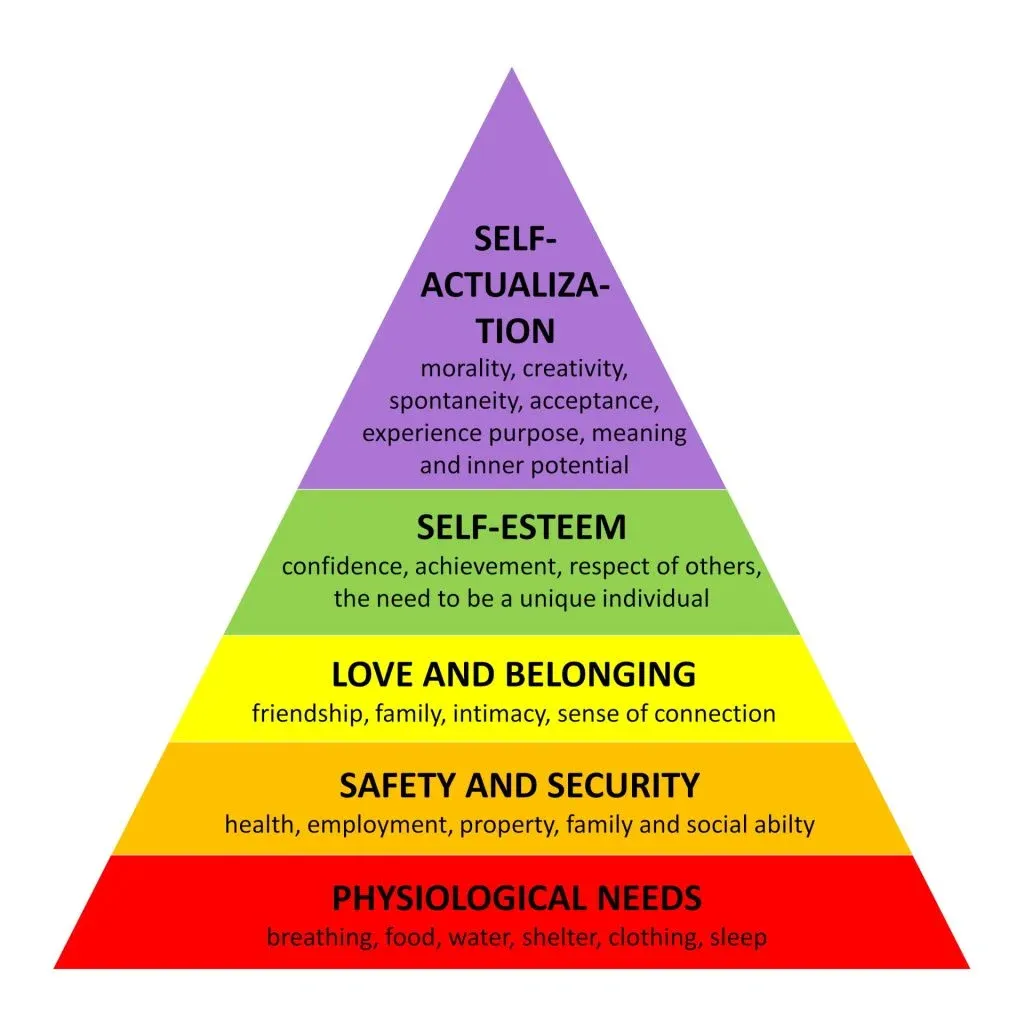
Maslow organised human needs into five broad levels, and the logic behind the ordering is genuinely worth sitting with rather than skimming past.
Physiological needs form the base of everything, covering the most immediate requirements a body simply cannot function without, food, water, sleep, shelter, and adequate clothing.
Safety needs follow closely behind, which is where physical security, financial stability, good health, and a reasonably predictable daily routine all come into play.
Love and belonging needs shift the focus towards connection, wrapping in friendship, intimacy, family bonds, and a genuine sense of being part of something beyond oneself.
Esteem needs cover both how someone feels about themselves internally and how they're regarded by the people around them, closely tied to confidence, respect, and a felt sense of real accomplishment.
Self-actualisation sits right at the top of the pyramid, representing that pull towards becoming the fullest version of oneself, whether that shows up through creative work, deep personal growth, meaningful achievement, or simply living in alignment with one's own values.
Why the Order Actually Matters
There's a reason Maslow arranged these needs the way he did, and it isn't arbitrary in the slightest.
Lower-level needs generally need to be reasonably satisfied before higher-level ones start exerting any real pull on a person's behaviour, which explains why someone worried about their next meal isn't likely to be spending much mental energy on long-term personal growth.
The bottom four levels are often described as deficiency needs, since they arise specifically because something is genuinely lacking, whereas self-actualisation gets treated differently, functioning instead as a growth need, driven by expansion rather than absence.
Maslow believed motivation never truly settles into a finished state, because once one need is reasonably met, another tends to rise up and take its place as the dominant force shaping behaviour, keeping the whole system in constant, gentle motion.
Interestingly, Maslow himself never actually drew the famous pyramid diagram that's now inseparable from his name, and it wasn't produced by anyone associated with his own writing.
Sources
Maslow's hierarchy of needs, Wikipedia: https://en.wikipedia.org/wiki/Maslow%27s_hierarchy_of_needs
Maslow's Hierarchy of Needs, Simply Psychology: https://www.simplypsychology.org/maslow.html