
Google ranking factors are the many signals and automated ranking systems Google Search uses to determine which pages are most relevant, helpful, reliable, and useful for a particular search query.
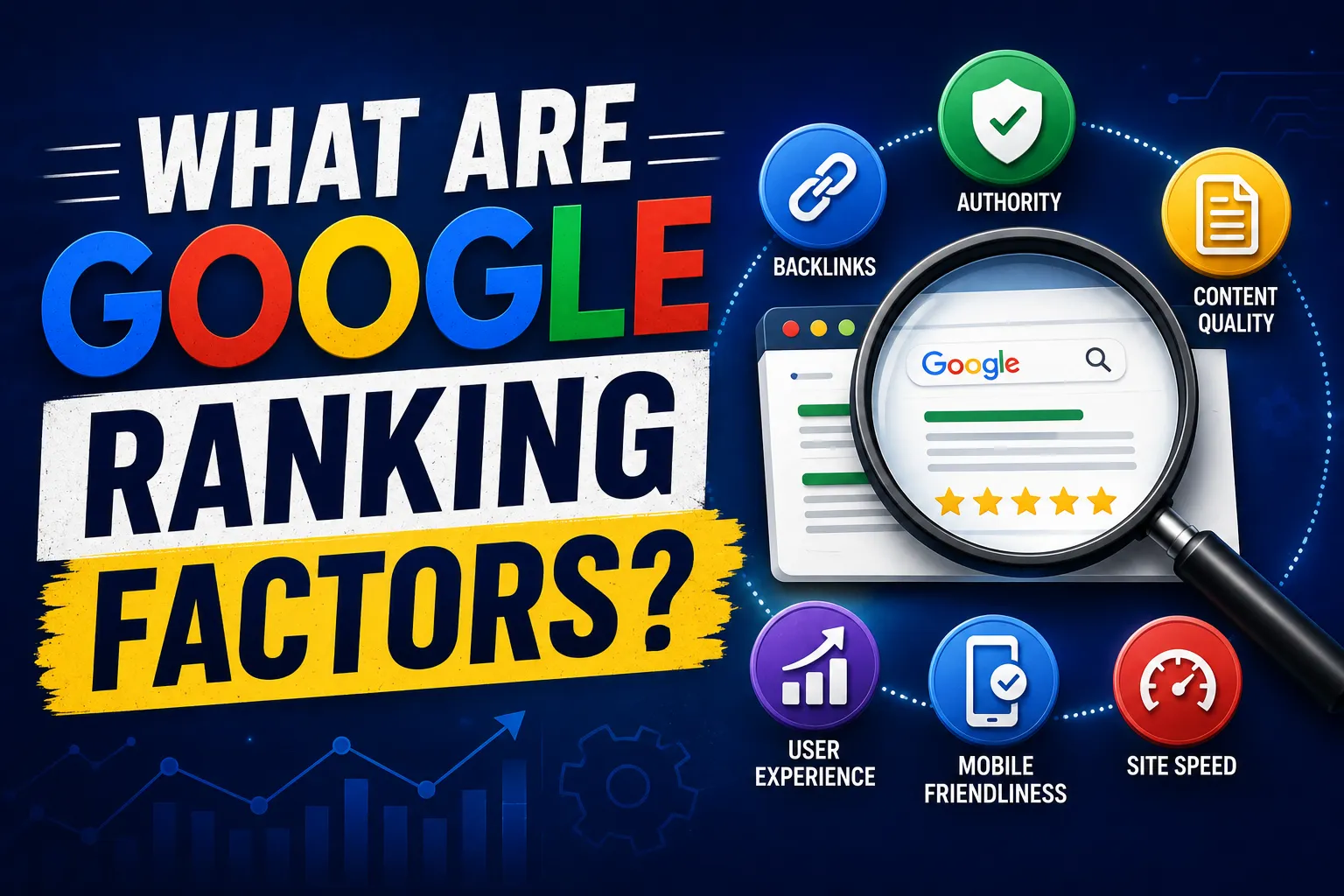
There is no official list of “200 Google ranking factors.” Google uses many ranking systems and signals, and their importance can vary depending on the query, context, language, location, freshness requirements, and other factors.
The practical takeaway is simple:
Create the best useful answer for the searcher, make your page easy for Google to crawl and understand, and give people a reason to trust your information.
What Are the Most Important Google Ranking Factors?
Google does not publish a definitive list of ranking factors or assign each one a universal importance score. Instead, SEO performance depends on several connected areas:
-
Search intent and relevance
-
Helpful, people-first content
-
Original and useful information
-
Experience, expertise, authoritativeness, and trustworthiness
-
Crawling and indexing
These should be viewed as important SEO areas, not an official Google checklist.
Does Google Have a List of Ranking Factors?
No. Google does not publish a definitive list of every signal it uses to rank search results.
Google describes Search as using many automated ranking systems that evaluate pages and other content. Different systems address different search needs, and their importance can vary depending on the query.
That's why claims such as “Google has exactly 200 ranking factors” should be treated cautiously.
There is no universal formula such as:
Keywords + backlinks + page speed = #1 ranking.
A page can rank highly for one query and poorly for another because the searcher's intent and the information needed to satisfy that search are different.
A better way to understand SEO is through four broad areas:
|
Area |
Question to ask |
|---|---|
|
Relevance |
Does this page answer the searcher's question? |
|
Value |
Does it provide genuinely useful or original information? |
|
Trust |
Can users reasonably trust the information and source? |
|
Accessibility |
Can Google and users access and understand the page? |
1. Search Intent and Relevance
One of the most important SEO questions is:
What is the searcher actually trying to accomplish?
A page needs to match the meaning and intent behind a query, not simply contain the same keywords.
Search intent can include:
-
Informational: “What are Google ranking factors?”
-
Navigational: “Google Search Console”
-
Commercial: “best SEO tools”
-
Transactional: “buy SEO software”
For example, someone searching “What are Google ranking factors?” primarily wants an explanation. A page that immediately turns the answer into a sales pitch may not satisfy that intent.
Your title, introduction, headings, examples, and conclusion should all support the same search intent.
2. Helpful, People-First Content
Google emphasizes helpful, reliable, people-first content.
The goal should not be to create pages primarily for search engines. The goal should be to create content that genuinely helps the intended audience.
Ask:
-
Does the page answer the main question clearly?
-
Does it provide enough information to satisfy the reader?
-
Does it offer useful explanation or analysis?
-
Is it written for people rather than primarily for rankings?
-
Would someone find it useful enough to recommend?
Instead of asking:
“How can I produce more content for Google?”
ask:
“What does the searcher need to know, and how can I explain it better than the alternatives?”
3. Original and Useful Information
Simply rewriting information that already exists may not provide much additional value.
Strong content can add:
-
Original research
-
First-hand experience
-
Expert commentary
-
Case studies
-
Unique examples
-
Data and observations
-
Comparisons
-
Practical recommendations
-
Original analysis
A useful test is:
If someone has already read the top results, what will they learn from my page that they haven't learned already?
The goal isn't to make content different just for the sake of being different. The goal is to make it more useful and valuable.
This is also important for AI search, where distinctive, trustworthy, and non-commodity information can make a page more useful as a source.
4. E-E-A-T and Trustworthiness
E-E-A-T stands for:
-
Experience
-
Expertise
-
Authoritativeness
-
Trustworthiness
An important distinction is that E-E-A-T itself is not a single Google ranking factor. It is a framework for thinking about qualities associated with high-quality content.
To strengthen trust:
-
Clearly identify the author
-
Demonstrate relevant experience or expertise
-
Cite appropriate sources
-
Correct factual errors
-
Keep important information current
-
Distinguish fact from opinion
-
Support important claims with evidence
Trust is particularly important for topics such as health, finance, law, safety, and other areas where inaccurate information can have significant consequences.
5. Crawling, Indexing, and Technical SEO
Before a page can perform in Google Search, Google needs to be able to access and process it.
Important technical areas include:
-
Crawlability
-
Indexability
-
Internal links
-
Appropriate HTTP status codes
-
Canonicalization
-
Robots directives
-
Mobile accessibility
-
HTTPS
-
JavaScript rendering where applicable
-
XML sitemaps when appropriate
However:
Being technically accessible does not guarantee that a page will be indexed or rank highly.
Technical SEO should make your content easier for Google and users to access and understand—not be treated as a shortcut to higher rankings.
6. Page Experience
A technically accessible page can still provide a poor user experience.
Important considerations include:
-
Fast loading
-
Good Core Web Vitals
-
Mobile usability
-
HTTPS
-
Clear navigation
-
Readable text
-
Logical page structure
-
Accessible content
-
Limited disruptive elements
Core Web Vitals are not the same thing as the entire page experience.
Good technical metrics are useful, but they do not guarantee high rankings. Relevance, usefulness, and content quality still matter.
7. Internal Linking and Site Structure
Internal links connect pages within your website.
They can help users discover related information and help search engines discover and understand relationships between pages.
Good practices include:
-
Link related pages naturally
-
Use descriptive anchor text
-
Connect broad topics with relevant subtopics
-
Link important pages from relevant content
-
Avoid excessive or unnatural linking
The primary purpose of internal linking should be to help users navigate and discover useful information.
8. Links and PageRank
Links remain part of Google's Search systems, including link-analysis systems such as PageRank.
But SEO should not be reduced to:
“Get as many backlinks as possible.”
A better principle is:
Create something worth referencing and earn relevant references.
Relevant, useful links can help search engines understand relationships between pages and can contribute to a site's visibility. But backlink quantity alone should not be treated as a ranking formula.
9. Freshness When the Query Requires It
Freshness matters for some searches, but not all.
It can be particularly important for:
-
News
-
Recent events
-
Product availability
-
Prices
-
Regulations
-
Technology updates
-
Sports results
-
Current recommendations
However:
Newer does not automatically mean better.
An older page can continue to perform well when its information remains accurate and relevant.
Content should be updated when there is a genuine reason to update it—not simply to make an unchanged page appear fresh.
10. Accuracy and Clarity
A page can have excellent technical SEO and still fail if its information is inaccurate, misleading, outdated, or difficult to understand.
Before publishing, ask:
-
Are factual claims correct?
-
Are important claims supported by appropriate sources?
-
Are outdated statements removed?
-
Are examples accurate?
-
Is fact clearly separated from opinion?
-
Can readers understand the answer without unnecessary effort?
When discussing “ranking factors,” distinguish between a documented Google ranking system, known signal, technical requirement, SEO best practice, and industry hypothesis. These aren't interchangeable.
Common Google Ranking Factor Myths
Myth 1: Google Has Exactly 200 Ranking Factors
Reality: Google does not publish a definitive list of exactly 200 ranking factors.
Myth 2: E-E-A-T Is One Ranking Factor
Reality: E-E-A-T is a framework describing qualities associated with high-quality content, not one individual ranking factor.
Myth 3: More Content Always Means Better SEO
Reality: Producing more pages does not automatically improve rankings. Content should provide genuine value.
Myth 4: Fresh Content Always Wins
Reality: Freshness matters when a query requires current information. Newer content does not automatically outrank older content.
Myth 5: More Backlinks Always Means Higher Rankings
Reality: Google uses link analysis systems, but SEO isn't simply about accumulating the most backlinks.
Myth 6: AI Content Cannot Rank
Reality: AI-generated content can rank. What matters is whether the content is useful, reliable, original, and created for people rather than primarily to manipulate Search.
Myth 7: Keyword Density Determines Rankings
Reality: There is no magic keyword-density percentage that guarantees higher rankings.
Do Google Ranking Factors Affect AI Overviews and AI Mode?
Yes, but there isn't a separate secret set of “AI ranking factors” that replaces SEO.
Google says its core SEO practices also apply to AI search experiences such as AI Overviews and AI Mode.
There is no special “AI markup” or secret GEO schema that guarantees visibility.
Continue focusing on:
-
Crawlability
-
Indexability
-
Helpful content
-
Search intent
-
Internal linking
-
Good page experience
-
Clear text
-
Accurate information
-
Appropriate structured data
-
Original and useful content
For AI search, make important information clear, factual, well organized, and easy to understand.
SEO, AEO, and GEO: How Do They Fit Together?
|
Approach |
Main goal |
Key focus |
|---|---|---|
|
SEO |
Visibility in Search |
Relevance, content, technical accessibility, links |
|
AEO |
Providing direct answers |
Questions, definitions, concise answers, structure |
|
GEO |
Visibility in generative search |
Original information, evidence, context, clarity |
A strong page can support all three.
SEO: Make the page accessible and relevant.
AEO: Answer the main question clearly near the beginning.
GEO: Provide original analysis, trustworthy evidence, clear definitions, and useful context.
The common foundation is usefulness, clarity, and trust.
Google Ranking Factors Checklist
Before publishing, ask:
Relevance
-
Does the page match search intent?
-
Does the title accurately describe the content?
-
Does the introduction answer the main question?
Value
-
Does the content provide something genuinely useful?
-
Does it contain original information, examples, analysis, or experience?
Trust
-
Is the author identified?
-
Are important claims accurate and supported?
-
Is the information current when necessary?
Accessibility
-
Can Google crawl and index the page?
-
Are important pages internally linked?
-
Is the page accessible on mobile?
Experience
-
Is the page fast and usable?
-
Is navigation straightforward?
-
Are disruptive elements limited?
Links
-
Does the content have useful internal links?
-
Can it naturally earn relevant external references?
Final Takeaway
Google ranking factors are not a fixed list of 200 items.
Google uses many ranking systems and signals to determine which results are most relevant and useful for individual searches. Their importance can vary depending on the query and context.
The practical SEO strategy is therefore not to chase every rumored ranking factor.
Instead:
Understand search intent. Create helpful and original content. Build trust. Keep information accurate. Make your website accessible. Use useful internal links. Earn relevant references. Provide a good page experience. Keep information fresh when the query requires it.
For AI search experiences, the same principle applies:
Don't try to write for an imaginary AI algorithm. Create information that is genuinely useful, distinctive, trustworthy, and easy to understand.
The goal isn't to check every supposed ranking-factor box.
The goal is to create the best answer for the person searching—and make that answer easy for Google and other search experiences to discover, understand, and trust.
Source & Reference:
Also Read: How can rank my website on Google?