Google Ads is not just one type of advertising. It offers several campaign types designed for different marketing goals, such as generating leads, increasing online sales, building brand awareness, promoting mobile apps, and reaching potential customers across Google's advertising channels.
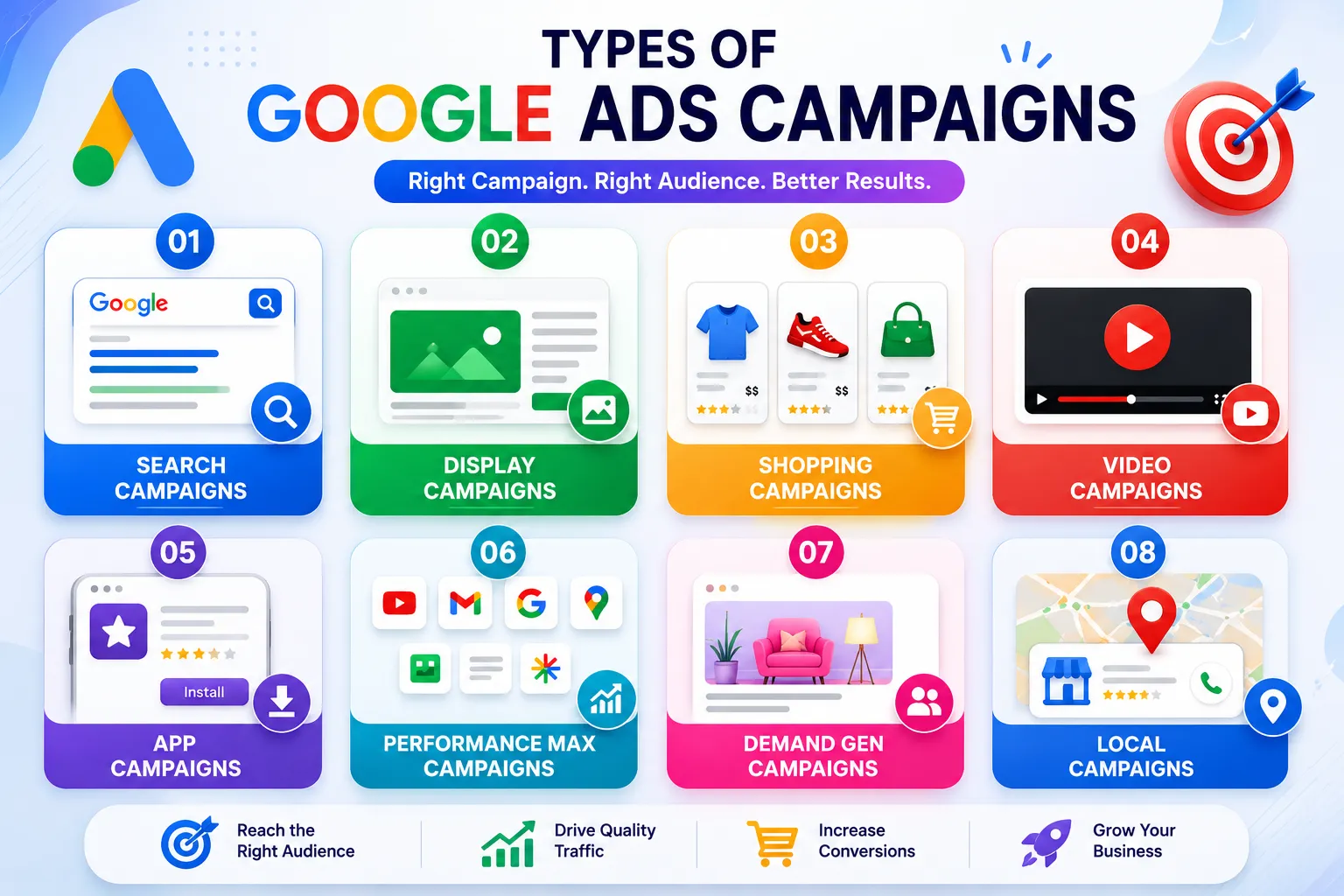
The main Google Ads campaign types are Search, Performance Max, Shopping, Video, Demand Gen, Display, and App campaigns. Businesses with physical locations can also use Google Ads campaigns with local and store-related goals.
Choosing the right campaign type matters because it affects where your ads can appear, how Google optimizes your campaigns, what audiences you can reach, and which business goals you can optimize for.
Google Ads Campaign Types at a Glance
Campaign Type | Best For |
|---|
Search | High-intent leads, sales, and website traffic |
Performance Max | Conversions across multiple Google channels |
Shopping | E-commerce product sales |
Video | Brand awareness, engagement, and video-driven conversions |
Demand Gen | Creating demand and building consideration |
Display | Visual reach and remarketing |
App | App installs and in-app actions |
Local / Store Goals | Store visits, calls, directions, and local actions |
2026 update: Google is transitioning Display advertising toward Demand Gen. Campaign availability and migration options can vary by account, so advertisers should check the latest Google Ads interface and documentation before creating or changing campaigns.
1. Search Campaigns
Google Search campaigns show ads when people search Google for products, services, or information related to what a business offers.
For example, someone searching for "digital marketing agency" may see Search ads from agencies targeting relevant search terms.
Search campaigns are particularly useful for:
Generating leads
Increasing website traffic
Driving sales
Promoting local services
Targeting high-intent searches
Reaching customers who are actively looking for a solution
The main advantage of Search advertising is user intent. Someone who searches for a specific product or service has already demonstrated an interest in that topic.
Best for: Businesses that want to capture existing demand and reach customers who are actively searching.
2. Performance Max Campaigns
Performance Max (PMax) is a goal-based Google Ads campaign that allows advertisers to reach customers across multiple Google advertising channels through one campaign.
Depending on available inventory and campaign settings, Performance Max can serve across surfaces such as Google Search, YouTube, Display, Discover, Gmail, and Google Maps.
Performance Max uses Google's automated bidding, targeting, and machine-learning systems to optimize campaigns toward specified conversion goals.
It can be useful for:
Performance Max is most useful when advertisers have reliable conversion tracking, strong creative assets, accurate product information where relevant, and clearly defined business goals.
Best for: Advertisers looking to drive conversions across Google's available advertising inventory.
3. Shopping Campaigns
Google Shopping campaigns are designed primarily for e-commerce businesses that want to promote physical products.
Shopping ads can display useful product information such as:
Product image
Product name
Price
Store name
Other product details
This gives shoppers a quick idea of what is being sold before they click the advertisement.
Shopping campaigns are commonly used for:
E-commerce sales
Product promotion
Increasing product visibility
Driving qualified store traffic
Reaching shoppers with commercial intent
Retailers generally need product information connected through Google Merchant Center so Google can use accurate product data for advertising.
Best for: Online stores that want to showcase physical products to shoppers who are researching or ready to buy.
4. Video Campaigns
Google Video campaigns allow businesses to advertise using video content, particularly across YouTube.
Video can be especially useful when a business needs to demonstrate a product, explain a service, introduce a brand, or tell a story.
Businesses can use Video campaigns to:
For example, a software company could use a video to demonstrate how its platform works, while an e-commerce brand could showcase a new product.
Best for: Businesses that can communicate their value effectively through demonstrations, storytelling, education, or visual content.
5. Demand Gen Campaigns
Demand Gen campaigns are designed to create interest and consideration before a customer performs a high-intent search.
While Search campaigns primarily capture existing demand, Demand Gen uses visually engaging advertising and audience targeting to reach people earlier in the buying journey.
Demand Gen can help businesses:
Create product interest
Build consideration
Reach new audiences
Promote visually appealing products
Re-engage potential customers
Support awareness and consideration campaigns
A simple way to understand the difference is:
Search captures existing demand, while Demand Gen helps create and develop demand.
For example, someone searching for "buy running shoes online" has clear purchase intent and may be a strong Search audience. Someone interested in fitness content but not actively searching for running shoes could potentially be reached through Demand Gen.
Best for: Brands that want to build awareness, consideration, and product interest among relevant audiences.
6. Display Advertising
Google Display advertising uses visual advertising formats to reach audiences across Google's Display ecosystem and partner inventory.
Display advertising has traditionally been used for:
For example, an online clothing store could use visual advertising to reconnect with people who previously visited its website.
Important 2026 Update
Google is transitioning Display advertising toward Demand Gen, so the way advertisers create and manage these campaigns is changing. Because availability and migration options can vary, advertisers should check the latest Google Ads documentation before launching or restructuring Display campaigns.
Best for: Where available, Display can support visual reach, awareness, and audience-based advertising such as remarketing.
7. App Campaigns
Google App campaigns help businesses promote mobile applications across Google's advertising ecosystem.
Instead of creating separate campaigns for every placement, advertisers provide creative assets and campaign information while Google's systems help identify users who are likely to install or engage with the app.
App campaigns can focus on:
Increasing app installations
Encouraging in-app actions
Re-engaging existing users
Increasing app revenue
They are particularly useful for businesses whose products or services depend heavily on a mobile app.
Best for: Businesses focused on acquiring new app users or increasing engagement from existing users.
8. Local Advertising and Store Goals
Businesses with physical locations can use Google Ads to reach customers searching for products and services in their local area.
Examples include:
Local-focused advertising can help businesses encourage actions such as:
Store visits
Phone calls
Directions
Website visits
Local inquiries
Local advertising is better understood as a strategy and campaign goal rather than simply another campaign type equivalent to Search or Shopping. Businesses can use Search and relevant Performance Max or store-focused goals to support local customer actions.
Best for: Businesses that depend on customers visiting a physical location or contacting a local service provider.
How to Choose the Right Google Ads Campaign
The best campaign depends on your business model, marketing objective, audience, customer journey, budget, creative assets, and conversion data.
A simple way to choose is:
Want leads from people actively searching? → Search
Want to sell physical products online? → Shopping and/or Performance Max
Want conversions across multiple Google channels? → Performance Max
Want to build awareness through video? → Video
Want to create demand and consideration? → Demand Gen
Want to promote a mobile app? → App campaigns
Want local calls, directions, or store visits? → Search and relevant local/store-focused goals
There is no single Google Ads campaign that is best for every business. The right choice depends on where your customers are in the buying journey and what you want them to do.
Search vs. Performance Max vs. Demand Gen
Feature | Search | Performance Max | Demand Gen |
|---|
Main purpose | Capture existing demand | Drive conversions across Google | Create interest and consideration |
User intent | Usually high | Varies | Often earlier-stage |
Main strength | Search intent | Automation and cross-channel reach | Visual audience engagement |
Best for | Leads and sales | Conversions | Awareness and consideration |
Frequently Asked Questions
What are the main types of Google Ads campaigns?
The main Google Ads campaign types are Search, Performance Max, Shopping, Video, Demand Gen, Display, and App campaigns. Businesses with physical locations can also use local and store-focused campaign goals.
Which Google Ads campaign is best for beginners?
There is no universal answer. Search can be a good starting point for businesses that already have customers actively searching for their products or services.
What is the difference between Search and Performance Max?
Search primarily captures existing search demand, while Performance Max uses Google's automated systems to pursue conversion goals across multiple Google advertising channels.
Which Google Ads campaign is best for e-commerce?
E-commerce businesses commonly consider Shopping and Performance Max because they can promote products and pursue online sales.
Which Google Ads campaign is best for local businesses?
Local businesses can use Search, location targeting, and relevant store-focused campaign goals to encourage calls, directions, website visits, and physical store visits.
Final Thoughts
The different Google Ads campaign types are designed for different marketing objectives and stages of the customer journey.
Search is useful for capturing existing demand, Shopping is focused on product promotion and e-commerce, and Performance Max can help drive conversions across Google's advertising inventory. Video supports visual storytelling, Demand Gen helps create interest and consideration, and App campaigns focus on mobile app acquisition and engagement.
The best Google Ads strategy is not simply about finding the lowest cost per click. Businesses should match their campaign type, audience, creative assets, landing pages, conversion tracking, bidding strategy, and business objectives.
When the campaign type matches the customer's intent and the business's goals, Google Ads becomes much more than a source of website traffic—it can become a measurable part of a broader PPC and customer acquisition strategy.
Source & Reference:
Also Read: How Does GEO Differ from Traditional SEO?