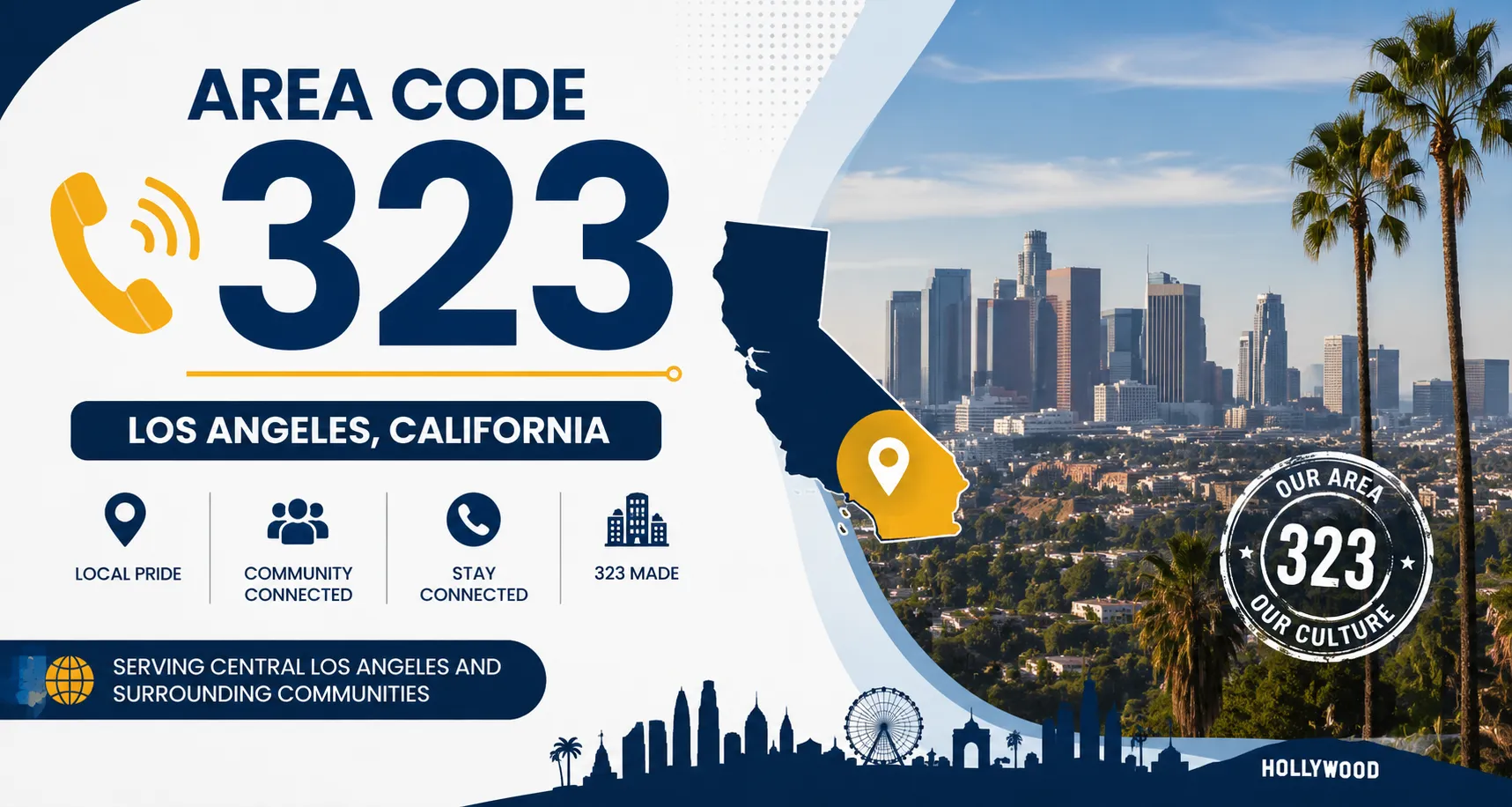
The 323 area is a telephone area code serving central Los Angeles, California, and its surrounding municipalities. Originally created in 1998 as a split from the 213 area code, it now operates as an overlay complex alongside 213 and 738, covering major neighborhoods like Hollywood, Beverly Hills, Montebello, and Huntington Park.
In this guide you will learn:
✓ The specific geographic boundaries and area code 323 location
✓ A brief history of California telecommunication splits and overlays
✓ Answers to common questions regarding a 323 country code and dialing rules
✓ The business benefits of securing a 323 code
✓ A summary of the cities and communities served
Area 323 At a Glance
| Fact | Details |
| Location | Central Los Angeles County, California |
| Time Zone | Pacific Time Zone (PT / UTC-8) |
| Date Established | June 13, 1998 |
| Parent Code | Split from original area code 213 |
| Overlay Codes | 213 (2017) and 738 (2024) |
| Major Cities Served | Los Angeles, Hollywood, Bell, Montebello, South Gate |
| Dialing Rule | 10-digit or 11-digit dialing required (1 + Area Code + Number) |
Introduction to the 323 Code
If you are expanding a business into Southern California or trying to identify an incoming caller ID, you likely need to know the exact location of 323 area code. According to the California Public Utilities Commission (CPUC), the 323 code covers a dense geographic region in the heart of Los Angeles County.
Unlike newer area codes, the 323 prefix carries significant historical and cultural weight, representing the entertainment capital of the United States. This guide breaks down exactly where is 323, how the numbering plan evolved over the last century, and why securing a local presence in this region remains highly valuable for modern businesses.
Where is 323 Area Code Located?
When residents and businesses ask, "where is 323?", the answer points directly to central Los Angeles. The area 323 operates within the Pacific Time Zone (PT) and encompasses a vast array of neighborhoods, municipalities, and unincorporated communities within Los Angeles County.
According to CPUC data, the area code 323 location generally serves the downtown portion of Los Angeles and surrounding cities. Notable communities within this overlay include:
-
Hollywood and West Hollywood
-
Beverly Hills (eastern edges)
-
East Los Angeles
-
Huntington Park and Florence-Graham
-
Montebello and Commerce
-
Bell and Bell Gardens
-
South Gate and Lynwood
The History and Evolution of the 323 Area Codes
To understand the current telecommunications landscape of Los Angeles, it is necessary to look at the history of the original North American Numbering Plan (NANP).
-
1947 (The Original Code): When AT&T devised the first nationwide numbering plan, all of Southern California was assigned the 213 area code.
-
1998 (The Creation of 323): As the population boomed and cell phones became mainstream, the 213 prefix ran out of numbers. On June 13, 1998, the region was officially split. The 213 code was restricted to a geographically tiny area covering just Downtown LA, while the new 323 area codes were created to completely surround it, covering the rest of central Los Angeles.
-
2017 (The Overlay Complex): Because 213 still had available numbers while 323 was exhausting its supply, the CPUC erased the boundary between the two in 2017. They converted the entire region into an overlay, meaning both 213 and 323 serve the exact same central Los Angeles geography.
-
2024 (The 738 Addition): To ensure a continued supply of telephone numbers, the CPUC approved a new area code, 738, which began operating as a third overlay over the combined 213/323 region in November 2024.
Business Benefits of a 323 Local Number
If you operate a business, establishing a presence in the 323 area offers distinct commercial advantages:
-
Local Trust and Brand Identity: Customers in Los Angeles are far more likely to answer calls and trust businesses that display a recognizable local prefix rather than a generic toll-free or out-of-state number.
-
Seamless Virtual Expansion: Thanks to VoIP technology, your company does not need a physical office in California to purchase a 323 code. You can route calls directly to your existing mobile device or call center.
-
Targeting Key Demographics: The region represents a massive economic hub encompassing the film, media, and technology sectors, allowing you to tailor marketing campaigns to a lucrative urban market.
Frequently Asked Questions (FAQ)
1. Is there a 323 country code?
No, there is no 323 country code. The prefix 323 is strictly a domestic area code within the North American Numbering Plan. If dialing internationally to Los Angeles, you must use the United States country code (+1) followed by the 323 area code.
2. Where is area code 323 location exactly?
It covers central Los Angeles County, including Downtown LA, Hollywood, East Los Angeles, Montebello, and Huntington Park.
3. Do I need to dial the area code for local calls within 323?
Yes. Because the region is an overlay complex (sharing 213, 323, and 738), the CPUC mandates 10-digit or 11-digit dialing (1 + area code + 7-digit number) for all local calls.
4. Is the 323 code toll-free?
No, numbers with this prefix are standard local numbers. Callers from outside the local calling area will be charged standard long-distance rates by their carriers.
5. What time zone is the 323 area?
The entire region operates in the Pacific Time Zone (PT), following Pacific Standard Time (PST) in the winter and Pacific Daylight Time (PDT) during the summer.
Also Read: Where is Area Code 415?
Also Read: Area Code 855
Also Read: Where is the 844 area code?