We've all used this phrase. But most answers to this question stay shallow. This one won't.
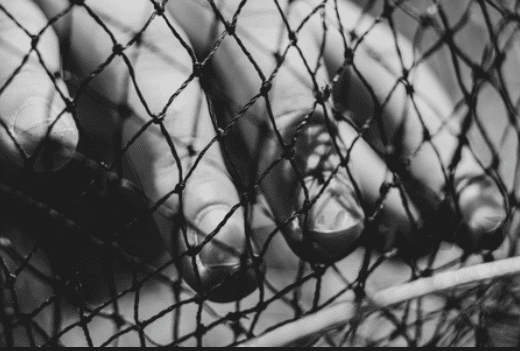
Being a victim of circumstances means suffering real harm from events that were completely outside your control — you did not cause it, you did not choose it, and you could not have stopped it. A victim of circumstance is an individual who suffers ill consequences because of factors that were out of their control — they encountered a harmful situation without seeking it out.
That's the simple definition. But the psychology behind it — and what separates genuine victimhood from a self-defeating mindset — is far more important to understand.
The Science: What Happens in the Brain of a Victim
Psychology has studied this for over 50 years. Here's what the research actually says.
Learned Helplessness — Seligman & Maier (1967)
First described in 1967 by psychologists Overmier and Martin Seligman, learned helplessness was identified as a syndrome with three key features: a motivational deficit (failure to respond to challenges), an associative deficit (inability to learn from successful coping), and an emotional deficit (apparent underreactivity to painful events).
In the 1970s, Seligman extended this concept to clinical depression in humans — people repeatedly exposed to stressful situations beyond their control develop an inability to make decisions or engage effectively in purposeful behavior.
This is the brain science behind why some people stop trying after repeated failures. It's not weakness. It's a conditioned neurological response to uncontrollable events.
Locus of Control — Julian Rotter (1966)
Julian Rotter introduced locus of control into psychology in 1966, defining it as: "the degree to which persons expect that a reinforcement or an outcome of their behavior is contingent on their own behavior or personal characteristics vs. the degree to which persons expect that the reinforcement or outcome is a function of chance, luck, or fate."
In plain terms:
- Internal locus = "I control what happens to me"
- External locus = "Things just happen to me"
Rotter found that individuals with an internal locus of control are generally more resilient to emotional stressors, while an external locus of control has been associated with higher rates of psychological distress, including anxiety and depression.
Victims of circumstance almost always shift toward external locus — temporarily. The danger is when that shift becomes permanent.
Introducing: The Victim → Survivor → Creator Model
(Proprietary framework by Nakul Chauhan, Letsdiskuss)
Most psychology discussions treat this as a binary — you're either a victim or you're not. That's wrong. It's a spectrum with three identifiable stages.
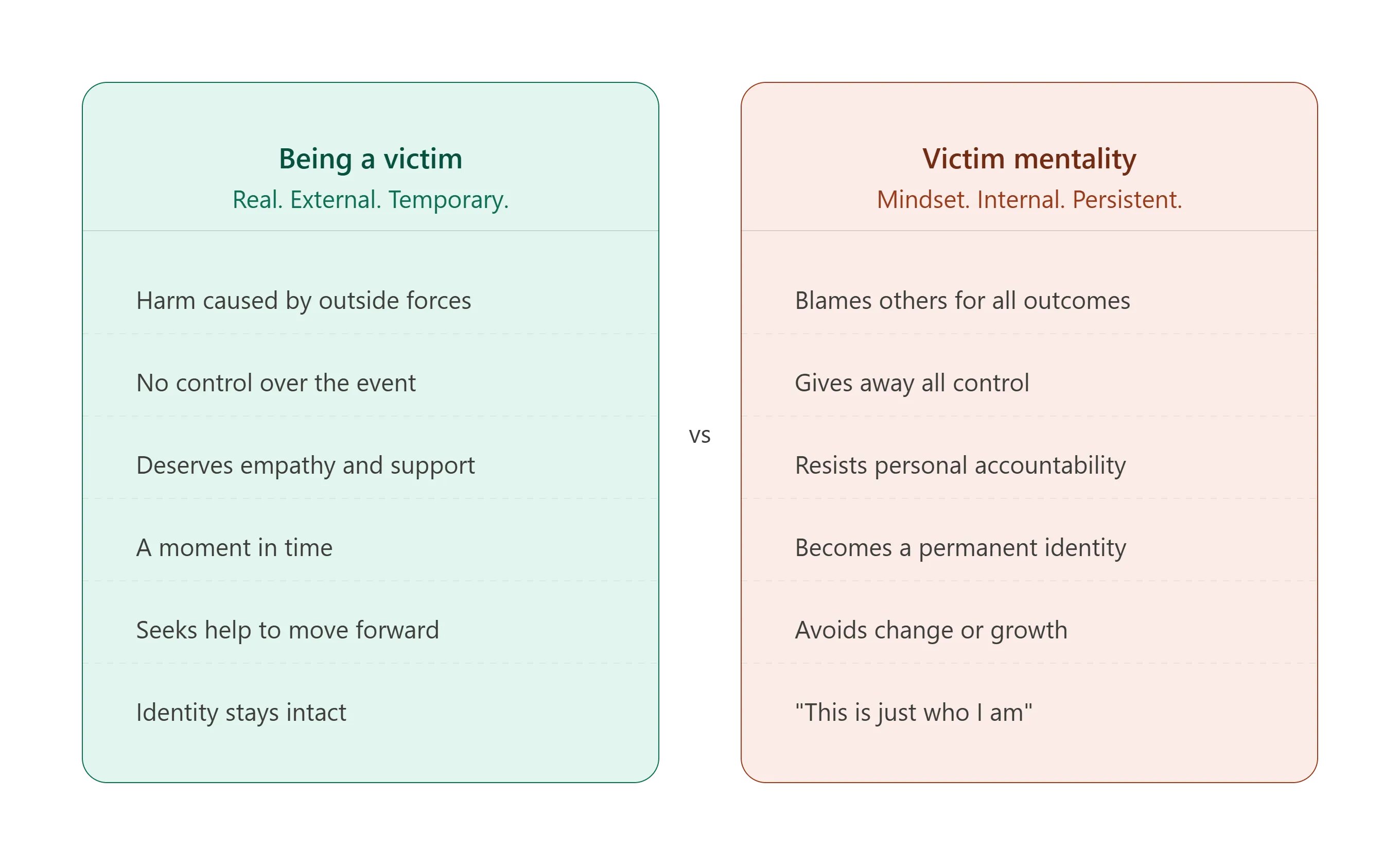
Stage 1 — Victim Something real happened. You had no control. Your locus of control shifts external. Learned helplessness may set in. This stage deserves empathy — not dismissal.
Stage 2 — Survivor Awareness begins. You recognize what happened without letting it define all future outcomes. Cognitive reframing starts. This is where therapy (especially CBT) intervenes most effectively.
Stage 3 — Creator You reclaim internal locus of control. The experience is integrated into your identity as a source of strength, not damage. Post-traumatic growth becomes possible.
Most people get stuck between Stage 1 and Stage 2. The goal is not to skip Stage 1 — that's denial. The goal is to move through it.
The Circumstance Identity Trap
Here is where real damage happens — and nobody talks about it clearly enough.
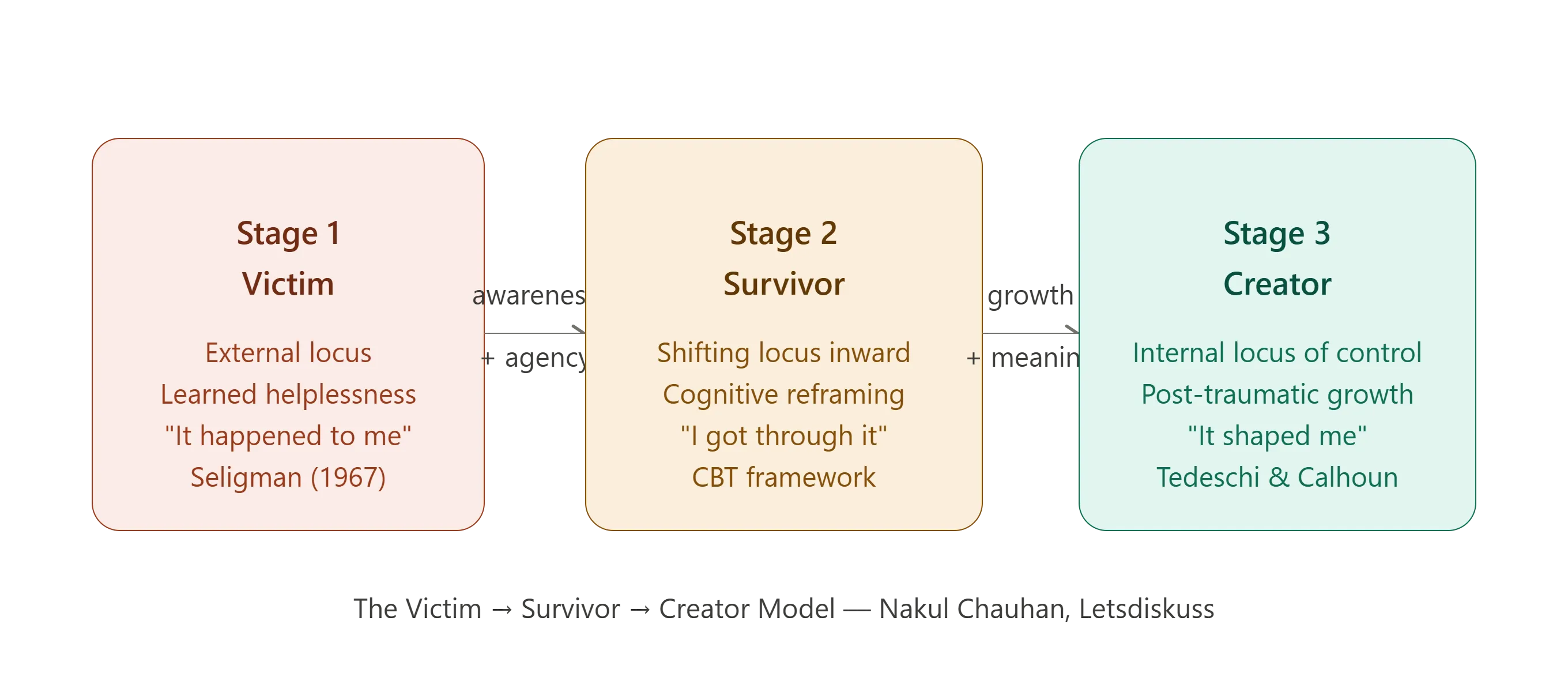
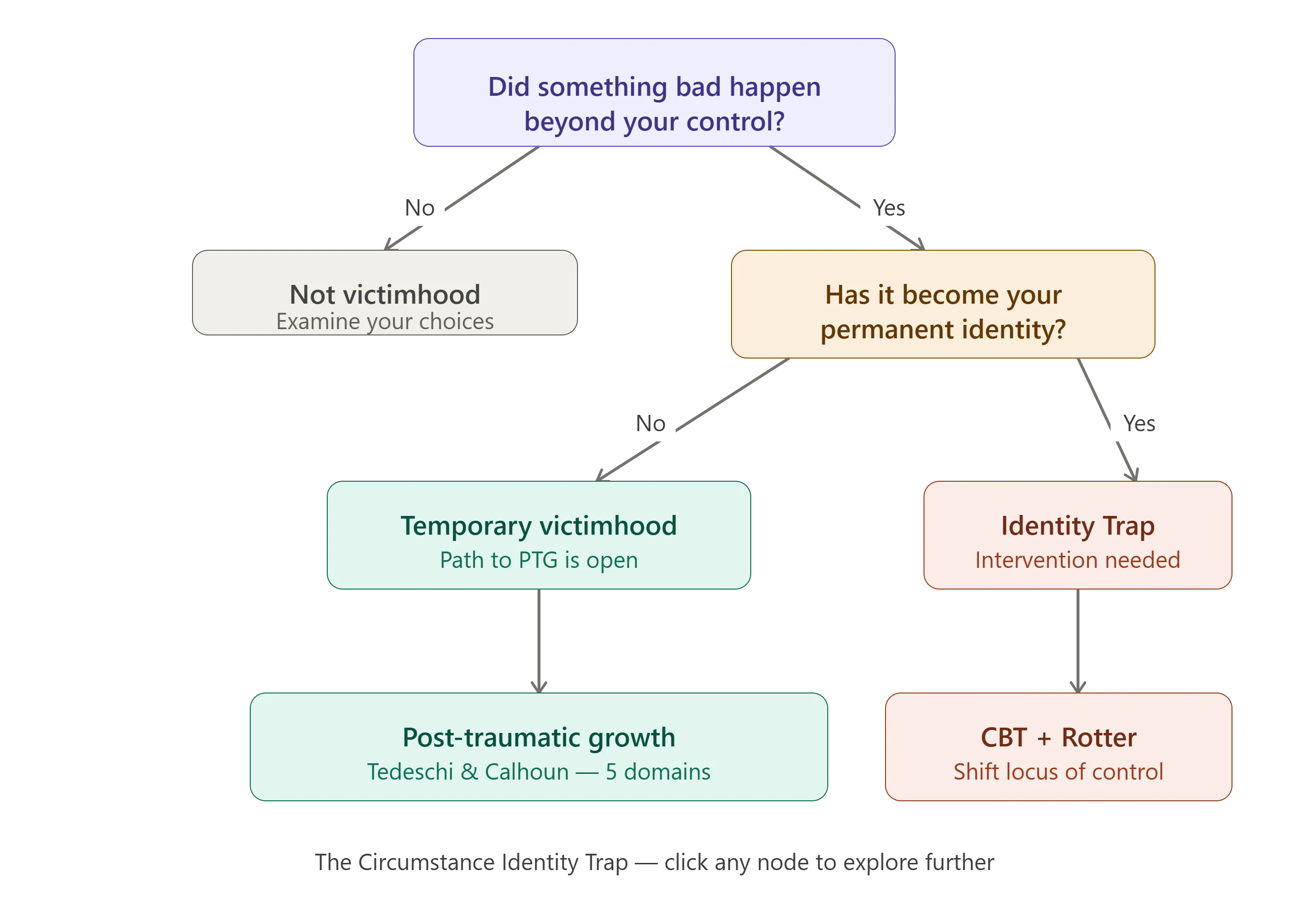
The Circumstance Identity Trap occurs when a temporary, real victim experience hardens into a permanent self-concept. The person stops being someone who experienced harm and becomes someone who is harmed, by definition, forever.
Signs you or someone else is in this trap:
- Every new failure is explained by the original event
- Growth is resisted because it would "disprove" the suffering
- Sympathy and recognition are sought more than solutions
- The phrase "that's just how I am because of what happened" is used to block change
Victim mentality is a psychological concept referring to a mindset in which a person tends to recognize or consider themselves a victim of the actions of others — including a tendency to blame misfortunes on others. It can develop as a defense mechanism to cope with negative life events.
This is not a character judgment. It's a documented psychological pattern — and it's breakable.
Post-Traumatic Growth: The Research Most People Miss
Here's what the literature shows that most self-help articles never mention: suffering can produce genuine psychological expansion.
Post-traumatic growth (PTG) is defined as positive psychological change experienced as a result of the struggle with highly challenging life circumstances or traumatic events (Calhoun & Tedeschi, 1999).
Research has established that positive changes from PTG manifest across five domains: recognition of new possibilities, greater appreciation of life, closer interpersonal relationships, increased sense of personal strength, and spiritual development (Tedeschi & Calhoun, 1996).
It has been estimated that up to 70% of the global population have been exposed to at least one traumatic event — and a growing number of studies have demonstrated that some individuals exposed to traumatic events can also experience post-traumatic growth.
This is the research-backed answer to "what comes after being a victim?" — not just recovery, but documented growth in people who were genuinely victimized.
The CBT Perspective: How to Actually Shift
Cognitive Behavioral Therapy gives us the most practical tools for moving through the victim stage.
The core CBT insight: your circumstances don't determine your response. Your interpretation of circumstances does. And interpretation is trainable.
Three CBT-aligned shifts:
- Event → Thought → Feeling → Behavior — Break the automatic link between "bad thing happened" and "I am broken"
- Cognitive restructuring — Challenge catastrophizing. "This ruined my life" vs "This changed my path"
- Behavioral activation — Take one small action within your control. Even micro-agency rebuilds internal locus
These aren't platitudes. They're documented clinical interventions with strong evidence bases.
What Genuine Victimhood Looks Like vs What It Doesn't
Genuine victim of circumstances:
- Job lost due to company shutdown — you had no warning and no choice
- Health crisis that appeared without warning
- Natural disaster, accident, or crime
- Systemic injustice that blocked opportunity
Not victimhood — but often mislabeled as it:
- Consequences of choices you made, then regret
- Outcomes you could have changed but didn't act on
- Using past genuine victimhood to avoid current accountability
The distinction matters because conflating them prevents real help from reaching people who need it, and prevents growth in people who are capable of it.
The Bottom Line
Being a victim of circumstances is real, valid, and deserves acknowledgment. Seligman's research proved the brain literally learns helplessness under repeated uncontrollable stress. Rotter showed us that locus of control shifts — and that this shift has measurable consequences for mental health.
But Tedeschi and Calhoun proved something equally important: human beings are capable of post-traumatic growth. Not despite their circumstances, but through the struggle with them.
The circumstance is not the prison. Staying permanently defined by it is.
Where you are on the Victim → Survivor → Creator spectrum right now is not fixed. That is the most important thing this article can tell you.