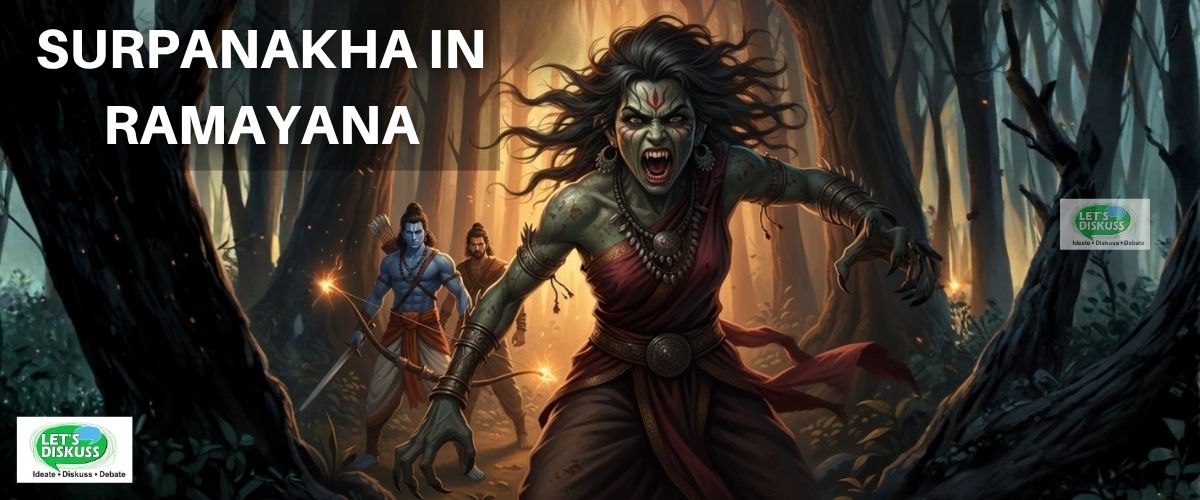
When I first read about Surpanakha in Ramayana, I remember feeling oddly conflicted. On one side, there was the “demoness” who tried to harm Sita, and on the other, a woman who dared to express love in a world that expected her to stay quiet. The more I thought about her, the more I realized how relevant her story still feels today.
We often remember Surpanakha as the reason Ravana declared war on Rama, but we rarely pause to ask who she really was. Her story, in many ways, is a reflection of how society treats rejection, desire, and shame—things that still make people uncomfortable, even now.
Who is Surpanakha?
In every version of the story of Surpanakha, she’s introduced as Ravana’s sister, born to Sage Vishrava and Kaikesi. But I see her as more than that. She was a woman who grew up surrounded by power yet never truly belonged anywhere—too fierce for the saints, too emotional for the demons.
When I read about who is Surpanakha, it reminded me of people who never quite fit the mold. The ones labeled as “too much” or “too emotional” because they refuse to shrink themselves. In her case, that defiance became her curse.
The Meaning Behind Her Name
The Surpanakha meaning is “sharp-nailed” or “sharp-featured.” But Her Surpanakha real name —Meenakshi, meaning “fish-eyed beauty”—paints a different picture altogether. It’s strange how one incident changed not only her life but even her name.
In a way, that’s what happens in real life too. One mistake, one misunderstood action, and people forget everything else you were before that. She went from being Meenakshi to “Surpanakha,” just as some people go from “brilliant” to “difficult” the moment they step out of line.
Surpanakha’s Early Life and Marriage
Before her infamous encounter with Rama, Surpanakha lived a fairly normal life—at least by Rakshasa standards. She was married to Dushtabuddhi, and many texts mention his name as the Surpanakha husband name. He was a brave prince but arrogant, and Ravana killed him for disobedience.
That loss shaped her deeply. When I think of her loneliness after losing her husband, I picture someone trying to find love again, not out of lust but longing. That makes her story less mythical and more human. Haven’t we all, at some point, reached for the wrong person just because we were tired of being alone?
The Forest Encounter That Changed Everything
The turning point of the Surpanakha story is when she encounters Rama and Lakshmana when they are on exile. She is captivated when she looks at Rama. She comes out to say that she wants to marry him. That scene is something that I find myself halting every time- not by the audacity she portrays, but by the nature in which the tale handles it.
Rama mildly declines by claiming he is committed to Sita. Lakshmana mocks her. When she flings herself at Sita with her jealousy and cuts off her nose and ears, Lakshmana strikes back by chopping off her nose and ears.
Many people focus on the violence she provoked, but I always think about the humiliation she felt. In that one act, she lost her beauty, her pride, and her sense of self. I once saw a colleague go through public embarrassment at work; though her situation wasn’t violent, the shame in her eyes looked similar—raw, consuming, unforgettable.
Who Killed Surpanakha? The Truth Behind It
People often ask who killed Surpanakha, but the truth is—no one did. She wasn’t killed, only disfigured. But sometimes, a wound that doesn’t kill you changes you even more.
After her nose was cut, she became the voice that carried rage back to Lanka. Her pain set everything in motion. Ravana’s anger over his sister’s insult led to the abduction of Sita, and eventually, to the war that destroyed him.
It’s strange how one woman’s humiliation became the foundation for an epic battle. I’ve seen smaller versions of that play out in real life too—how one insult, one harsh word, can set off a chain of consequences that no one can take back.
What Happened to Surpanakha After Ravana’s Death?
Very few people talk about what happened to Surpanakha after Ravana death. Once the war ended, she was neither killed nor celebrated. Some versions say she went back to the forest, living alone until she faded into myth. Others suggest she turned inward, spending her days in remorse.
I like to believe she found peace eventually. Not forgiveness from others, but from herself. When I think of Surpanakha in her later years, I imagine someone sitting quietly, reflecting on how one impulsive act shaped so many lives. There’s a strange kind of redemption in solitude.
Is Surpanakha Still Alive?
Legends are like, is Surpanakha still alive? Naturally not literally, but perhaps in stories still she is. Even some of the folk tales in South India venerate her as a goddess who protects the forests. People tell us that she is still roaming because she is an embodiment of anger that will never die.
I believe that Surpanakha still lives in a different form of being in every person who has ever felt rejected, shamed, and misunderstood. She is the other half of us that does not know how to take rejection with dignity and yet wants to be noticed.
What Her Story Teaches Us
The story of Surpanakha isn’t just about a demoness. It’s about being human. She was not evil, she was quick, emotional, fallible--as we all are.
When I read her Ramayana, I consider the fact that we are too fast to criticize women who declare what they want concerning women. In the modern world, trusting a woman is viewed as arrogance and passion as danger even today. The punishment that Surpanakha got was not only physical but also a form of silencing her on the part of society as she desired too much.
The reader can easily sympathize with Rama or Lakshmana as they are the heroes. However, you stand up in her shoes, at least temporarily, and things become different. It is not so much about the divine justice but about the pain of people.
Surpanakha’s Role in Destiny
Without Surpanakha in Ramayana, there would have been no abduction of Sita, no war in Lanka, and no final victory of good over evil. In that sense, she became the spark that lit the epic.
It’s ironic, isn’t it? The woman everyone blamed was also the one who made the story possible. I see a bit of that irony in life too—how sometimes the people who seem to “cause trouble” are actually the ones who push things toward change.
In that way, Surpanakha was not just Ravana’s sister. She was destiny’s messenger.
My Takeaway from Surpanakha’s Story
Whenever I go back to Surpanakha in Ramayana, I find myself contemplating the empathy. Her experience makes me remember that I should not judge the book by its cover. Not all outbursts are motivated by malice, sometimes it is merely pain, which is searching the means of expression.
The little bit of Surpanakha that we all have inside of us is the part that desires to be loved, the part that responds when we disdain them, and the part that is judged too soon. The question is what we do after being hurt.
Perhaps, this is why her story continues to live. Not that she was evil, but that she was real.
Conclusion: The Forgotten Voice of the Ramayana
Finally, Surpanakha in Ramayana is not just a mythological story. It is a mirror to the human feelings, love, rejection, shame, and revenge.
She was not the boogey woman history had built her to be. She was a woman who happened to do wrong, had to endure cruelty and still managed. I do not see a demoness when I thought of her. I recognize someone that, like us all, simply wanted to be recognized and taken in.
And perhaps, that is the most human thing about her.