A content cluster in SEO is a group of closely related web pages organized around a central topic. It usually consists of a pillar page, supporting cluster content, and contextual internal links connecting the pages.
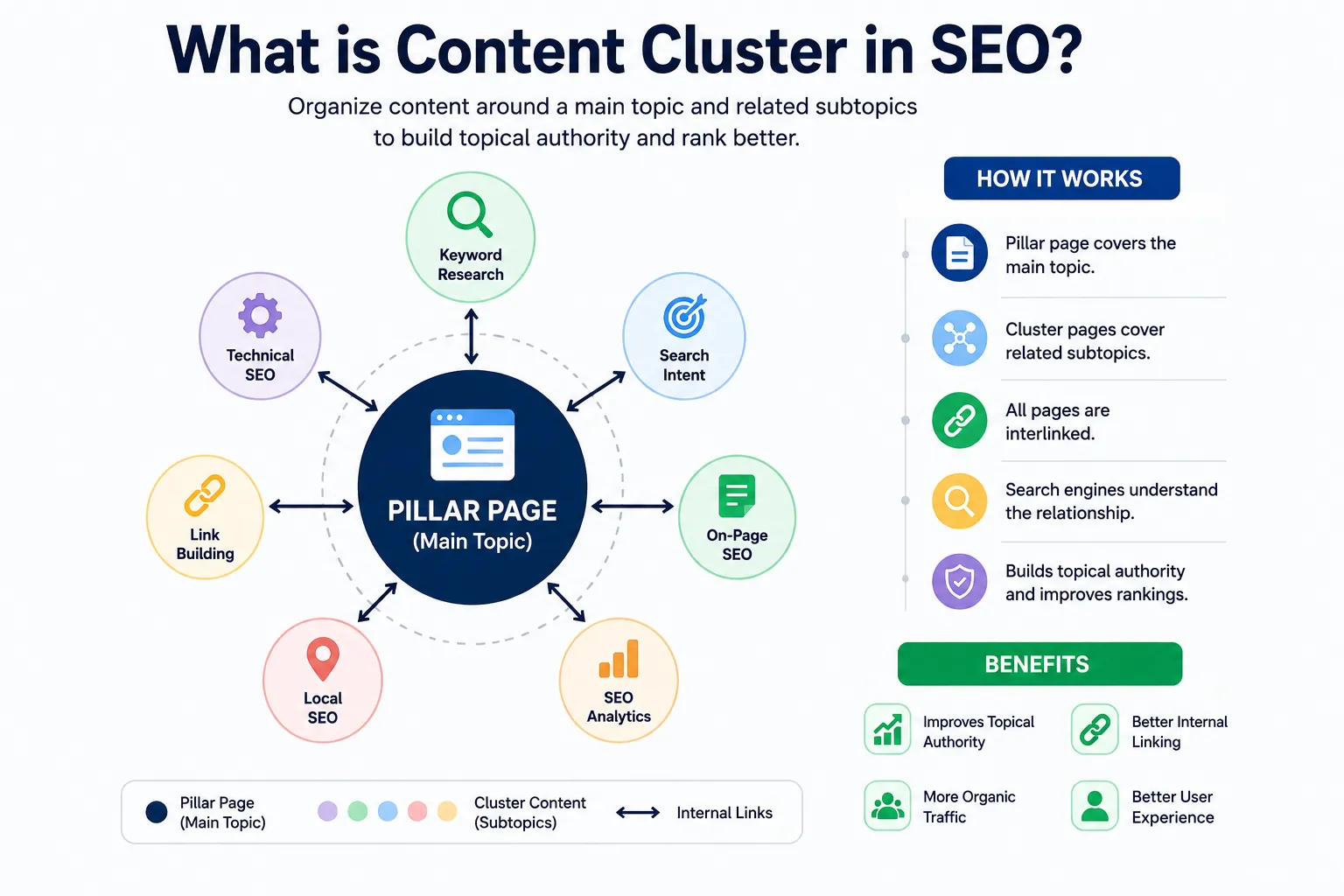
For example, a website about SEO could create a pillar page called “Complete Guide to SEO” and support it with detailed articles about keyword research, technical SEO, search intent, on-page SEO, link building, local SEO, and structured data.
The goal of a content cluster is not simply to publish more articles. It is to organize useful information around a topic so users can easily discover related resources and search engines can better understand the relationship between the pages.
What Are the Main Parts of a Content Cluster?
A content cluster has three core components:
1. Pillar Page
The pillar page is the central resource covering the broad topic.
For example:
Complete Guide to SEO
It might introduce keyword research, technical SEO, on-page SEO, link building, local SEO, and SEO analytics. Each section can link to a more detailed supporting article.
The pillar page provides an overview rather than trying to answer every subtopic in maximum depth.
2. Cluster Content
Cluster content consists of detailed pages covering specific subtopics, questions, or search intents related to the main topic.
For an SEO cluster, these could include:
What Is Keyword Research?
How to Do Keyword Research
What Is Search Intent?
What Is Technical SEO?
How Does Link Building Work?
What Is Local SEO?
What Is Schema Markup?
What Are Core Web Vitals?
Each page should satisfy a distinct user need. You should not create a separate page for every keyword variation if multiple keywords have essentially the same search intent.
3. Internal Linking
Internal linking connects the pillar page and cluster pages.
For example:
SEO Guide → Keyword Research → Search Intent → Keyword Mapping
A keyword research article can link back to the main SEO guide and to other closely related resources.
These contextual links create a logical information architecture and help users discover relevant information.
Example of a Content Cluster
Suppose your website focuses on SEO.
Pillar page:
Complete Guide to SEO
Cluster pages:
Keyword Research
Search Intent
Technical SEO
On-Page SEO
Off-Page SEO
Link Building
Local SEO
Schema Markup
Core Web Vitals
Internal Linking
The important point is that these pages should not exist as isolated blog posts. They should be connected when the relationship is genuinely useful to the reader.
Why Are Content Clusters Important for SEO?
Content clusters can improve the organization, discoverability, and topical coverage of a website.
Instead of publishing unrelated articles around individual keywords, a cluster allows a website to cover a broader subject through multiple interconnected resources.
For example, a website with one general article about SEO provides limited coverage. A website with a strong SEO guide supported by useful resources about technical SEO, keyword research, search intent, local SEO, and internal linking provides a more comprehensive resource.
However, more pages do not automatically mean better rankings.
Content quality, relevance, originality, helpfulness, authority, and satisfying search intent remain important. A cluster should therefore focus on useful topical coverage rather than content volume.
Content Clusters and Search Intent
A strong content cluster should be based on search intent, not just keyword variations.
Search intent describes what the user wants to accomplish.
Common types include:
Informational: The user wants to learn something, such as “What is technical SEO?”
Navigational: The user wants to find a specific website or page.
Commercial: The user is researching options, such as “Best SEO tools.”
Transactional: The user is ready to take an action, such as purchasing a product or service.
For example, “What is technical SEO?” and “Best technical SEO tools” are related to the same broad topic but have different intents. They may therefore require different pages.
This approach helps prevent unnecessary duplicate content and keyword cannibalization.
Content Clusters and Semantic SEO
Content clusters are closely related to semantic SEO, which focuses on relationships between concepts, entities, topics, and meanings rather than repeating exact-match keywords.
For example, a digital marketing cluster might cover:
SEO
Content Marketing
Email Marketing
Social Media Marketing
Paid Advertising
Conversion Optimization
Analytics
The goal is not to force all related keywords into one article. Instead, related concepts should be organized into useful pages and connected where appropriate.
The better question is not:
“How many times should I use my keyword?”
It is:
“Does this content comprehensively and accurately satisfy the user's need?”
How to Create a Content Cluster
A practical process looks like this:
Step 1: Choose a broad topic.
Select a subject relevant to your business, audience, products, services, and expertise.
Step 2: Create the pillar page.
Build a comprehensive overview of the main topic.
Step 3: Research subtopics.
Use keyword research, search results, customer questions, competitor research, forums, and existing website data.
Step 4: Group topics by search intent.
Determine whether each topic deserves its own page or can be covered within an existing resource.
Step 5: Create valuable cluster content.
Each page should provide a focused, useful, and original answer to a specific user need.
Step 6: Add contextual internal links.
Connect related pages naturally rather than linking every page to every other page.
Step 7: Update the cluster.
Review important pages periodically and update outdated information, statistics, tools, examples, and recommendations.
Common Content Cluster Mistakes
Avoid these common problems:
Creating a page for every keyword variation when several keywords have the same intent.
Publishing thin content simply to increase the number of cluster pages.
Overusing internal links without considering whether they help the reader.
Covering irrelevant topics that are only loosely connected to the main subject.
Focusing on quantity instead of quality.
Ignoring search intent when deciding which pages to create.
A content cluster should be built around genuine information needs, not an arbitrary number of articles.
Frequently Asked Questions
How many pages should a content cluster have?
There is no fixed number. Create as many useful pages as necessary to cover meaningful subtopics and search intents. Quality is more important than quantity.
Do content clusters improve rankings?
Content clusters do not guarantee rankings. However, they can create better information architecture, internal linking, topical coverage, and content discoverability.
Is a pillar page the same as a content cluster?
No. The pillar page is the central page, while the content cluster is the complete interconnected group of the pillar and supporting pages.
Should every keyword have its own page?
No. If multiple keywords have the same search intent, one strong page may be better than several overlapping pages.
Final Thoughts
A content cluster in SEO is more than a collection of related blog posts. It is a structured content architecture built around a central topic, with supporting pages addressing specific user needs and contextual internal links connecting them.
A successful content cluster focuses on search intent, topical relevance, semantic relationships, useful internal linking, content quality, and genuine expertise.
The goal is not to publish the most pages. The goal is to build a useful, trustworthy, and well-connected resource that comprehensively serves your audience.
Also Read: How Does GEO Differ from Traditional SEO?