
ICU (Intensive Care Unit) and CCU (Coronary Care Unit or Cardiac Care Unit) are both specialized hospital units that provide 24-hour monitoring and treatment for critically ill patients. However, the main difference is the type of patients they treat.
An ICU cares for patients with a wide range of life-threatening medical and surgical conditions, including severe infections, respiratory failure, major trauma, stroke, multi-organ failure, and post-operative complications. In contrast, a CCU is a specialized unit dedicated primarily to patients with serious heart-related conditions, such as heart attacks, heart failure, dangerous heart rhythm disorders, and recovery after cardiac surgery.
It's worth noting that hospital terminology can vary. In many hospitals, CCU stands for Cardiac (or Coronary) Care Unit, while in some hospitals or countries, CCU may also mean Critical Care Unit, which functions similarly to an ICU. Always refer to the hospital's terminology for the exact meaning.
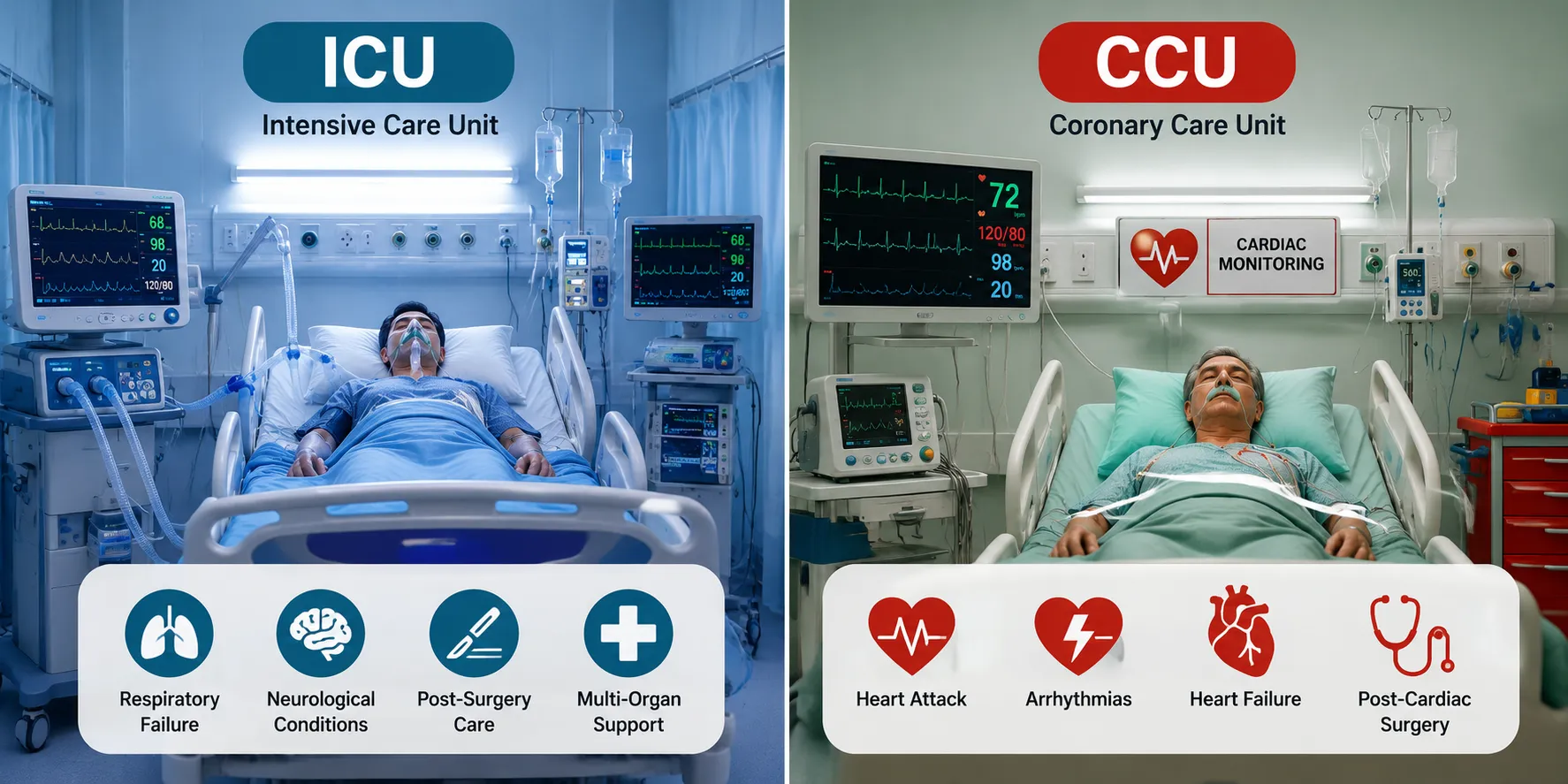
| Feature | ICU | CCU |
|---|---|---|
| Full Form | Intensive Care Unit | Coronary Care Unit or Cardiac Care Unit* |
| Main Purpose | Treats critically ill patients with various life-threatening conditions | Specializes in serious heart-related conditions |
| Patients | Medical, surgical, trauma, neurological, respiratory, and multi-organ cases | Heart attack, heart failure, arrhythmias, cardiac surgery patients |
| Specialists | Intensivists, critical care physicians, surgeons, pulmonologists, neurologists | Cardiologists, cardiac intensivists, cardiac surgeons |
| Monitoring | Continuous monitoring of multiple organ systems | Continuous cardiac monitoring with advanced heart care |
| Equipment | Ventilators, dialysis machines, infusion pumps, multi-parameter monitors | Cardiac monitors, ECG systems, temporary pacemakers, defibrillators, ventilators (if required) |
| Length of Stay | Depends on illness severity | Depends on cardiac condition and recovery |
*In some hospitals, CCU may instead refer to a Critical Care Unit, which is functionally similar to an ICU.
Intensive Care Unit (ICU)
An Intensive Care Unit (ICU) is a specialized hospital department that provides advanced medical care for patients with life-threatening illnesses or injuries. ICU patients require constant monitoring, specialized equipment, and immediate medical intervention because one or more vital organs may not be functioning normally.
Coronary Care Unit (CCU)
A Coronary Care Unit (CCU), also called a Cardiac Care Unit, is a specialized critical care unit that focuses exclusively on patients with severe heart and cardiovascular conditions. Healthcare professionals working in CCUs have advanced training in managing complex cardiac emergencies and recovery after heart procedures.
Similarities
Although ICU and CCU have different specialties, they share several important features.
-
Provide 24-hour patient monitoring.
-
Care for critically ill patients.
-
Use advanced life-support equipment.
-
Staffed by specially trained doctors and nurses.
-
Monitor vital signs continuously.
-
Can provide ventilator support when needed.
-
Maintain a low nurse-to-patient ratio for close observation.
-
Aim to stabilize patients and prevent life-threatening complications.
Admission Criteria
Patients are admitted to either unit based on their medical condition.
ICU Admission
Patients may be admitted for:
-
Severe infections (sepsis)
-
Respiratory failure
-
Stroke
-
Multi-organ failure
-
Major trauma
-
Serious burns
-
Complicated surgeries
-
Poisoning or overdose
-
Neurological emergencies
CCU Admission
Patients may be admitted for:
-
Heart attack (myocardial infarction)
-
Heart failure
-
Serious cardiac arrhythmias
-
Unstable angina
-
Recovery after heart surgery
-
Cardiogenic shock
-
Other critical cardiovascular conditions
Doctors determine the most appropriate unit based on the patient's diagnosis, organ involvement, and the level of monitoring required.
Common Misconceptions
"ICU and CCU are exactly the same."
Not always.
In many hospitals, ICU provides broad critical care, while CCU focuses specifically on cardiac patients. However, some hospitals use CCU to mean Critical Care Unit, making it functionally similar to an ICU.
"Only heart attack patients go to the CCU."
Not true.
CCUs also treat patients with heart failure, severe arrhythmias, cardiogenic shock, and those recovering from cardiac surgery.
"Every ICU patient is on a ventilator."
No.
Many ICU patients require close monitoring but may not need mechanical ventilation. Treatment depends on the underlying condition.
"Being admitted to the ICU or CCU means recovery is impossible."
Incorrect.
Admission to these units simply indicates that a patient requires specialized monitoring and advanced medical care. Many patients recover and are later transferred to general wards as their condition improves.
Frequently Asked Questions (FAQs)
1. What is the main difference between ICU and CCU?
The ICU treats patients with a wide range of critical illnesses, whereas the CCU specializes in serious heart and cardiovascular conditions.
2. Which is more serious, ICU or CCU?
Neither is inherently more serious.
Both units care for critically ill patients. The choice depends on the type of medical condition rather than its severity.
3. Can a patient be moved from the CCU to the ICU?
Yes.
If a cardiac patient develops complications affecting other organs, or requires broader intensive care, doctors may transfer the patient to the ICU. Likewise, ICU patients with specialized cardiac needs may be transferred to a CCU if appropriate.
4. Who works in the ICU and CCU?
ICUs are staffed by intensivists, critical care nurses, respiratory therapists, and specialists from multiple disciplines. CCUs include cardiologists, cardiac intensivists, cardiac nurses, and cardiac surgeons, along with other critical care professionals.
5. Do all hospitals have a separate CCU?
No.
Large hospitals often have dedicated CCUs, while smaller hospitals may treat cardiac patients within a general ICU or combined critical care unit.
Both the ICU and CCU are specialized hospital units designed to provide continuous, life-saving care for critically ill patients, but they serve different purposes. The ICU manages a broad range of severe medical and surgical conditions affecting multiple organ systems, while the CCU focuses specifically on advanced care for patients with serious heart and cardiovascular diseases. Although the names and organization of these units may vary between hospitals, understanding their primary roles can help patients and families better navigate critical care decisions and hospital admissions.
Must Read: Top 10 Hospitals in Gurgaon: Find the Best Healthcare for Your Needs
 Answered by