
The Law of Conservation of Mass states that mass can neither be created nor destroyed in a chemical reaction; it can only be rearranged or changed from one form to another. In a closed system, the total mass of all substances before a chemical reaction is equal to the total mass after the reaction.
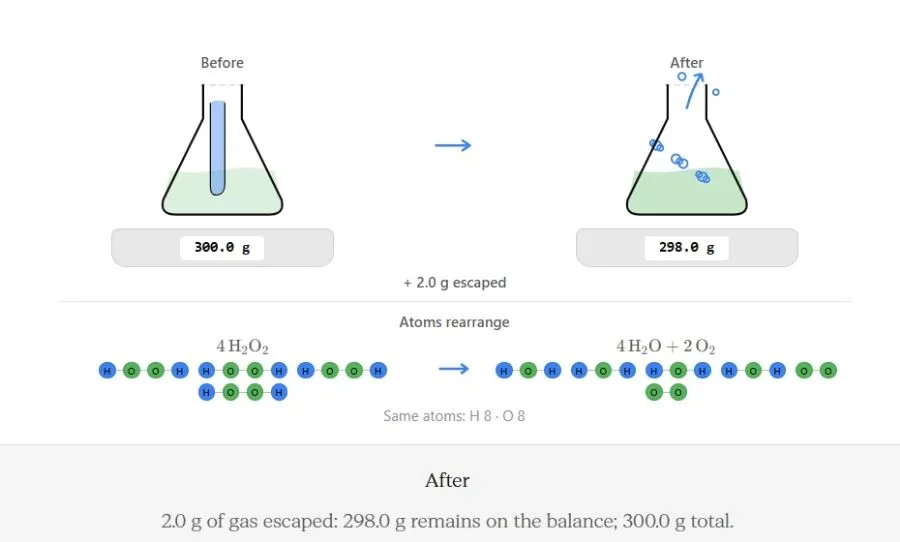
This means that during an ordinary chemical reaction, atoms are rearranged to form new substances, but the total amount of matter remains the same.
Why Is the Law of Conservation of Mass Important?
The law is an important principle of chemistry because it helps us understand chemical reactions and balance chemical equations. It is strongly associated with the work of French chemist Antoine Lavoisier, whose experiments helped establish the idea that matter is conserved during chemical changes.
1. Total Mass Is Conserved
In a closed system, the total mass remains constant during a chemical reaction.
For example, if 10 g of reactants take part in a reaction inside a closed container, the total mass of the products will also be 10 g.
The substances may look different after the reaction, but the total mass remains the same.
2. Atoms Are Rearranged
Chemical reactions do not normally create or destroy atoms. Instead, the atoms present in the reactants are rearranged into new combinations to form products.
For example, hydrogen and oxygen can react to form water. The hydrogen and oxygen atoms are still present; they are simply arranged differently in the water molecules.
3. It Helps Us Balance Chemical Equations
The law of conservation of mass explains why chemical equations must be balanced. The number of atoms of each element must be the same on both sides of a chemical equation.
For example:
2H₂ + O₂ → 2H₂O
On the left side, there are 4 hydrogen atoms and 2 oxygen atoms. On the right side, there are also 4 hydrogen atoms and 2 oxygen atoms.
This shows that the atoms have been rearranged, not lost or created.
Closed and Open Systems
The conservation of mass is easiest to observe when we consider a closed system, where matter cannot enter or leave.
System | What Happens to Measured Mass? |
|---|---|
Closed system | Total mass remains constant |
Open system | Measured mass may change if matter enters or leaves |
For example, if a chemical reaction produces a gas in an open container, the gas may escape. The container may then appear to have less mass. However, the gas has not disappeared—it has simply moved outside the system being measured.
Simple Example
Imagine 100 g of wood and the required oxygen reacting inside a completely closed container. After the reaction, the total mass of everything inside the container remains equal to the total mass that was present before the reaction.
New substances, such as gases, ash, and other products, may form, but the total mass is conserved.
Conclusion
The Law of Conservation of Mass is a fundamental principle of chemistry. It states that, in a closed system, the total mass before a chemical reaction is equal to the total mass after the reaction.
During an ordinary chemical reaction, matter is not simply lost or created. Instead, atoms are rearranged to form new substances. This principle is also the reason chemical equations must be balanced.
Also Read: what is ligament?