
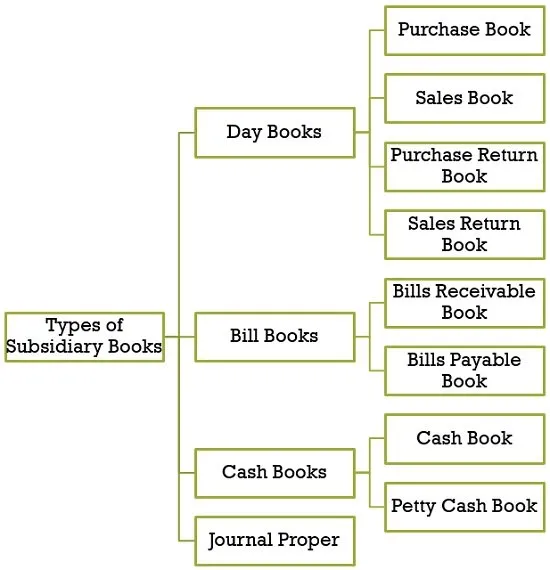
A subsidiary book is an accounting book used to record transactions of a similar nature in a business before they are posted to the ledger. It is also known as a book of original entry or book of prime entry. Subsidiary books help businesses organize financial transactions, reduce the workload of maintaining the journal, and make accounting records easier to manage.
In a business, many transactions take place every day, such as purchasing goods, selling products, receiving cash, making payments, and returning goods to suppliers. Recording all these transactions in a single journal can be time-consuming and difficult to manage. Therefore, businesses use different subsidiary books to record specific types of transactions separately.
Types of Subsidiary Books
There are several types of subsidiary books used in accounting. Each book records a particular category of transactions.
1. Purchase Book
The purchase book records credit purchases of goods intended for resale. It does not usually include cash purchases or purchases of assets such as furniture and machinery.
Example: A business purchases goods worth ₹10,000 on credit from a supplier. This transaction is recorded in the purchase book.
2. Sales Book
The sales book records credit sales of goods made by a business to its customers. Cash sales are recorded separately in the cash book.
Example: A shop sells goods worth ₹5,000 on credit to a customer. The transaction is entered in the sales book.
3. Purchase Returns Book
The purchase returns book records goods returned to suppliers because of defects, damage, or other reasons.
Example: A business returns defective goods worth ₹2,000 to a supplier.
4. Sales Returns Book
The sales returns book records goods returned by customers to the business.
Example: A customer returns goods worth ₹1,500 that were previously purchased on credit.
5. Cash Book
The cash book records cash and bank transactions, including cash receipts, cash payments, and bank deposits or withdrawals. Depending on its format, it may also record discounts and cheque transactions.
6. Bills Receivable Book
This book records bills of exchange received by a business from its customers as evidence of amounts payable in the future.
7. Bills Payable Book
This book records bills of exchange accepted by a business, representing amounts it must pay at a future date.
8. Journal Proper
Journal proper records transactions that cannot conveniently be entered in other subsidiary books, such as opening entries, adjustment entries, and certain rectification entries.
Advantages of Subsidiary Books
Subsidiary books offer several benefits to businesses:
Time-saving: Similar transactions are recorded together, making accounting more efficient.
Accuracy: Dividing transactions into categories helps reduce recording errors.
Easy reference: Transactions can be located quickly in the appropriate book.
Division of work: Different employees can maintain different books.
Better control: Organized records make it easier to review transactions and prepare financial statements.
Conclusion
Subsidiary books are an important part of the accounting system. They help businesses record daily transactions systematically and simplify the preparation of ledger accounts. By maintaining separate books for purchases, sales, returns, cash transactions, and other activities, businesses can improve efficiency, accuracy, and financial record management.