
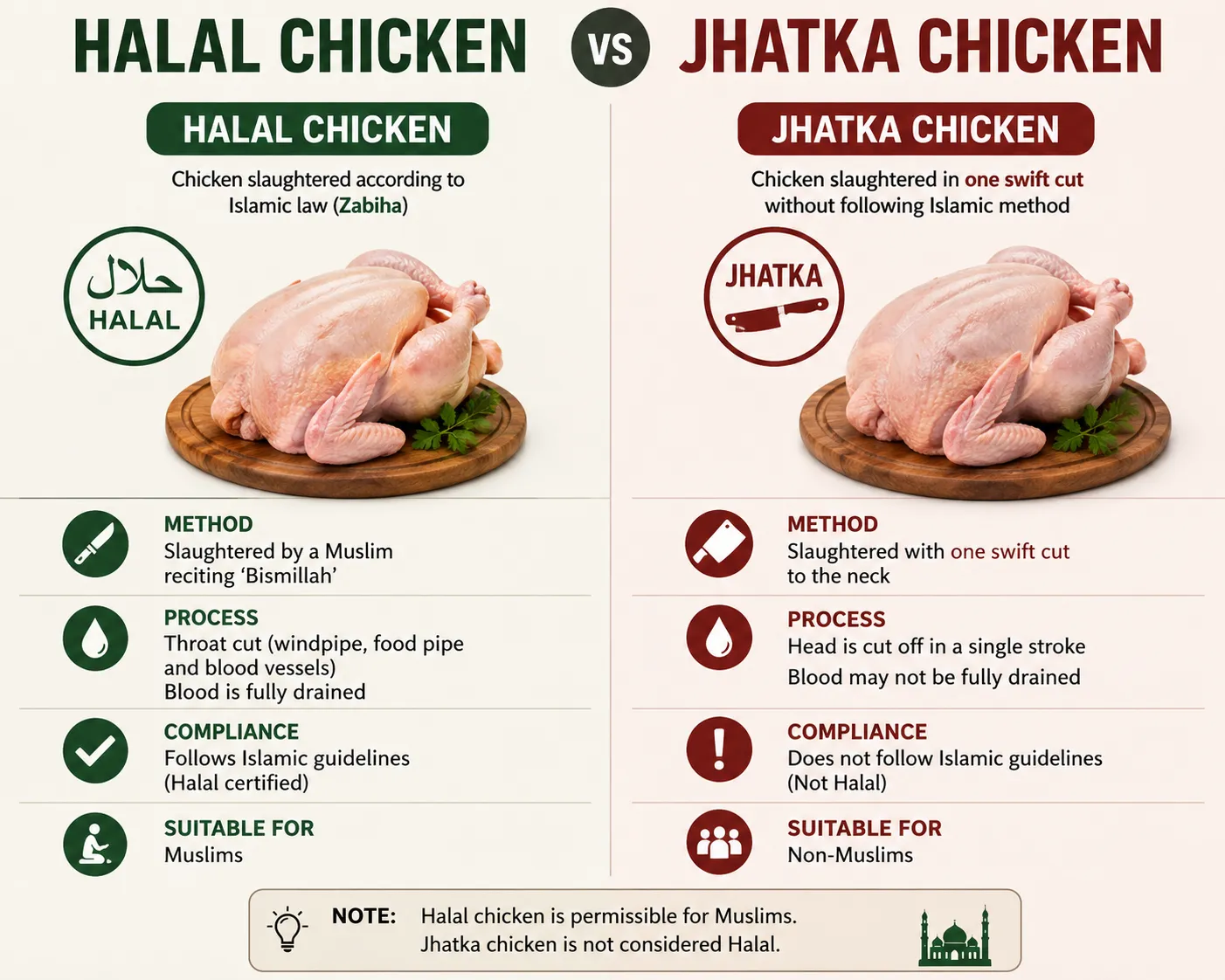
The main difference between halal chicken and jhatka chicken lies in the method of slaughter and the religious beliefs associated with each practice. Halal chicken is prepared according to Islamic dietary laws, where the bird is slaughtered with a specific religious procedure. Jhatka chicken, on the other hand, involves a single, swift cut to the neck and is traditionally associated with Sikh and certain Hindu communities.
I've had conversations with friends from different cultural and religious backgrounds about this topic, and one thing became clear: for most people, choosing halal or jhatka isn't just about food. It's often about respecting family traditions, religious beliefs, and personal values. That's why the discussion goes far beyond taste.
What Is Halal Chicken?
Halal is an Arabic word meaning "permissible" or "lawful."
For chicken to be considered halal:
-
The bird must be healthy at the time of slaughter.
-
A Muslim performing the slaughter recites the name of God (Bismillah).
-
The throat, windpipe, and major blood vessels are cut with a sharp knife.
-
The blood is allowed to drain from the body.
For practicing Muslims, these steps are part of following Islamic dietary laws and are considered an important aspect of consuming permissible food.
What Is Jhatka Chicken?
Jhatka means "instant" or "swift strike."
In the jhatka method:
-
The chicken is slaughtered with a single, quick cut intended to sever the head or neck immediately.
-
The process is designed to cause an instantaneous death.
-
No specific religious prayer is required during the slaughter.
Jhatka meat is traditionally preferred by many Sikhs and is also consumed by many Hindus, although dietary practices vary widely among individuals and communities.
Halal Chicken vs Jhatka Chicken
| Feature | Halal Chicken | Jhatka Chicken |
|---|---|---|
| Meaning | Permissible under Islamic law | Instant slaughter |
| Method | Religious slaughter with blood drainage | Single swift cut |
| Religious Association | Islam | Sikhism (traditionally) and preferred by many Hindus |
| Prayer During Slaughter | Yes | No |
| Purpose | Follow Islamic dietary laws | Follow traditional religious practices |
Taste, Nutrition, and Practical Differences
One question that comes up quite often is whether one tastes better than the other.
In reality, there's no universal answer.
The taste of chicken is influenced much more by factors such as:
-
The breed of the chicken.
-
Its diet.
-
Freshness.
-
Marination.
-
Cooking method.
-
Spices and seasoning.
Nutritionally, halal and jhatka chicken are very similar because they come from the same animal. Their protein, fat, vitamins, and mineral content remain largely comparable.
The primary practical difference is how the chicken is slaughtered, not its nutritional composition.
Religious and Cultural Significance
This is where the difference becomes most meaningful.
For Muslims, eating halal food is an important religious obligation based on Islamic dietary guidelines.
For many Sikhs, jhatka meat aligns with traditional beliefs and historical practices. Likewise, many Hindus who consume meat may also choose jhatka for cultural or personal reasons, though Hindu dietary practices vary significantly across regions and families.
Ultimately, these preferences are deeply personal and deserve mutual respect.
Common Misconceptions
Myth: Halal and jhatka chickens are different breeds.
Reality: They come from the same type of chicken. The difference lies only in the slaughter method.
Myth: One is always healthier than the other.
Reality: There is no widely accepted scientific consensus showing that either halal or jhatka chicken is inherently more nutritious than the other.
Myth: Everyone from a particular religion eats only one type.
Reality: Individual food choices differ. Not every Muslim, Hindu, or Sikh follows identical dietary practices, and personal preferences can vary.
Halal vs Jhatka at a Glance
| Aspect | Halal | Jhatka |
|---|---|---|
| Main Difference | Religious slaughter method | Instant slaughter method |
| Associated With | Islamic dietary laws | Sikh tradition and preferred by many Hindus |
| Nutritional Value | Similar | Similar |
| Taste | Depends mainly on cooking and freshness | Depends mainly on cooking and freshness |
| Key Distinction | Religious practice | Traditional practice |
Halal chicken and jhatka chicken are not different types of chicken: they differ in the method of slaughter and the religious traditions they represent. From a nutritional perspective, they're largely similar, while taste depends far more on cooking techniques than on the slaughter method. Understanding these differences helps us appreciate the cultural and religious significance behind each practice and encourages informed, respectful food choices.
Frequently Asked Questions (FAQs)
1. Is halal chicken healthier than jhatka chicken?
There is no conclusive scientific evidence that halal chicken is inherently healthier or more nutritious than jhatka chicken. Both provide similar nutritional value when sourced and prepared under comparable conditions.
2. Why do Muslims eat only halal chicken?
Practicing Muslims follow Islamic dietary laws, which require meat to be prepared according to halal guidelines, making it permissible for consumption.
3. Why do some Sikhs prefer jhatka meat?
Many Sikhs prefer jhatka because it aligns with traditional Sikh beliefs and historical practices. However, dietary choices can vary among individuals.
4. Does halal or jhatka chicken taste different?
Generally, the cooking method, seasoning, freshness, and quality of the chicken have a much greater impact on taste than the slaughter method itself.
5. Can vegetarians eat halal or jhatka chicken?
No. Since both halal and jhatka are forms of chicken meat, they are not suitable for vegetarians.
Must Read: How to Make Chicken Curry with Spices and Delicious Texture?
 Answered by