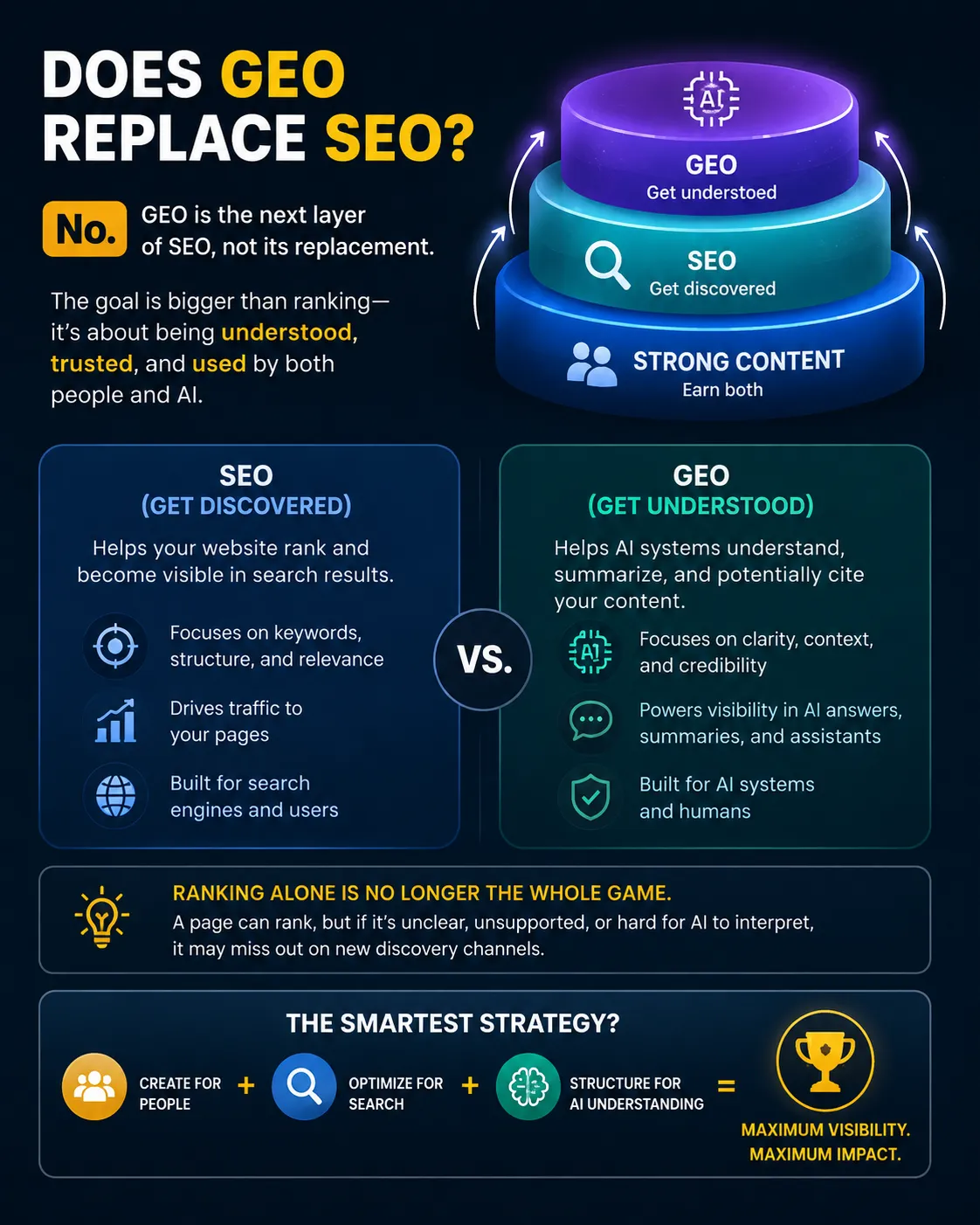
GEO does not replace SEO—it builds on it.
As AI-powered search engines like Google AI Overviews, ChatGPT, Gemini, and Perplexity become more popular, Generative Engine Optimization (GEO) is emerging as the next evolution of search optimization. However, SEO remains the foundation that helps websites get discovered, indexed, and ranked.
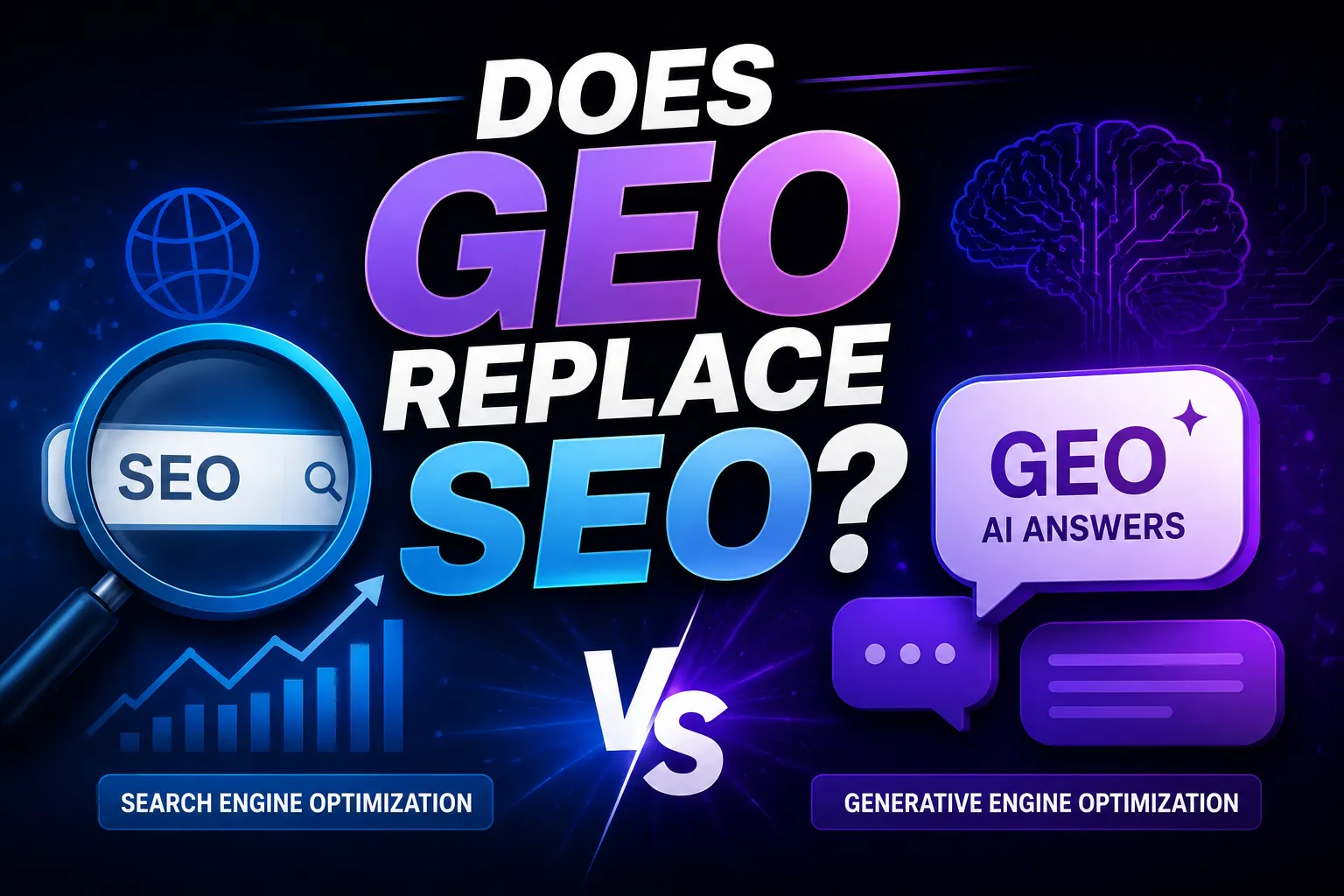
GEO vs. SEO: What's the Difference?
SEO (Search Engine Optimization) | GEO (Generative Engine Optimization) |
|---|
Optimizes for search rankings | Optimizes for AI-generated answers |
Focuses on keywords and SERPs | Focuses on citations and AI visibility |
Drives organic website traffic | Increases brand mentions in AI responses |
Targets Google, Bing, etc. | Targets ChatGPT, Google AI, Gemini, Perplexity |
Measures clicks and rankings | Measures citations, mentions, and answer inclusion |
Why SEO Still Matters
Even AI search systems rely on quality web content.
Without strong SEO:
Your pages may not be indexed.
AI models may not discover your content.
Your website loses organic visibility.
You receive less traffic from traditional search.
SEO is still essential because it provides the trusted, structured information that AI systems often use to generate answers.
Why GEO Is Becoming Important
GEO focuses on making your content easy for AI assistants to understand, trust, and reference.
A GEO-optimized article typically includes:
Direct answers to common questions
Clear headings and logical structure
Expert insights and original research
Statistics with credible sources
FAQs and conversational language
Entity-based optimization
Structured data (Schema markup)
The goal is to increase the likelihood that AI search tools cite or summarize your content.
SEO + GEO = The Winning Strategy
Instead of choosing one over the other, combine both.
SEO helps you:
Rank in Google Search
Increase organic traffic
Improve crawlability
Build domain authority
GEO helps you:
Appear in AI-generated answers
Earn citations from AI assistants
Increase brand visibility
Reach users who search through conversational AI
The future of digital marketing is SEO + GEO, not SEO vs. GEO.
Best Practices for 2026
To perform well in both traditional and AI search:
Write people-first, experience-based content.
Answer questions clearly within the first few paragraphs.
Use descriptive headings (H2 and H3).
Add FAQs using natural language.
Include statistics and link to authoritative sources.
Demonstrate expertise, experience, authority, and trustworthiness (E-E-A-T).
Use Schema markup where appropriate.
Keep content updated with the latest information.
Build topical authority instead of targeting only individual keywords.
Create original insights that AI systems can confidently reference.
Final Verdict
No, GEO does not replace SEO.
SEO remains the foundation for online visibility, while GEO is the next layer of optimization designed for AI-powered search experiences.
Businesses that combine traditional SEO with Generative Engine Optimization (GEO) are more likely to rank in Google Search, appear in Google AI Overviews, and be cited by AI assistants such as ChatGPT, Gemini, and Perplexity.
Key Takeaway: Think of GEO as the evolution of SEO—not its replacement. The most successful websites in 2026 optimize for both search engines and AI engines.
FAQ
Q: Is SEO dead because of AI?
No. SEO is evolving, not disappearing. AI search still depends on high-quality, well-optimized web content.
Q: Can I do GEO without SEO?
Not effectively. GEO works best when built on a solid SEO foundation.
Q: Which is more important in 2026: SEO or GEO?
Both are essential. SEO helps your content get discovered, while GEO helps it get referenced in AI-generated answers.
Source & Reference:
Also Read: Does web design affect SEO?