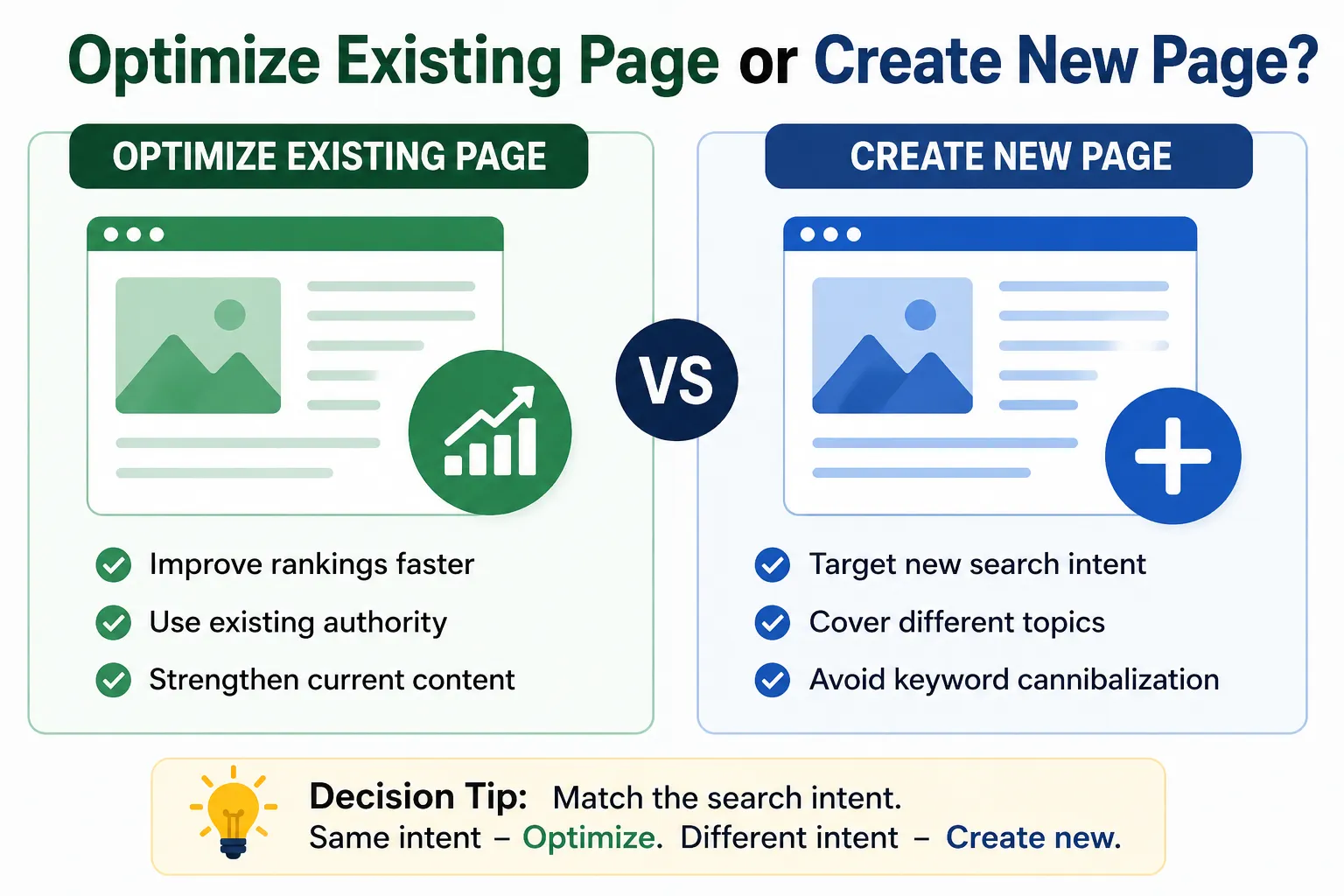
If an existing page already ranks for keywords related to your target topic, optimizing that page is usually the better SEO choice. An established page may already have backlinks, authority, internal links, search visibility, and user signals that a new page would need to build from scratch. However, creating a new page makes more sense when the new topic has a clearly different search intent or requires substantially different content. Before deciding, compare the existing page’s keywords, search intent, topical relevance, rankings, backlinks, and organic traffic with the new keyword opportunity. The goal is to avoid creating multiple pages that compete for the same search queries, a problem commonly known as keyword cannibalization. In most cases, if the existing page is closely aligned with the query and already performs well, improve and expand it rather than starting over.
When You Should Optimize an Existing Page
Optimizing an existing page is generally the right approach when the page already targets the same or closely related search intent. For example, if a page ranks for “SEO page optimization” and you want to target “how to optimize a page for SEO,” improving the existing content can strengthen its relevance without splitting authority between two URLs.
Look at the page’s Google Search Console data to identify queries for which it already receives impressions but has relatively low rankings. These queries can reveal opportunities to improve headings, explanations, semantic keywords, FAQs, internal links, and overall topical coverage.
You should also consider backlinks and existing authority. A page with quality backlinks and consistent organic traffic has accumulated SEO value that a brand-new URL does not automatically inherit.
When Creating a New Page Is Better
Create a new page when the proposed keyword represents a different search intent, audience need, or topic. For example, a page explaining “technical SEO” should not necessarily be expanded indefinitely to target “SEO audit tools” if users expect a dedicated comparison or resource page.
A new page may also be appropriate when the existing URL is already highly focused and adding another topic would make the content less useful or less relevant. Clear topical separation helps both search engines and AI search systems understand which page best answers a particular question.
Quick Decision Guide
Situation | Best SEO Approach |
|---|
Existing page targets the same search intent | Optimize the existing page |
Existing page ranks for closely related keywords | Usually optimize it |
New keyword has a completely different search intent | Create a new page |
Existing page has strong backlinks and authority | Prefer optimization |
Two pages would target nearly identical keywords | Avoid creating another page |
Existing page is too narrow to satisfy the new topic | Consider a new page |
How to Make the Decision
Start by searching the target keyword and analyzing the search intent behind the results. Then check whether your existing page genuinely answers that intent.
Next, review Google Search Console for impressions, clicks, average position, and related queries. Tools such as Semrush or Ahrefs can also help identify keyword overlap and potential cannibalization.
If the existing page is relevant, improve its content rather than simply adding keywords. Strengthen the introduction, answer the main question quickly, add useful supporting information, improve internal linking, update outdated facts, and cover relevant subtopics naturally.
For AEO and GEO, make important answers easy for AI systems to extract. Use descriptive headings, concise explanations, clear definitions, structured comparisons, and FAQs where they genuinely help users.
Conclusion
The safest general rule is: if the existing page already matches the search intent, optimize it; if the new keyword represents a substantially different intent, create a new page. This approach preserves existing SEO equity while reducing keyword cannibalization and creating a clearer website structure.
FAQs
1. Is it better to update an existing page or create a new one for SEO?
Usually, updating an existing relevant page is better when it already ranks for related keywords and matches the same search intent. A new page is preferable when the topic or intent is substantially different.
2. Does creating multiple pages for similar keywords hurt SEO?
It can. When multiple pages target the same search intent, they may compete with one another and create keyword cannibalization. Consolidating or clearly differentiating overlapping content can be more effective.
3. How do I know whether an existing page should be optimized?
Check its rankings, organic traffic, impressions, backlinks, target keywords, and search intent. If it is already relevant to the new keyword and has existing SEO authority, optimization is often the better option.
4. Should I create a new URL for every new keyword?
No. SEO is not about creating one page for every keyword. A strong page can rank for many closely related queries when it comprehensively satisfies the underlying search intent.
Also read : What Is Search Engine Land and How It Helps SEO?