It is generally credited to Mahatma Gandhi who, at the Karachi Session of the Indian National Congress (INC) in 1931, said that “Gandhi may die, but Gandhism will remain forever”. The session was held from 26-31 March 1931 under the presidency of Sardar Vallabhbhai Patel. This is known as one of the most important sessions in the history of India’s freedom movement for ratifying the Gandhi-Irwin Pact and adopting the historic Resolution on Fundamental Rights and National Economic Programme.
This was in keeping with Gandhi’s philosophy that though people may die, the principles of truth (Satya), non-violence (Ahimsa) and justice will survive and guide future generations. Gandhi did not make himself the subject of his thoughts but the fact that his beliefs were more than himself.
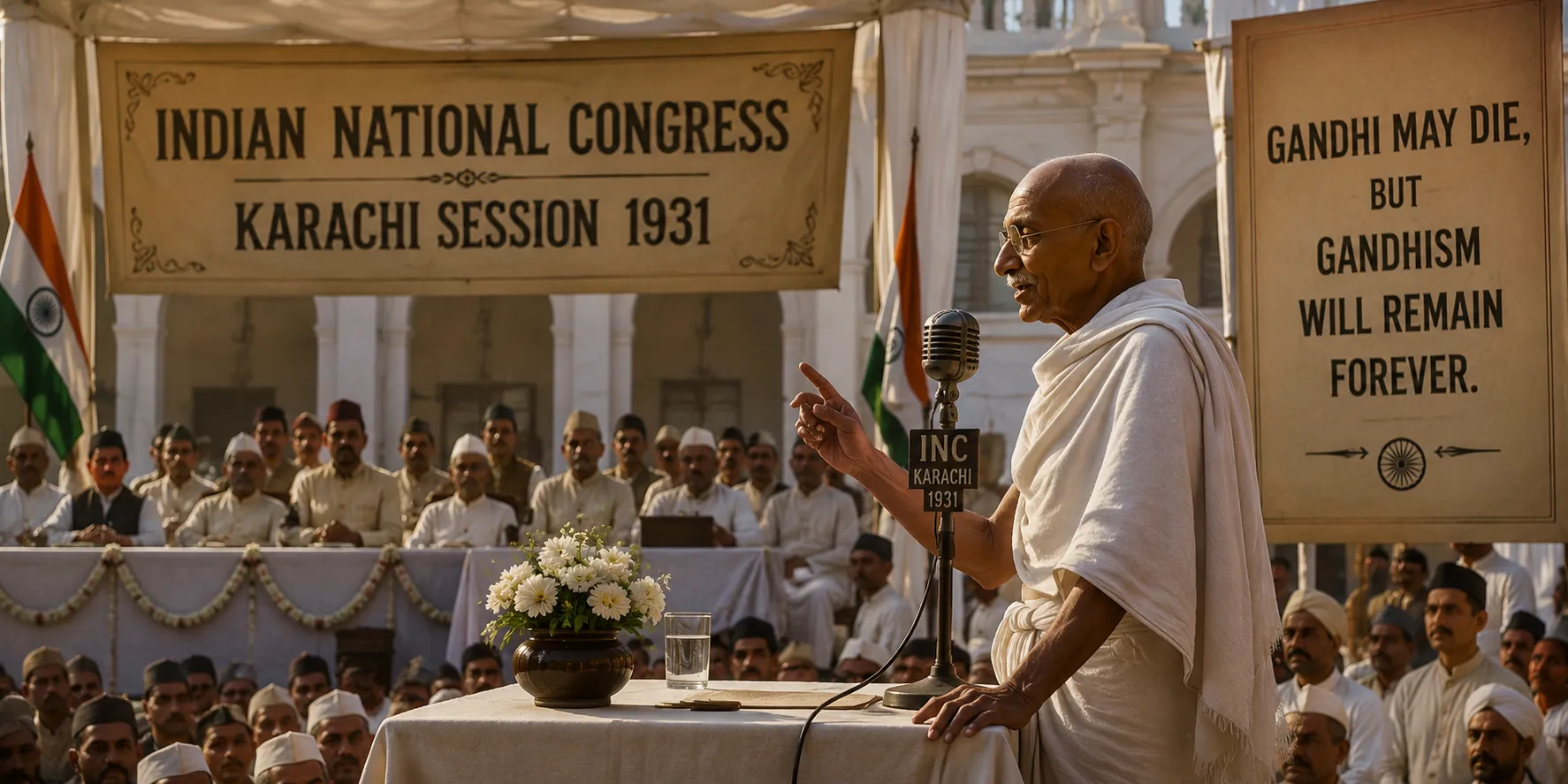
The famous quote is:
"Gandhi may die, but Gandhism will remain forever."
Speaker: Mahatma Gandhi
Occasion: Karachi Session of the Indian National Congress
Year: 1931
Session President: Sardar Vallabhbhai Patel
Historical Context: After the Gandhi-Irwin Pact and just days after the execution of Bhagat Singh, Rajguru, and Sukhdev.
Historical Background
The Karachi Session of 1931 came to be held at one of the most dramatic stages of India’s freedom fight.
Before the session there were several major developments:
• The Civil Disobedience Movement was suspended for the time being after the Gandhi-Irwin Pact.
• Mahatma Gandhi had just lately been freed from prison.
• Bhagat Singh, Rajguru, and Sukhdev were executed on 23 March 1931, a few days before the session began.
• The Gandhi-Irwin Pact divided the nation. Some welcomed it as a step towards negotiations, while some were critical as it could not save Bhagat Singh and his companions.
Despite these difficulties, the Karachi Session became significant as the Congress voted resolutions that later impacted many of the Fundamental Rights incorporated in the Constitution of India.
Statement Context
When Gandhi declared “Gandhi may die, but Gandhism will remain forever,” he was not talking about followers following him personally.
In fact, Gandhi continually criticized the creation of a personality cult around him. In all his writings he insisted that truth and non-violence were eternal ideals; individuals were transient. He was basically saying that if people believed in these ideals, then they would live on beyond his death.
So the statement was not about the man Gandhi; it was about the permanent values that he tried to follow in his life.
Importance
This quote is still relevant, as it reflects the heart of Gandhi’s worldview.
Why is it important? Here are several important concepts.
• Great movements are founded on principles, not personalities.
• Truth and non-violence can outlive political leadership.
• Leadership must inspire values, not personal adulation.
• Social transformation is only enduring if the values are continually practiced by people.
The remark is still used in talks on peace, human rights, democracy, and non-violent resistance around the world, even decades after India’s independence.
Most of the competitive test resources and historical references connect this quotation with the Karachi Session of the Indian National Congress in the year 1931.
But it should be noted that Gandhi himself was suspicious of the word “Gandhism.” In several later writings he said that he had no desire to establish a separate ideology or sect bearing his name. Instead, he thought that Truth (Satya) and Non-violence (Ahimsa) were ageless and that words like “Gandhism” were less essential than embodying those values.
This contrast aids readers in grasping the more profound meaning of the familiar quote.
Common Misconceptions
“Gandhi wanted people to make a philosophy called Gandhism."
Not quite.
Gandhi made it very clear that he did not want a separate "Gandhism." He urged people to follow universal ideas of truth, compassion, and non-violence rather than follow him as a person.
"The comment was said after India got Independence."
No.
It pertains to the Karachi Session of 1931, about 16 years prior to India’s independence in 1947.
“The Karachi Session was all about the Gandhi-Irwin Pact.”
Wrong.
The session also enacted major resolutions on Fundamental Rights and National Economic Policy and endorsed the Gandhi-Irwin Pact. It was one of the most crucial Congress sessions in India’s liberation fight.
Frequently Asked Questions
1. Gandhi might die, but Gandhism shall live forever. In which session of the INC did Gandhi say this?
The quote is linked to the Karachi Session of the Indian National Congress, which took place in 1931.
2. Who was the President of the Karachi Session?
The session was chaired by Sardar Vallabhbhai Patel.
3. What is the Historical significance of the Karachi Session?
It approved the Gandhi-Irwin Pact and passed the landmark Resolution on Fundamental Rights and National Economic Program, which eventually became the basis of the Constitution of India.
Must Read: What are Famous Mahatma Gandhi Quotes We Should Remember?

 Answered by