
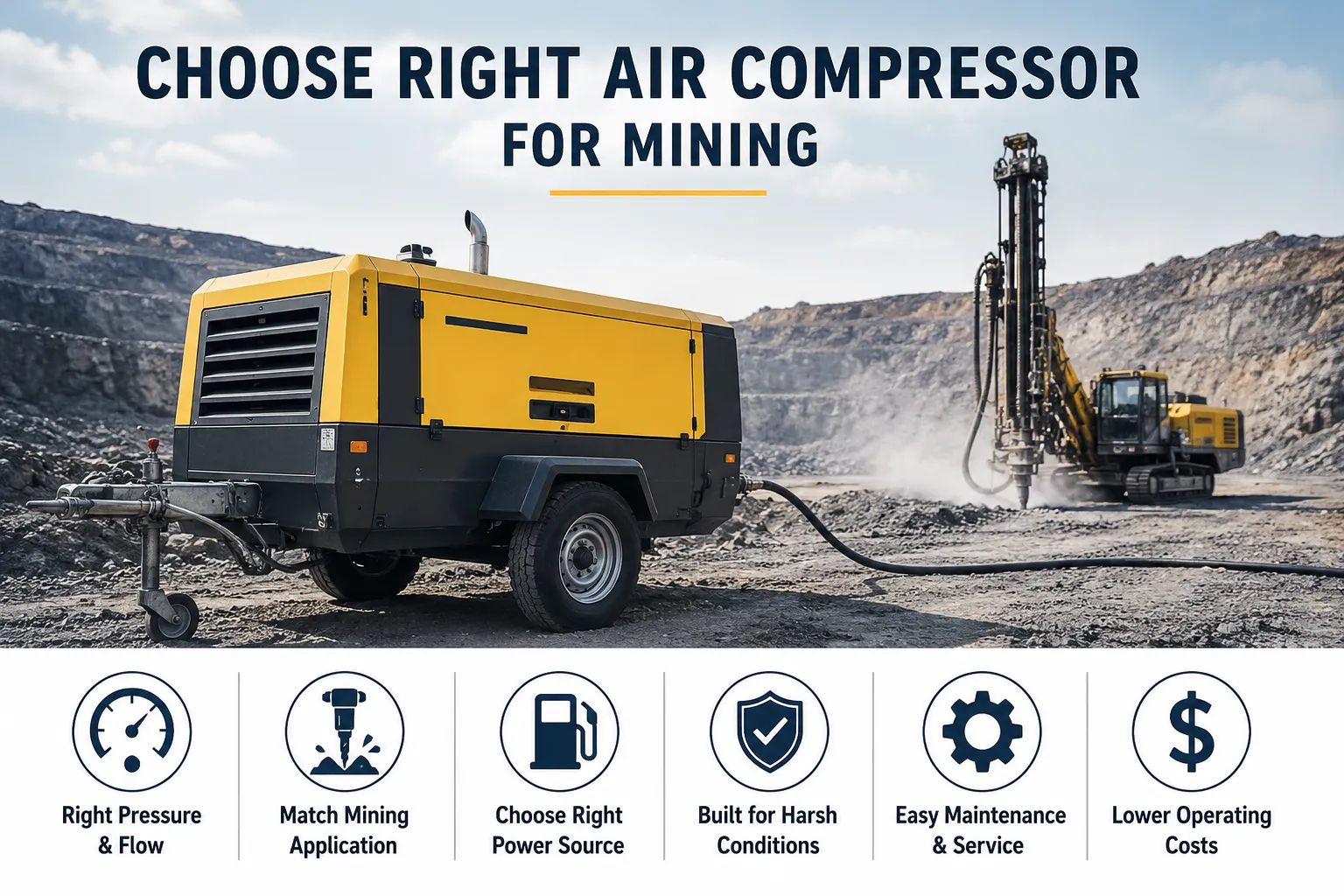
Choosing the right air compressor for mining applications starts with matching the compressor’s airflow (CFM/FAD), operating pressure (PSI/bar), and application requirements. Mining operations commonly use compressed air for rock drilling, blast-hole drilling, pneumatic tools, cleaning, ventilation support, and material handling. The compressor must also suit the mine environment, including dust, temperature, mobility, available power, and operating conditions. For remote or mobile mining sites, diesel-powered portable compressors are often practical, while electric compressors can be suitable where a reliable power supply is available.
The most important rule is to size the compressor according to the actual air demand, rather than choosing a unit simply by horsepower. An undersized compressor can cause pressure drops and productivity problems, while an oversized unit can increase energy and maintenance costs.
Key Factors for Selecting a Mining Air Compressor
Selection factor | What to consider |
|---|---|
Airflow (CFM/FAD) | Calculate the combined air consumption of drills, pneumatic tools, and other equipment operating simultaneously. |
Pressure (PSI/bar) | Match the compressor's working pressure to the drilling or equipment manufacturer's requirements, including pressure losses in hoses and filters. |
Application | Identify whether the compressor will be used for DTH drilling, top-hammer drilling, blasting, pneumatic tools, cleaning, or other mining tasks. |
Compressor type | Rotary screw compressors are commonly suited to continuous heavy-duty applications; portable units provide flexibility at changing work locations. |
Power source | Choose diesel for remote/mobile operations or electric when dependable electrical infrastructure is available. |
Operating environment | Consider dust, heat, humidity, altitude, rough terrain, and limited maintenance access. |
Air quality | Determine whether oil-injected or oil-free compressed air is required by the specific process. ISO 8573-1 can be used to define air purity requirements. |
Mobility | For surface and quarry operations, portable compressors with suitable undercarriages can simplify movement between drilling locations. |
Fuel and energy efficiency | Compare fuel consumption or electricity use, especially for compressors running continuously across multiple shifts. |
Maintenance and service | Prioritize robust filtration, accessible service points, long service intervals, and reliable local technical support. |
1. Determine the Required Airflow and Pressure
CFM and pressure are the two most important sizing parameters. First, list every piece of equipment that will consume compressed air and determine its required CFM and operating pressure. If several tools operate simultaneously, their air requirements need to be considered together.
For drilling operations, the required pressure and airflow can be substantially higher than for ordinary pneumatic tools. Some portable mining compressors, for example, are designed around approximately 7–14 bar and hundreds of CFM, while specialized high-pressure drilling compressors can operate at considerably higher pressures.
2. Match the Compressor to the Mining Application
The compressor should be selected according to the actual mining task. DTH drilling, top-hammer drilling, blast-hole drilling, quarrying, rock anchoring, and pneumatic tools can have very different compressed-air requirements.
For example, heavy-duty portable compressors are available specifically for mining and quarrying applications such as DTH and top-hammer drilling and blast-hole preparation.
3. Choose Diesel or Electric Power
A diesel-powered portable air compressor is generally useful where equipment must move around remote mining areas or where grid electricity is unavailable. Electric compressors can be attractive for mines with reliable electrical infrastructure because they avoid diesel refueling and can provide quieter operation.
For underground operations, however, the mine's ventilation, emissions, electrical infrastructure, and applicable safety requirements should be evaluated before selecting the power source.
4. Consider Harsh Mining Conditions
Mining compressors operate in environments containing dust, vibration, heat, moisture, and rough terrain. Therefore, look for heavy-duty filtration, robust enclosures, effective cooling, corrosion protection, and easy maintenance.
A compressor that performs well in a controlled industrial environment may not necessarily be the best choice for a demanding mine site.
5. Evaluate Total Cost of Ownership
The purchase price is only one part of the cost. Compare fuel or electricity consumption, maintenance intervals, spare parts, downtime, service availability, and expected operating hours.
Variable-speed or pressure-adjustable technology can also be valuable when air demand changes throughout the operation. Some portable compressor systems allow pressure and flow settings to be adjusted for different tasks, improving flexibility.
6. Check Air Quality Requirements
Not every mining application requires oil-free air. For general heavy-duty drilling and pneumatic tools, an oil-injected compressor may be appropriate. However, certain processing applications can require cleaner compressed air to prevent contamination.
ISO 8573-1 provides classifications for compressed-air purity, including particles, water, and oil.
Conclusion
The right air compressor for mining applications should be selected by first calculating the required CFM and pressure, then matching the unit to the specific mining application, power source, site conditions, mobility requirements, air-quality needs, and operating costs. For demanding drilling work, prioritize sufficient airflow and pressure rather than horsepower alone. A properly sized, rugged, and serviceable compressor can improve productivity, reduce downtime, and lower the overall cost of mining operations.
FAQs
1. What size air compressor is best for mining?
There is no single compressor size for every mine. The required size depends mainly on CFM, operating pressure, number of air-consuming tools, and the specific drilling or mining application.
2. Are diesel compressors suitable for mining?
Yes. Diesel portable compressors are widely suited to remote mining and quarrying operations because they can operate independently of an electrical grid and can be transported between work areas.
3. What is more important, CFM or PSI?
Both are important, but they serve different purposes. PSI/bar determines the pressure available for the application, while CFM determines how much air the compressor can continuously deliver. The compressor must meet both requirements.
4. Are oil-free compressors required in mining?
Not necessarily. The correct choice depends on the application and required air purity. Oil-injected compressors can be suitable for many heavy-duty applications, while oil-free technology may be preferred where contamination must be avoided.
Also read : What are Breathing Air Compressors?