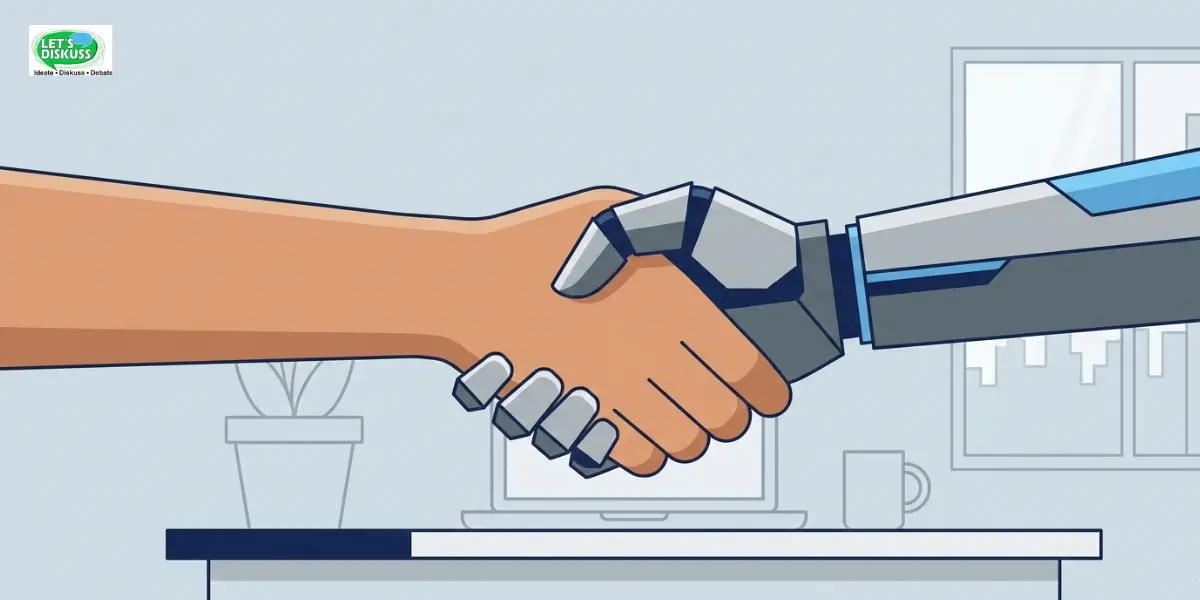

AI is already transforming jobs in America, but the story is more complicated than “AI is taking everyone’s jobs.”
AI today is automating some processes, allowing workers to accelerate existing work, and creating demand for new skills and occupations related to AI. In fact, the most recent projections from the U.S. Bureau of Labor Statistics expect strong growth in several AI-related fields, including 33.5% employment growth for data scientists and 28.5% growth for information security analysts between 2024 and 2034.
Meanwhile, America’s broader hiring market has cooled off. Payroll employment moved little in June 2026, while unemployment was 4.2%.
That’s an important difference as far as I’m concerned. Not every bad hiring number should be dubbed an “AI job loss.”
How AI Is Transforming Work
The immediate impact of AI is at the task level.
Someone who used to spend two hours summarizing materials, creating a first draft, analyzing basic data, or writing routine code may now be able to do some of this work considerably more quickly.
Before AI | With AI Support |
|---|---|
Creating a first draft from scratch | Draft first, then refine |
Manual research | Summarize and structure information |
Routine coding | AI-assisted development |
Basic data analysis | Faster analysis and explanations |
Repetitive admin | Partial automation |
Personally, I see AI less as “press button, employee disappears” and more as work getting reorganized.
Jobs Most Affected
Jobs involving a lot of digital data and repeatable cognitive processes are naturally more exposed to AI.
This includes parts of:
Software engineering
Customer service
Clerical work
Marketing and content
Accounting and finance
Legal research
Data analysis
But exposure doesn’t equal eradication.
AI is expected to boost the productivity of software development, yet demand for software engineers is expected to continue. At the same time, greater automation could eliminate some jobs involving highly routine duties.
That's why I would look at tasks within a career rather than just asking whether an entire profession is “safe.”
Job Loss vs. Job Transformation
Yes, some jobs will go away or become smaller because of AI. There’s no use pretending otherwise.
But the available evidence does not support the notion that AI has already caused massive economy-wide job destruction in America.
An examination by the Federal Reserve Bank of New York in May 2026 found minimal indication in job-posting data of a unique AI-driven decline in labor demand. The New York Fed also found that firms using AI were often planning to retrain workers, with limited evidence so far of AI having a major effect on hiring.
As of May 2026, America still had around 7.6 million job openings.
So, we're somewhere in the muddy middle: displacement is occurring in some places, transformation is occurring practically everywhere, and entirely new work is developing as well.
Entry-Level Impact & Hiring
This is the bit I’d be watching intently.
Entry-level workers generally learn by doing tasks such as basic research, initial drafts, junior coding, documentation, and administrative assistance. Those are exactly the sorts of tasks AI can increasingly help with.
Entry-level hiring has declined, but blaming AI alone would be premature. The New York Fed found that the decline in vacancies for highly AI-exposed occupations actually started before the launch of ChatGPT, complicating attempts to isolate AI as the cause.
There’s another peculiar impact, too: AI makes applying for jobs easier. In 2026, Stanford reported that employers were receiving almost three times as many applications for entry-level jobs as in 2022, while AI-based screening had also become widespread.
AI is basically sitting on both sides of the interview table now.
Skills Workers Require
If I were entering the American job market today, I would not attempt to compete with AI on the things it can do cheaply.
I'd build skills that make AI more useful:
AI literacy → Domain expertise → Critical thinking → Communication → Data skills → Judgement
Technical skills around AI, cybersecurity, data, and computing are also likely to remain valuable. BLS expects computer and mathematical occupations to expand much faster than the average for all occupations through 2034.
And knowing how to use the chat feature of ChatGPT is not an AI skill by itself. Knowing how to employ AI while recognizing its mistakes, adding genuine expertise, and delivering superior work is much more important.
Questions and Answers
1. Are we seeing employment losses in America today due to AI?
Some organizations are cutting or reshaping roles around AI, but the latest research does not point to AI as the main driver of the broader hiring slowdown in America.
2. Are junior jobs under threat?
Entry-level tasks can be highly automatable, and junior roles may change. But the data available today don’t point to AI as the only cause of the decline in entry-level hiring.