
A
Aanya Sharma· 10 days ago
Translating science and technology into stories that inform, challenge, and matter.

How is ethyl bromide prepared from ethyl alcohol?

4
48

Join this conversation

Sort By
Replying to the question above
Updated on08/27/26

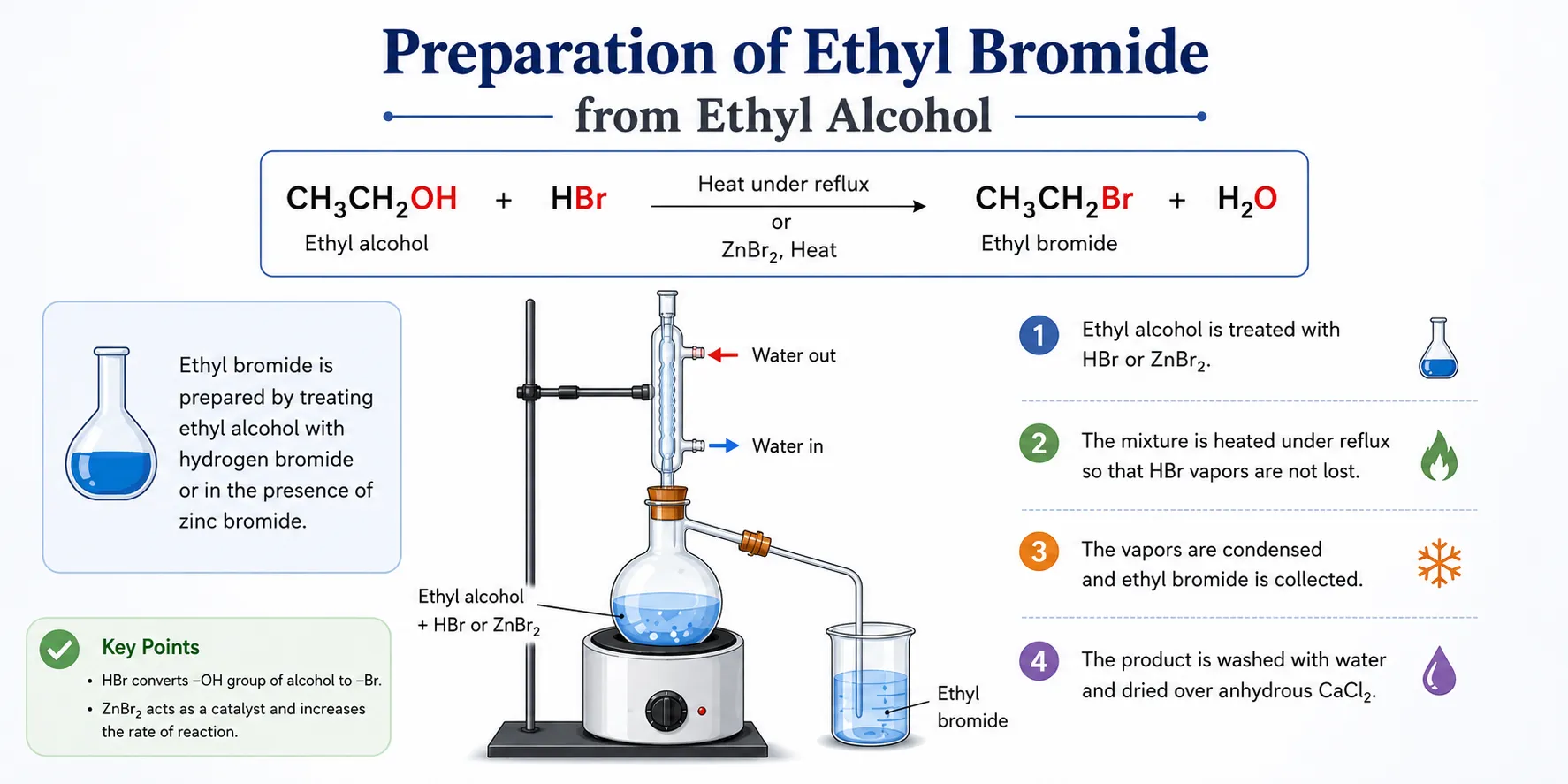
Ethyl bromide, also called bromoethane, is an organic compound with the molecular formula C₂H₅Br. It belongs to the class of compounds known as haloalkanes or alkyl halides. Ethyl bromide can be prepared from ethyl alcohol (ethanol) by replacing the hydroxyl group (–OH) of ethanol with a bromine atom. The conversion of alcohols into alkyl halides is an important reaction in organic chemistry.
Article image

Principle of Preparation

The preparation of ethyl bromide is based on a substitution reaction between ethanol and hydrogen bromide (HBr). In the reaction, the –OH group of ethanol is ultimately replaced by bromine, producing bromoethane and water.

The general reaction is:

C₂H₅OH + HBr → C₂H₅Br + H₂O

This reaction illustrates the general conversion of an alcohol into an alkyl halide using a hydrogen halide. Hydrogen bromide provides the bromide ion required for substitution.

Laboratory Preparation

For the laboratory preparation of ethyl bromide, a bromide salt such as sodium bromide (NaBr) can be used together with a strong acid to generate hydrogen bromide in the reaction mixture. Chemistry references describe the use of a mixture of a sodium or potassium bromide salt and concentrated sulfuric acid as a way of producing HBr, which then reacts with the alcohol.

The overall transformation can be represented in simplified form as:

C₂H₅OH + NaBr + H₂SO₄ → C₂H₅Br + NaHSO₄ + H₂O

The important chemical change is the conversion of ethanol into bromoethane. Laboratory preparation and purification require appropriate safety procedures because the reagents and volatile product require controlled handling.

Reaction Mechanism

Ethanol is a primary alcohol, and its reaction with hydrogen bromide under acidic conditions proceeds through an S<sub>N</sub>2 nucleophilic substitution pathway. The hydroxyl group itself is a poor leaving group. Acid protonates the alcohol, converting the –OH group into a better leaving group in the form of water. Bromide ion can then displace the water-derived leaving group from the primary carbon, forming ethyl bromide.

This explains why simply mixing an alcohol with a non-acidic bromide salt does not produce the same result. The acidic environment is important because it activates the hydroxyl group and allows substitution to occur.

Properties of Ethyl Bromide

Ethyl bromide, or bromoethane, is a haloalkane containing an ethyl group bonded to bromine. Its molecular formula is C₂H₅Br. It is a volatile compound and therefore requires appropriate laboratory precautions when handled.

The compound is also a useful example for understanding the relationship between alcohols and alkyl halides. In this case, ethanol acts as the starting alcohol, while bromoethane is the corresponding brominated product.

Conclusion

The preparation of ethyl bromide from ethyl alcohol is an example of converting an alcohol into a haloalkane through substitution. Ethanol reacts with hydrogen bromide according to:

C₂H₅OH + HBr → C₂H₅Br + H₂O

In a laboratory context, hydrogen bromide can be generated from a bromide salt and a suitable acid. Because ethanol is a primary alcohol, the substitution is explained by an S<sub>N</sub>2 mechanism, in which bromide replaces the acid-activated hydroxyl group. This reaction is an important example of the preparation and chemical behavior of alkyl halides.

Also Read: How is AI affecting jobs in America?

Source & Reference:

Nakul Chauhan
Learn how ethyl bromide is prepared from ethyl alcohol through a simple chemical reaction.
View Profile

Nakul Chauhan is a technology consultant and science and technology writer with over 3 years of professional experience advising organisations on digital transformation, cloud infrastructure, and emerging technology adoption. He holds a Bachelor's degree in Computer Science and Engineering from the National Institute of Technology (NIT) Jaipur and carries an AWS Certified Solutions Architect certification — credentials that give his writing a technical depth that generalist science writers rarely bring to the table. His content covers artificial intelligence, cloud computing, cybersecurity, software development trends, and the practical application of emerging technologies across industries in India. His work has appeared on platforms including Analytics India Magazine, TechGig, and Digit.in, where he writes for technology professionals, business decision-makers, and informed readers who want science and technology content grounded in real consulting experience — not just trend reporting. Over three years, Nakul has advised startups and mid-size enterprises on technology strategy, evaluated and implemented cloud solutions, and translated complex technical decisions into business outcomes. He has published 100+ articles on science and technology across digital platforms and is an active contributor to the Indian technology community through his writing and professional practice. Across all his writing, every technical claim is verified, every trend is evaluated against real-world implementation experience, and every article is held to the standard his consulting clients expect — accuracy, clarity, and practical relevance.

0
Replying to the question above
Answered on08/28/26

Ethyl bromide (bromoethane, C₂H₅Br) is prepared from ethyl alcohol (ethanol, C₂H₅OH) by a substitution reaction in which the –OH group is replaced by bromine. In the laboratory, ethanol is heated with sodium bromide (NaBr) and concentrated sulfuric acid; the acid generates hydrogen bromide (HBr) in situ, which then reacts with the alcohol:

C₂H₅OH + NaBr + H₂SO₄ → C₂H₅Br + NaHSO₄ + H₂O

The reaction proceeds via an Sₙ2 mechanism: the acid first protonates the hydroxyl group, converting it into a good leaving group (water), after which bromide ion attacks the carbon and displaces water to form ethyl bromide.

T
Author
View Profile
0
Replying to the question above
Answered on08/28/26

Myself Simon Hopes. I am working at Zenith solz from 2012. I think Ethyl bromide is prepared from ethyl alcohol by treating it with hydrobromic acid (HBr). The reaction is:

C₂H₅OH + HBr → C₂H₅Br + H₂O

Thus, ethyl alcohol reacts with HBr to form ethyl bromide and water.

Simon Hopes
View Profile

Simon Hopes is a renowned author and social media enthusiast.

0
Replying to the question above
Answered on08/28/26

Ethyl bromide, also known as bromoethane, can be prepared from ethyl alcohol through a substitution reaction in which the hydroxyl group of ethanol is replaced by bromine. In general, ethanol reacts with a suitable brominating reagent under controlled chemical conditions to form bromoethane along with the corresponding byproducts. The reaction is commonly discussed as an example of converting an alcohol into an alkyl halide. For commercial applications, ethyl bromide should be manufactured using appropriate industrial equipment, quality controls, and established safety procedures. Proper handling and storage are also important because bromoethane is a hazardous and volatile chemical.

Kavya Pharma
View Profile

The products of Pharmaceutical Exporter in India that Kavya Pharma market are of the highest quality, and we offer them at competitive prices.

0