
There is no single safe countdown that applies to every grenade, and the popular idea that a grenade automatically starts counting down the instant its pin is pulled is misleading.
In common hand-grenade designs, removing the safety pin removes one safety mechanism, while the firing sequence is associated with release of the safety lever. Designs vary, however, and grenades should never be handled based on assumptions about timing or condition. U.S. Army safety guidance specifically warns against attempting to "cook off" grenades after removing a safety pin.
From my perspective, this is one of those topics where movies have made a dangerous object look far more predictable than it actually is. Knowing the basic principle is useful. Treating it like a stopwatch definitely isn't.
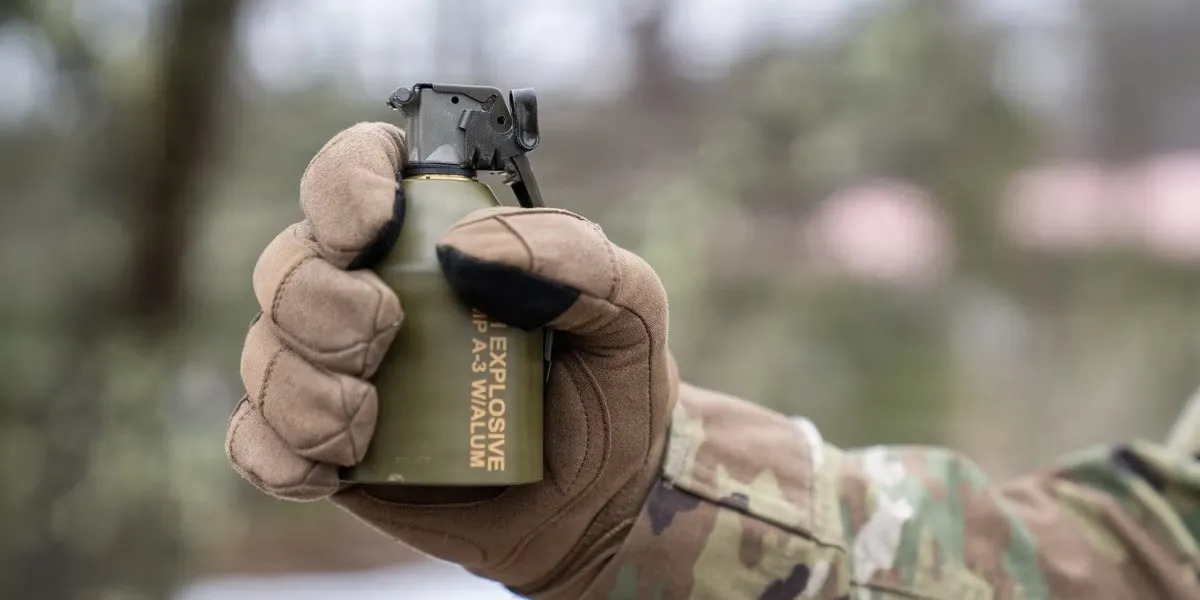
Why Timing Varies
Different grenades are designed for completely different purposes.
A fragmentation grenade, smoke grenade, stun grenade, incendiary device, and training grenade may use different fuze systems and behave differently.
Even within one category, assuming an exact delay is unsafe. A munition may also be old, damaged, modified, corroded, or unexploded from an earlier use.
Factor | Why it matters |
|---|---|
Grenade type | Different designs use different mechanisms |
Fuze | Determines how initiation occurs |
Condition | Damage or age can make behaviour unpredictable |
Previous use | A dud may remain extremely dangerous |
Identification | Similar-looking munitions may function differently |
The U.S. Army Corps of Engineers warns that unexploded ordnance should always be considered extremely hazardous because disturbing it can cause an explosion.
Pin vs. Activation
This is probably the biggest misconception.
Pulling a safety pin does not necessarily mean "the timer has started." In common lever-equipped designs, the pin helps prevent the safety lever from moving. Once the relevant safety mechanisms are removed and the lever is released, the fuze mechanism can initiate.
That distinction explains why movie scenes showing someone dramatically holding an unpinned grenade aren't a reliable guide to how every real grenade behaves.
More importantly, it shouldn't be interpreted as a handling technique. Real grenades aren't objects to experiment with.
Movies vs. Reality
Films need suspense, so grenades often behave according to whatever makes the scene work.
You'll see characters pulling pins with their teeth, holding grenades indefinitely, predicting the explosion perfectly, or deliberately waiting before throwing them.
Real military safety guidance is considerably less cinematic. The U.S. Army explicitly says personnel should not attempt to "cook-off" certain grenades and stresses correct identification and trained handling.
Personally, I'd put grenade countdowns in the same category as cars exploding whenever somebody shoots them: useful for Hollywood tension, terrible as technical education.
Emergency Safety
If you ever encounter what appears to be a grenade, unexploded shell, bomb, or other military munition, don't try to determine whether it's active.
The U.S. Army Corps of Engineers recommends the "3Rs":
Recognize that it may be dangerous.
Retreat without touching, moving, or disturbing it.
Report it to local emergency or law-enforcement authorities once you're safely away.
Old doesn't mean harmless either. Military safety guidance warns that munitions may become more dangerous with age, not safer.
Frequently Asked Questions (FAQs)
1. Does pulling a grenade pin immediately start the fuze?
Not necessarily. In common lever-equipped designs, activation is associated with the safety lever being released after safety mechanisms have been removed.
2. Do all grenades have the same delay?
No. Different grenade and fuze designs operate differently.
Must Read: Which country has the most powerful army?