
The answer depends on which measurement standard you're using.
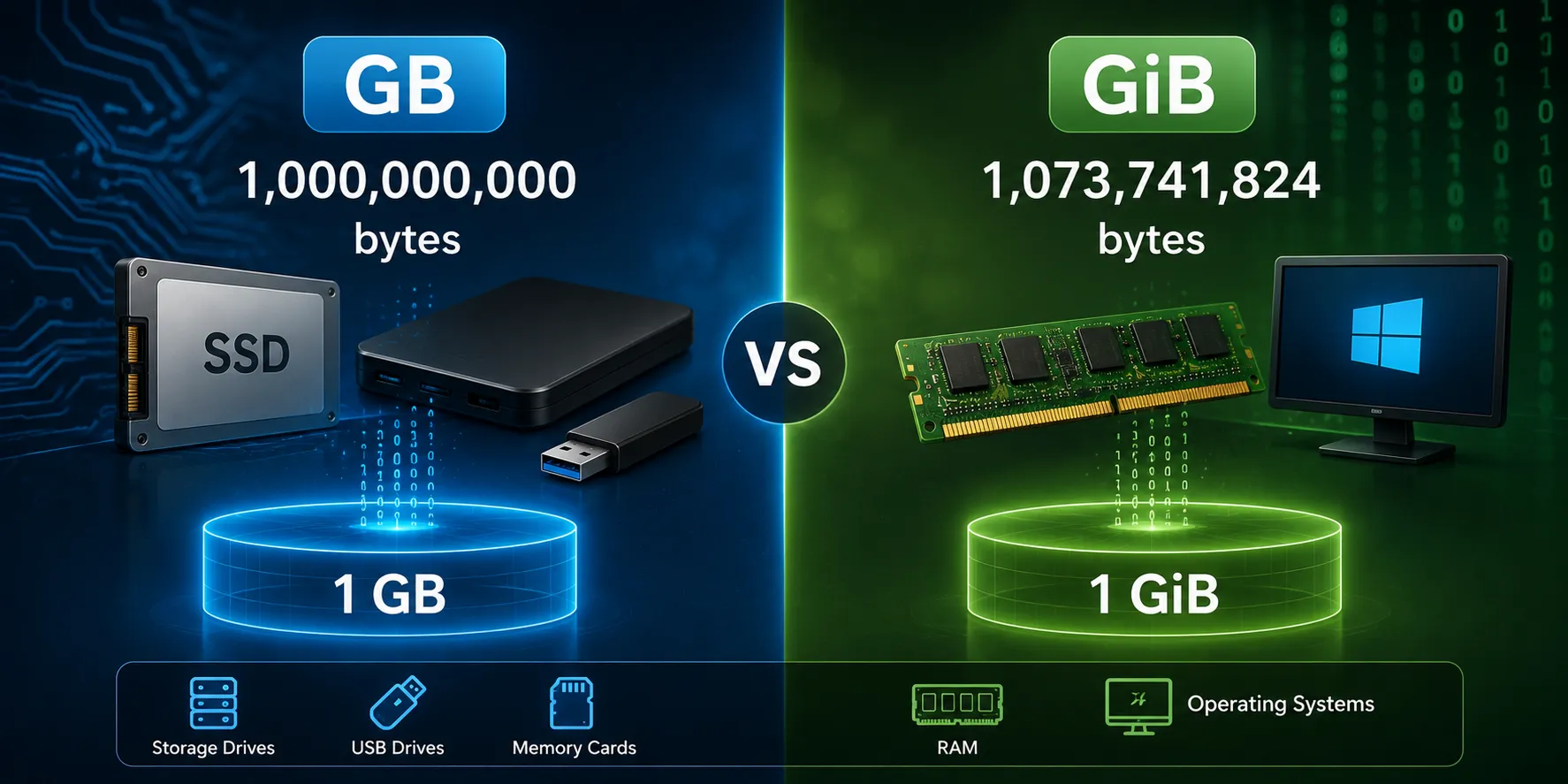
- 1 Gigabyte (GB) = 1,000,000,000 bytes under the decimal (SI) standard. This is the official definition used by storage manufacturers and international standards organizations.
- 1 Gibibyte (GiB) = 1,073,741,824 bytes under the binary standard. Many operating systems and memory-related calculations have historically used this value, which is why people sometimes say a gigabyte has 1,073,741,824 bytes.
If you're buying a hard drive or SSD, 1 GB almost always means 1,000,000,000 bytes. If you're talking about RAM or older operating system calculations, you'll often encounter the binary value instead.
Different Standards
The confusion exists because two different measurement systems are used in computing.
1. Decimal Standard (SI)
This is the internationally accepted definition.
1 GB = 1,000,000,000 bytes
It follows powers of 10:
- 1 KB = 1,000 bytes
- 1 MB = 1,000,000 bytes
- 1 GB = 1,000,000,000 bytes
This standard is used by:
- SSD manufacturers
- Hard drive manufacturers
- USB drives
- Memory cards
- Internet data plans
- Most storage packaging
The International Electrotechnical Commission (IEC) recommends this definition for the unit gigabyte (GB).
2. Binary Standard
Computers naturally work using binary (base 2) instead of decimal (base 10).
In binary calculations:
1 GiB = 1,073,741,824 bytes
That's because:
1024 × 1024 × 1024 = 1,073,741,824
To remove confusion, the IEC introduced a separate unit called the Gibibyte (GiB) in 1998.
So technically,
- GB = 1,000,000,000 bytes
- GiB = 1,073,741,824 bytes
Even today, many operating systems still display binary values while labeling them as "GB," which is why storage capacities sometimes appear smaller than advertised.
Comparison Table
| Unit | Decimal (SI) | Binary (IEC) |
|---|---|---|
| 1 KB | 1,000 bytes | 1,024 bytes (KiB) |
| 1 MB | 1,000,000 bytes | 1,048,576 bytes (MiB) |
| 1 GB | 1,000,000,000 bytes | 1,073,741,824 bytes (GiB) |
| Common Use | Storage devices, data plans | RAM, some operating systems |
A simple way to remember it is:
- GB → 1 billion bytes
- GiB → about 1.07 billion bytes
Practical Examples
This difference becomes obvious when you buy storage devices.
Example 1: A 500 GB SSD
The manufacturer advertises:
500 GB = 500,000,000,000 bytes
When your computer measures those same bytes using the binary system, it displays approximately:
466 GiB
Nothing is missing.
Your computer is simply using a different measurement standard.
Example 2: Smartphone Storage
A phone advertised with:
128 GB
contains:
128,000,000,000 bytes
The available storage shown after setup is usually lower because:
- The operating system occupies space.
- Pre-installed apps use storage.
- Some devices report capacity using binary calculations.
Example 3: Internet Data Plans
If your mobile provider offers:
100 GB
they almost always mean:
100 × 1,000,000,000 bytes
This follows the decimal standard used for commercial storage and networking.
Common Misconceptions
"A gigabyte always has 1,073,741,824 bytes."
Not exactly.
That's the binary value of 1 GiB, not the official SI definition of 1 GB.
"Storage manufacturers are cheating."
No.
Manufacturers follow the internationally accepted decimal definition:
1 GB = 1,000,000,000 bytes
The difference appears because many operating systems have historically used binary calculations while still displaying the label "GB."
"GB and GiB mean the same thing."
They don't.
They measure similar amounts of data but follow different standards.
GB uses base 10.
GiB uses base 2.
Gigabyte at a Glance
| Measurement | Bytes |
|---|---|
| 1 GB (Decimal) | 1,000,000,000 bytes |
| 1 GiB (Binary) | 1,073,741,824 bytes |
| Official SI Standard | Decimal |
| Common Binary Usage | RAM and some operating systems |
A gigabyte doesn't always represent the same number of bytes because two measurement standards coexist in computing. The official international definition is 1 GB = 1,000,000,000 bytes, and this is the value used by storage manufacturers, internet providers, and most commercial products. The larger number, 1,073,741,824 bytes, actually refers to a gibibyte (GiB), which follows the binary system used internally by computers. Once you understand the difference between GB and GiB, the mystery of why a new hard drive seems to "lose" storage suddenly makes perfect sense.
Frequently Asked Questions (FAQs)
1. How many bytes are in exactly 1 gigabyte?
According to the official SI standard, 1 gigabyte (GB) equals 1,000,000,000 bytes.
2. Why do some people say a gigabyte has 1,073,741,824 bytes?
That value comes from the binary measurement system and technically refers to 1 gibibyte (GiB) rather than 1 gigabyte.
3. Which standard do SSDs and hard drives use?
Storage manufacturers almost always use the decimal standard, where 1 GB = 1,000,000,000 bytes.
4. Why does my 500 GB drive show only about 466 GB?
Your computer is likely calculating capacity using the binary system (GiB), while the manufacturer labels storage using decimal gigabytes.
5. Is GB or GiB more correct?
Both are correct. GB is the official decimal unit, while GiB is the official binary unit introduced to eliminate confusion. The correct choice depends on the context.