Asked 6 years ago

How Many Cups Are in 8 Ounces? (8 oz to Cups)

Food & Cooking#8 oz to cups#how many cups are in an 8 oz#how many cups is 8 oz#how many cups in 8 oz
0
6.7K

Advertisement

Hey, help the community by sharing your answer.

Earn up to 300 points for helpful answers.

Login to Answer

8 oz to cups converts to exactly 1 cup when you're measuring a liquid like water, milk, or juice. That's the fixed rule in the US measuring system.

But if you're asking how many cups are in an 8 oz weight measurement, like flour or sugar, the answer changes. Dry ounces measure weight, not volume, so they don't convert the same way. Keep reading to see why.


How Many Cups Is 8 Oz? The Simple Answer

If you just need a quick number, here it is: 8 oz to cups equals 1 cup, as long as you're measuring a liquid.

This works because the US measuring system was built around this exact relationship. One cup always holds 8 fluid ounces. So if you're wondering how many cups is 8 oz of water, milk, or juice, the answer is always the same: one cup.

That said, there's a catch. The word "ounces" gets used for two very different things, and mixing them up is the top reason people miscount ingredients in the kitchen.
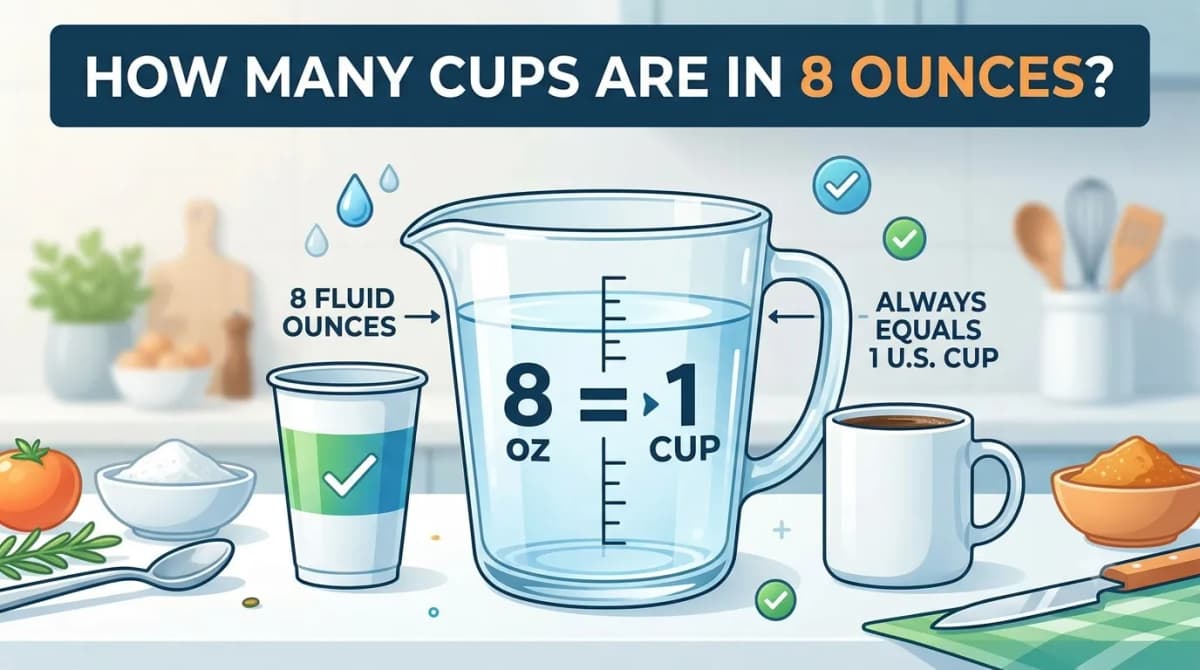
Kitchen chart showing 8 oz to cups conversion for liquids and dry ingredients like flour and sugar

Why "8 Ounces" Can Mean Two Different Things

Here's the part most kitchen conversion charts skip over.

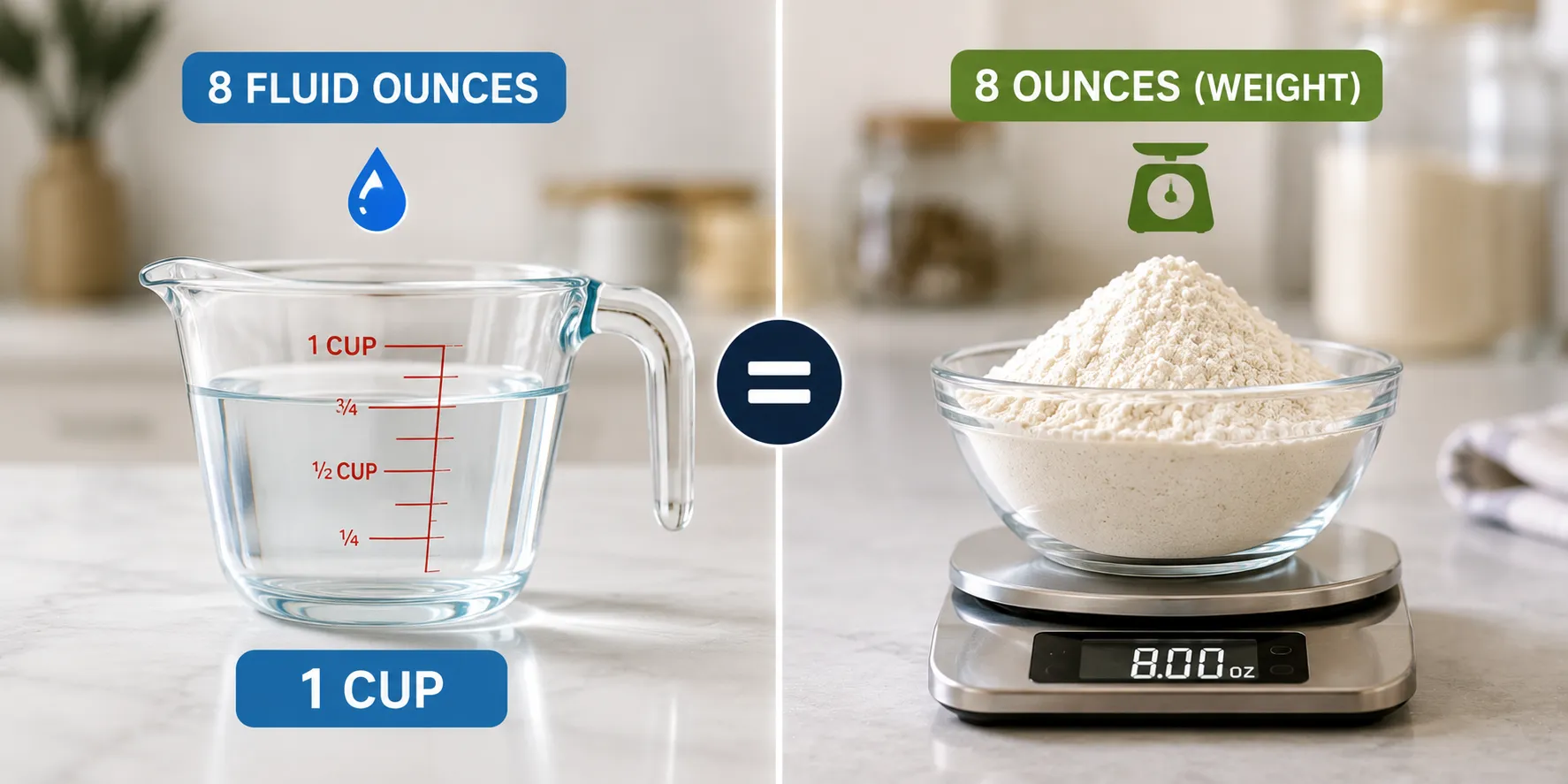
Fluid ounces measure volume — how much space a liquid takes up. Ounces (sometimes called dry ounces or weight ounces) measure weight — how heavy something is.

These are not the same unit, even though they share a name. A fluid ounce tells you how much room something takes up in your measuring cup. A weight ounce tells you how much something weighs on a scale.

So when people ask how many cups are in an 8 oz package of something, the honest answer is: it depends on what's inside.

  • Liquids: 8 fluid ounces always equals 1 cup. No exceptions.
  • Dry ingredients: 8 ounces by weight rarely equals exactly 1 cup, since different ingredients pack differently.

This is why a recipe that says "8 oz of flour" can throw off your baking if you scoop 1 cup and call it done.

How Much Is 8 Oz in Cups for Liquids (Fluid Ounces)

Let's start with the easy case, since this covers most everyday cooking questions.

For any liquid — water, milk, oil, juice, broth — the conversion never changes:

Fluid OuncesCups
2 fl oz1/4 cup
4 fl oz1/2 cup
6 fl oz3/4 cup
8 fl oz1 cup
16 fl oz2 cups
32 fl oz4 cups

So if you're wondering how many cups in 8 oz of water, the answer is simple: exactly 1 cup. The same goes for milk, juice, or anything else you'd pour from a carton or bottle.

This is also why a "standard glass" of water is often described as 8 ounces, or one cup, since that's the common US serving size.

How Many Cups Are in an 8 Oz Weight of Dry Ingredients

This is where things get more interesting, and where most online charts get sloppy.

When a recipe lists a dry ingredient in ounces, it's usually talking about weight, not volume. Since ingredients have different densities, 8 ounces of one ingredient can fill a very different amount of space than 8 ounces of another.

Here's how that plays out with common baking staples:

Ingredient8 oz (weight) in Cups
All-purpose flourAbout 1¾ to 2 cups
Granulated sugarAbout 1 to 1.1 cups
Butter1 cup
Shredded cheeseAbout 2 cups
Chocolate chipsAbout 1⅓ cups
Dry pastaAbout 2 cups
Rice (uncooked)About 1.2 cups

These numbers are approximate, because how you pack or scoop the ingredient changes the result. Flour that's sifted takes up more space than flour that's packed down, even at the exact same weight.

The safest fix: if a recipe gives you a weight in ounces, use a kitchen scale instead of guessing with a measuring cup. It takes ten extra seconds and it's far more accurate.

US Cups vs. UK Cups: Why This Matters Too

If you're following a recipe from outside the US, there's one more wrinkle worth knowing.

A US cup holds 8 fluid ounces (about 240 mL). But in the UK, Australia, and Canada, older references sometimes use a 10-fluid-ounce cup, though most modern recipes there now use the metric cup of 250 mL.

This means if you're checking how much is 8 oz in cups using a British or Australian recipe, the numbers won't line up exactly with a US measuring cup. When in doubt, check whether the recipe specifies "US cup" or "metric cup," or convert to grams and milliliters instead, since those units don't change between countries.

Quick Reference: Other Common Ounce-to-Cup Conversions

Since you're here for 8 oz to cups, you might also want these nearby amounts for liquids:

  • 1 oz = 1/8 cup
  • 2 oz = 1/4 cup
  • 4 oz = 1/2 cup
  • 6 oz = 3/4 cup
  • 8 oz = 1 cup
  • 12 oz = 1½ cups
  • 16 oz = 2 cups (1 pint)
  • 32 oz = 4 cups (1 quart)
  • 128 oz = 16 cups (1 gallon)

This chart works for any liquid. For dry ingredients, always check the specific ingredient, since the answer changes based on density, not just volume.

Common Mistakes to Avoid

A few small habits cause most measuring errors in the kitchen:

  • Assuming all "8 oz" means the same thing. Always check if a recipe means fluid ounces (volume) or ounces (weight).
  • Using a liquid measuring cup for dry ingredients. Liquid cups are designed to be read at eye level with the liquid settling naturally, while dry cups are made to be filled and leveled off flat.
  • Scooping flour straight from the bag. This packs it down and can add up to 20% more flour than the recipe intended. Spoon it into the cup instead, then level it off.
  • Ignoring the US vs. UK cup difference when following an international recipe.

Conclusion

So, how many cups are in 8 ounces? For any liquid, 8 oz to cups converts to exactly 1 cup, every time. For dry ingredients like flour, sugar, or cheese, the answer shifts depending on the ingredient's weight, so a kitchen scale is your most reliable tool.

Once you understand the difference between fluid ounces and weight ounces, kitchen conversions stop being confusing. Keep this guide handy next time a recipe leaves you second-guessing your measuring cup.


FAQs

How many cups is 8 oz? 
8 fluid ounces equals 1 cup. This is true for water, milk, juice, and most other liquids measured in the US system.

How many cups are in an 8 oz weight of flour? 
8 ounces of all-purpose flour is about 1¾ to 2 cups, depending on how it's packed or sifted. Using a kitchen scale gives you the most accurate result.

How much is 8 oz in cups for sugar? 
Close to 1 cup, but not exact. 8 ounces of granulated sugar is about 1 to 1.1 cups, since sugar is slightly denser than water.

Is a US cup the same as a UK cup? 
Not exactly. A US cup holds 8 fluid ounces (240 mL), while some UK and Australian references use a 10-fluid-ounce cup, though most modern recipes there use a 250 mL metric cup.

How many ounces are in 8 cups? 
8 cups equals 64 fluid ounces, since each cup holds 8 fluid ounces.

What's the difference between an ounce and a fluid ounce? 
An ounce measures weight, or how heavy something is. A fluid ounce measures volume, or how much space a liquid takes up. They aren't interchangeable.


Related conversions: How Many Ounces in a Quart?

Source & Reference

S

Answered By Scarlett Jackson

Executive Chef & Le Cordon Bleu grad turning kitchen-tested precision into everyday cooking answers.
View Profile

Scarlett Jackson is an Executive Chef and food writer with over 5 years of professional kitchen experience across fine dining, contemporary bistro, and large-scale catering environments. She holds a Grand Diplôme from Le Cordon Bleu, London and a Bachelor of Science in Culinary Nutrition from Johnson and Wales University, Providence — credentials that combine classical French technique with a working knowledge of the nutritional science behind food, giving her writing a precision most food content lacks. Her content covers professional cooking techniques, recipe development, kitchen equipment, ingredient sourcing, menu planning, food science, and the culinary trends shaping how restaurants and home cooks approach food today. Her work has appeared on platforms including Serious Eats, Food & Wine, and Epicurious, where she writes for readers who want food content built on real kitchen experience — tested recipes, technically accurate methods, and honest assessments of what actually works under heat and pressure. As an Executive Chef, Scarlett has managed kitchen brigades, developed seasonal menus, and overseen food operations serving hundreds of covers per service. She has published 180+ kitchen-tested recipes and food articles, competed at the American Culinary Federation (ACF) National Competition, and is a certified member of the ACF and the James Beard Foundation community of culinary professionals. Across all her writing, every recipe is tested to professional standards, every technique is verified in an actual kitchen, and no cooking trend is covered without assessing whether it holds up beyond the photograph — because food writing that cannot survive contact with a real stove is not worth the screen it is read on.

Updated on07/07/26
0

Advertisement

The answer depends on what kind of ounces we're talking about.

If you're measuring a liquid, then:

8 fluid ounces = 1 US cup

This is the standard conversion used in American recipes for ingredients like water, milk, oil, broth, and juice.

However, if you're talking about 8 ounces by weight (such as flour, sugar, cheese, or chocolate chips), it does not always equal 1 cup because different ingredients have different densities. That's one of the biggest reasons recipes sometimes don't turn out the way people expect.

Measurement Types

Before converting ounces into cups, it's important to know whether the recipe is referring to fluid ounces or weight ounces.

1. Fluid Ounces (Volume)

Fluid ounces measure how much space a liquid occupies.

Examples include:

  • Water
  • Milk
  • Juice
  • Oil
  • Vinegar

For these ingredients:

8 fluid ounces = 1 cup

This conversion is fixed and doesn't change.

2. Ounces (Weight)

Regular ounces measure weight, not volume.

Examples include:

  • Flour
  • Cocoa powder
  • Cheese
  • Butter
  • Nuts

Here, 8 ounces doesn't automatically mean 1 cup.

For example:

  • 8 oz water = about 1 cup
  • 8 oz flour = roughly 1¾–1⅞ cups
  • 8 oz shredded cheese = about 2 cups

The ingredient itself determines the conversion because every food has a different density.

Article image

Conversion Table

Here's a quick reference for common liquid conversions.

Fluid OuncesCups
2 fl oz¼ cup
4 fl oz½ cup
6 fl oz¾ cup
8 fl oz1 cup
12 fl oz1½ cups
16 fl oz2 cups

For liquids, the simple rule is:

Cups = Fluid Ounces ÷ 8

Practical Examples

This is where understanding measurements really matters.

Example 1: Measuring Water

Recipe says:

8 fluid ounces of water

Simply pour:

1 cup

Perfect.

Example 2: Measuring Milk

Need:

8 fluid ounces of milk

Again:

1 cup

No conversion needed.

Example 3: Measuring Flour

Recipe says:

8 ounces of flour

This is not 1 measuring cup.

The recipe is referring to weight, so the correct tool is a kitchen scale, not a measuring cup.

As someone who regularly writes about food and cooking, I also spend a lot of time experimenting with recipes. One lesson I've learned is that measurements aren't just numbers on a page, but they're often the difference between a recipe that works and one that doesn't.

A little extra flour can make a cake dense.

A little less milk can change the texture of pancake batter.

Too much oil can completely alter a dressing.

These differences may seem small, but they become very noticeable in baking and even in everyday cooking. That's why experienced home cooks and professional chefs pay close attention to whether a recipe is asking for fluid ounces or ounces by weight before measuring anything.

Common Mistakes

Assuming every 8 ounces equals 1 cup

This is probably the most common mistake.

It's only true for 8 fluid ounces, not every ingredient.

Using a Liquid Measuring Cup for Flour

Liquid measuring cups are designed for liquids.

Dry ingredients should be measured with dry measuring cups or, even better, a digital kitchen scale.

Ignoring Weight-Based Recipes

Many professional baking recipes use grams or ounces because they're much more accurate than measuring by volume.

If a recipe specifies 8 oz flour, don't convert it to 1 cup unless the recipe explicitly says "fluid ounces."

Cups and Ounces at a Glance

MeasurementEquivalent
8 fluid ounces1 cup
16 fluid ounces2 cups
32 fluid ounces4 cups
8 ounces (weight)Varies by ingredient

Knowing that 8 fluid ounces equals 1 cup is one of the most useful kitchen conversions, but it's only half the story. The real skill is recognizing whether a recipe is talking about volume or weight. Liquids follow a straightforward conversion, while dry ingredients depend on their density and are often best measured with a kitchen scale. Once you understand this distinction, you'll avoid one of the most common cooking mistakes and get far more consistent results, especially when baking.

Frequently Asked Questions (FAQs)

1. A recipe says 8 ounces of flour. Should I use 1 cup?

No. Flour is usually measured by weight in this case, so 8 ounces of flour is not equal to 1 cup. A kitchen scale is the most accurate option.

2. Is 8 ounces of water the same as 1 cup?

Yes. 8 fluid ounces of water equals exactly 1 US cup.

3. Why do professional bakers prefer weighing ingredients instead of using cups?

Weight measurements are more precise and eliminate variations caused by scooping, packing, or ingredient density, leading to more consistent baking results.

4. Can I use the same measuring cup for dry and liquid ingredients?

It's better not to. Liquid measuring cups and dry measuring cups are designed differently, and using the correct one improves accuracy.

5. What's the easiest way to remember the conversion?

Remember this simple rule:

8 fluid ounces = 1 cup

If the recipe mentions ounces by weight, stop and check the ingredient before converting.

Must Read: How many ounces in a quart?

I

Answered By Ishaanvi Reddy

Helping home cooks master kitchen measurements with practical cooking experience, precise conversions, and recipe-tested guidance.
View Profile

Ishaanvi Reddy is a trained chef and food writer with over 4 years of professional experience in culinary arts and food content. She holds a Diploma in Culinary Arts from the Institute of Hotel Management (IHM), Hyderabad — a qualification that gives her food writing a level of technical accuracy that distinguishes it from content written without kitchen experience. Her content covers recipes, cooking techniques, ingredient guides, food culture, nutrition basics, and restaurant trends across India. Her work has appeared on platforms including Slurrp, Herzindagi Food, and Eat This Not That India, where she writes for home cooks and food enthusiasts who want content that is tested, practical, and rooted in real culinary knowledge — not just adapted from other sources. With hands-on kitchen experience spanning South Indian, North Indian, and Continental cuisines, Ishaanvi brings a cross-regional perspective to her food writing. She has published 150+ food articles and recipes, covering everything from everyday meal planning to deep dives into the science of cooking and the cultural history of Indian food. Across all her work, every recipe is kitchen-tested, every technique is chef-verified, and every recommendation comes from direct culinary experience — not guesswork.

Updated on07/01/26
0
A “cup” (unit of extent) is 8 fluid ounces.


If you’re looking to recognise what number of cups of xxxxx item to attain 8 oz. Of weight, we’d want to recognize the object so we can calculate that.


In case you’re looking to understand how many cups (as in the item used as a field for any other item) then we would want to recognise that glass’s quantity before we should decide how many it might take to reach eight fluid oz..


C

Answered By Chhavi Tyagi

Author
View Profile

Hi , I am Chhavi Tyagi. Basically i have done B.tech from computer science . I am a Digital Marketer as a profession

Updated on02/29/20
0

Advertisement