
India is one of the most linguistically diverse countries in the world. According to the Census of India 2011 language data, people reported thousands of mother-tongue names, which were linguistically grouped and classified; the final census tables recognize 121 languages at the broader language level. India also has 22 languages specifically recognized in the Eighth Schedule of the Constitution.
So, if someone asks, “How many languages are spoken in India?”, I wouldn't simply answer 22. Those are Scheduled Languages, not the total number of languages people actually speak.
Personally, I think India's linguistic diversity is something we sometimes don't even notice because multilingualism feels so normal here. You can travel a few hundred kilometres and suddenly hear a completely different language, script, and dialect.
Language Count Explained
The number depends on what exactly we're counting.
Category | Number |
|---|---|
Languages recognised in Census 2011 | 121 |
Scheduled Languages | 22 |
Mother-tongue labels reported | Thousands |
India's national language | None |
The Census of India C-16 dataset records population by mother tongue across the country and classifies those mother tongues under recognized languages.
This is why you'll see wildly different answers online—22, 121, 1,600, or even more. They aren't necessarily referring to the same thing.
22 Scheduled Languages
India's Constitution currently recognizes 22 Scheduled Languages:
Assamese, Bengali, Bodo, Dogri, Gujarati, Hindi, Kannada, Kashmiri, Konkani, Maithili, Malayalam, Manipuri, Marathi, Nepali, Odia, Punjabi, Sanskrit, Santali, Sindhi, Tamil, Telugu and Urdu.
These languages are listed in the Eighth Schedule of the Constitution.
One thing I find interesting is that being widely spoken doesn't automatically determine whether a language is Scheduled. Constitutional recognition has its own historical and legal context.
National vs. Official Language
A very common misconception is that Hindi is India's national language.
India actually has no constitutionally designated national language.
Article 343 provides that the official language of the Union is Hindi in Devanagari script. English also continues to be used for official Union purposes under the Official Languages Act.
So:
Hindi = official language of the Union
English = continues for Union official purposes
Hindi = not India's “national language”
That's a distinction worth getting right, especially in exams and general-knowledge content.
Linguistic Diversity
India's languages belong to several language families, including Indo-Aryan, Dravidian, Austroasiatic and Tibeto-Burman traditions.
And diversity doesn't stop at languages. Within Hindi, Bengali, Tamil, Marathi and other language communities, you'll encounter numerous regional speech varieties and dialects.
The Census also separately tracks bilingualism and trilingualism, which reflects how common speaking multiple languages is in India.
For me, this is what makes India's linguistic landscape fascinating. Language here can change with state, district, community and sometimes even the neighboring town.
Most-Spoken Languages
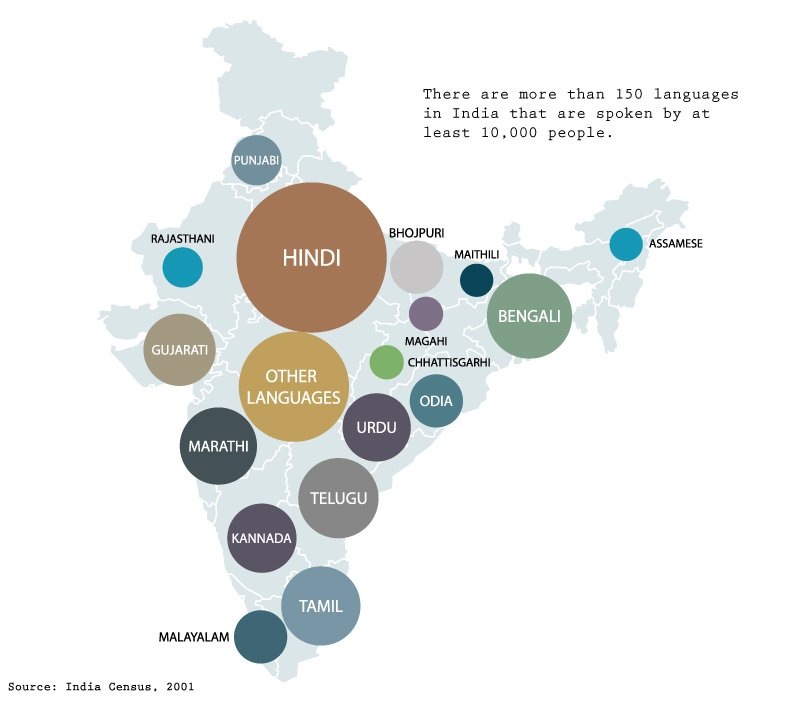
Hindi has the largest number of mother-tongue speakers in India. Bengali, Marathi, Telugu, Tamil, Gujarati, Urdu, Kannada, Odia and Malayalam are also among the country's major languages according to Census data.
But “most spoken” shouldn't be confused with “most important.” A language spoken by a relatively small Indigenous community can carry centuries of oral history, traditions and knowledge.
FAQs
How many languages are spoken in India?
Census 2011 recognizes 121 languages at its broader classified level, while many more mother-tongue names were reported.
How many Scheduled Languages does India have?
India has 22 Scheduled Languages.
What is the national language of India?
India does not have a constitutionally designated national language.
Is Hindi the official language of India?
Hindi in Devanagari script is the official language of the Union, while English also continues to be used for official purposes.
Must Read: How Languages Intersect Across India’s Diverse Cultures
.jpeg&w=640&q=75)