
There isn't a single correct answer because a tsunami and a tornado are dangerous in different ways.
If you're comparing overall destructive potential, a tsunami is generally considered more devastating because it can affect hundreds of kilometers of coastline, destroy entire communities, and result in massive loss of life and economic damage. Historic events like the 2004 Indian Ocean tsunami demonstrate how one tsunami can impact multiple countries at once.
However, if you're asking which disaster is more immediately violent at a local level, an EF4 or EF5 tornado can completely destroy homes and neighborhoods within minutes using winds that exceed 300 km/h (200+ mph).
The reality is that both are life-threatening natural disasters, and the level of danger depends on factors such as location, warning time, preparedness, and population density.
What Is a Tsunami?
A tsunami is a series of extremely powerful ocean waves, usually triggered by:
-
Underwater earthquakes
-
Volcanic eruptions
-
Underwater landslides
-
Rarely, meteorite impacts
Unlike normal sea waves caused by wind, tsunami waves carry an enormous amount of energy. As they approach shallow coastal waters, they grow dramatically in height and can travel far inland, sweeping away buildings, roads, vehicles, and infrastructure.
One of the most dangerous aspects of a tsunami is that it often arrives in multiple waves, with later waves sometimes being larger than the first.
What Is a Tornado?
A tornado is a rapidly rotating column of air that extends from a thunderstorm to the ground.
It forms over land and is known for:
-
Extremely high wind speeds
-
Narrow but intense damage paths
-
Sudden formation
-
Short duration
Although tornadoes usually affect a much smaller area than tsunamis, the damage inside their path can be catastrophic. Powerful EF5 tornadoes have the strength to level well-built homes, overturn heavy vehicles, and remove buildings from their foundations.
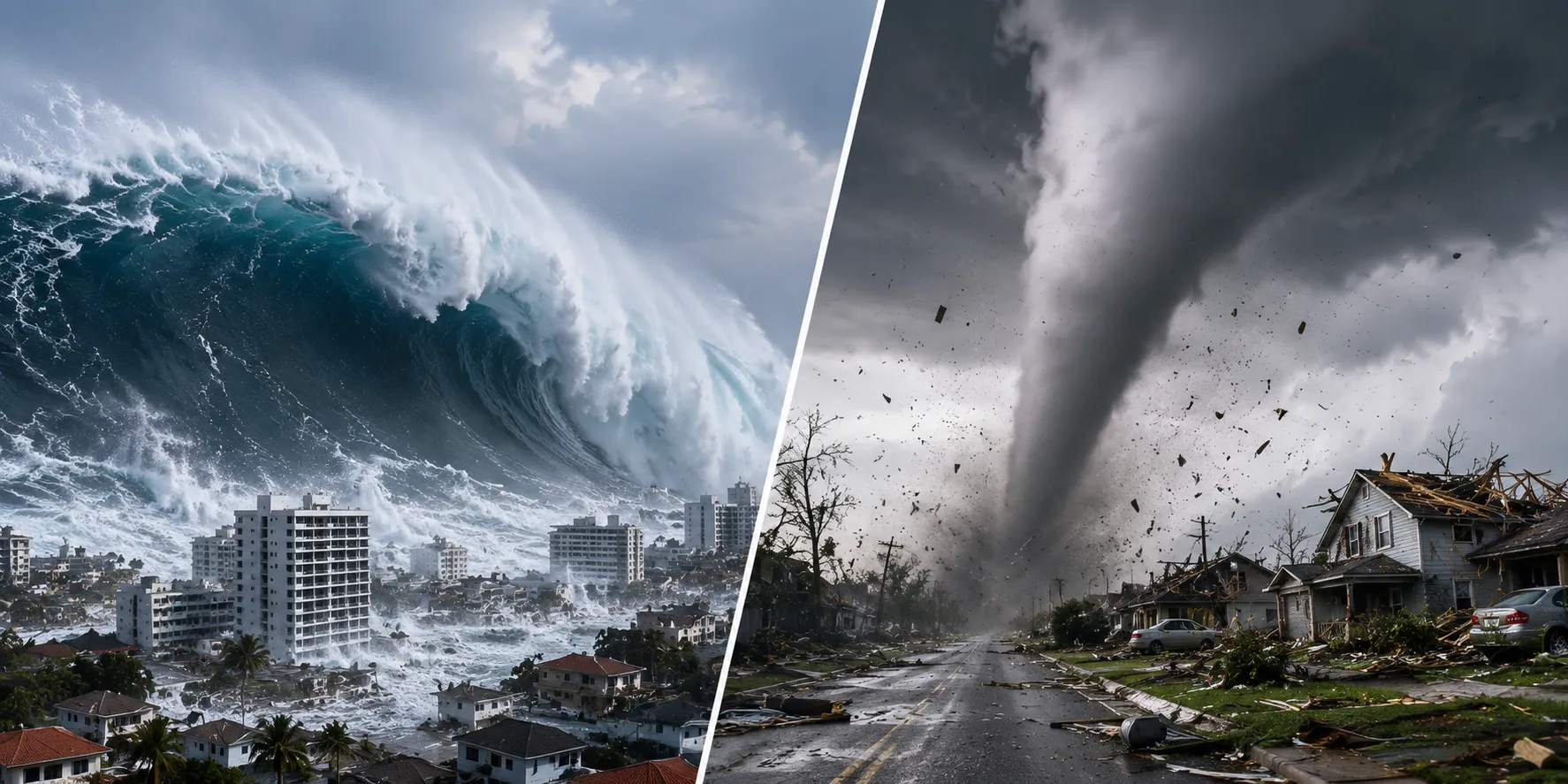
Tsunami vs Tornado Comparison
| Feature | Tsunami | Tornado |
|---|---|---|
| Cause | Underwater earthquake, volcanic activity, landslide | Severe thunderstorm |
| Location | Coastal areas | Mostly over land |
| Main Hazard | Massive flooding and wave impact | Extreme wind speeds and flying debris |
| Warning Time | Often minutes to several hours | Usually minutes |
| Area Affected | Entire coastlines or multiple countries | Localized path, often a few kilometers wide |
| Typical Duration | Several hours with multiple waves | Usually a few minutes |
| Economic Damage | Extremely high over large regions | Severe but generally localized |
Which Is More Dangerous?
If we're looking only at scale, tsunamis usually have the greater destructive potential.
A single tsunami can:
-
Affect several countries.
-
Displace hundreds of thousands of people.
-
Destroy ports, roads, hospitals, and entire coastal towns.
-
Cause long-term economic disruption.
Historic tsunami events have resulted in hundreds of thousands of deaths across multiple nations.
Tornadoes, on the other hand, are generally much smaller in geographic reach but can be incredibly destructive where they strike. A violent tornado can destroy a neighborhood in just a few minutes, leaving almost no time to react.
But here's something I've realized after reading survivor accounts and disaster reports.
People often ask,
"Which one is worse?"
From a scientific perspective, that's a valid comparison.
From a human perspective, it becomes much more difficult.
If someone loses their home, their parents, their children, or their entire community in a tornado, then for them, the tornado is the worst disaster imaginable.
If another family experiences the same loss in a tsunami, then the tsunami becomes their greatest tragedy.
Once lives are lost, the discussion stops being about which disaster is "more dangerous." It becomes about rebuilding lives that can never fully return to what they were. Both disasters leave behind emotional trauma, financial hardship, and communities that may take years or even decades to recover.
Safety Tips
Regardless of the disaster, preparation saves lives.
During a Tsunami
-
Move immediately to higher ground after a strong coastal earthquake.
-
Never wait to see the wave.
-
Follow official evacuation orders.
-
Stay away from beaches until authorities declare the area safe.
During a Tornado
-
Go to a basement or an interior room on the lowest floor.
-
Stay away from windows.
-
Protect your head and neck.
-
Monitor official weather warnings.
Modern warning systems have significantly reduced disaster-related deaths, but responding quickly remains one of the most important factors for survival.
Common Misconceptions
"A tsunami is just a giant wave."
Not exactly.
A tsunami is a series of powerful waves, not a single wave. Later waves can be larger than the first.
"Tornadoes only damage weak buildings."
False.
Powerful tornadoes can severely damage or destroy well-built structures, especially EF4 and EF5 tornadoes.
"One disaster is always more dangerous than the other."
Not necessarily.
The severity depends on:
-
Population density
-
Preparedness
-
Building quality
-
Warning systems
-
Location
-
Magnitude of the event
Frequently Asked Questions (FAQs)
1. Which causes more widespread destruction: a tsunami or a tornado?
Generally, a tsunami affects a much larger geographical area and can impact entire coastlines or multiple countries.
2. Which develops faster?
A tornado usually forms much more quickly, sometimes within minutes, while tsunamis are generated after major underwater events and may provide minutes to hours of warning depending on the distance from the source.
3. Can people survive a tsunami?
Yes. Early evacuation to higher ground and effective warning systems have saved countless lives during tsunami events.
4. Can a tornado destroy concrete buildings?
The strongest tornadoes can cause severe structural damage even to reinforced buildings, although well-designed storm shelters provide much better protection.
5. Which disaster causes greater economic losses?
Both can result in billions of dollars in damage. Tsunamis often produce larger regional economic losses because they affect extensive coastal infrastructure, while tornadoes create intense but usually more localized destruction.
Tsunami vs Tornado at a Glance
| Aspect | Tsunami | Tornado |
|---|---|---|
| Overall Reach | Very Large | Localized |
| Main Threat | Flooding & powerful waves | Extreme winds & debris |
| Typical Warning Time | Minutes to hours | Minutes |
| Potential Human Impact | Extremely High | Extremely High |
| Economic Damage | Regional to international | Local to regional |
| Can Either Be Called "Worse"? | No. Both can be catastrophic depending on where they strike and who is affected. |
Must Read: What is the cause of the Tsunami that has recently hit Indonesia?
 Answered by