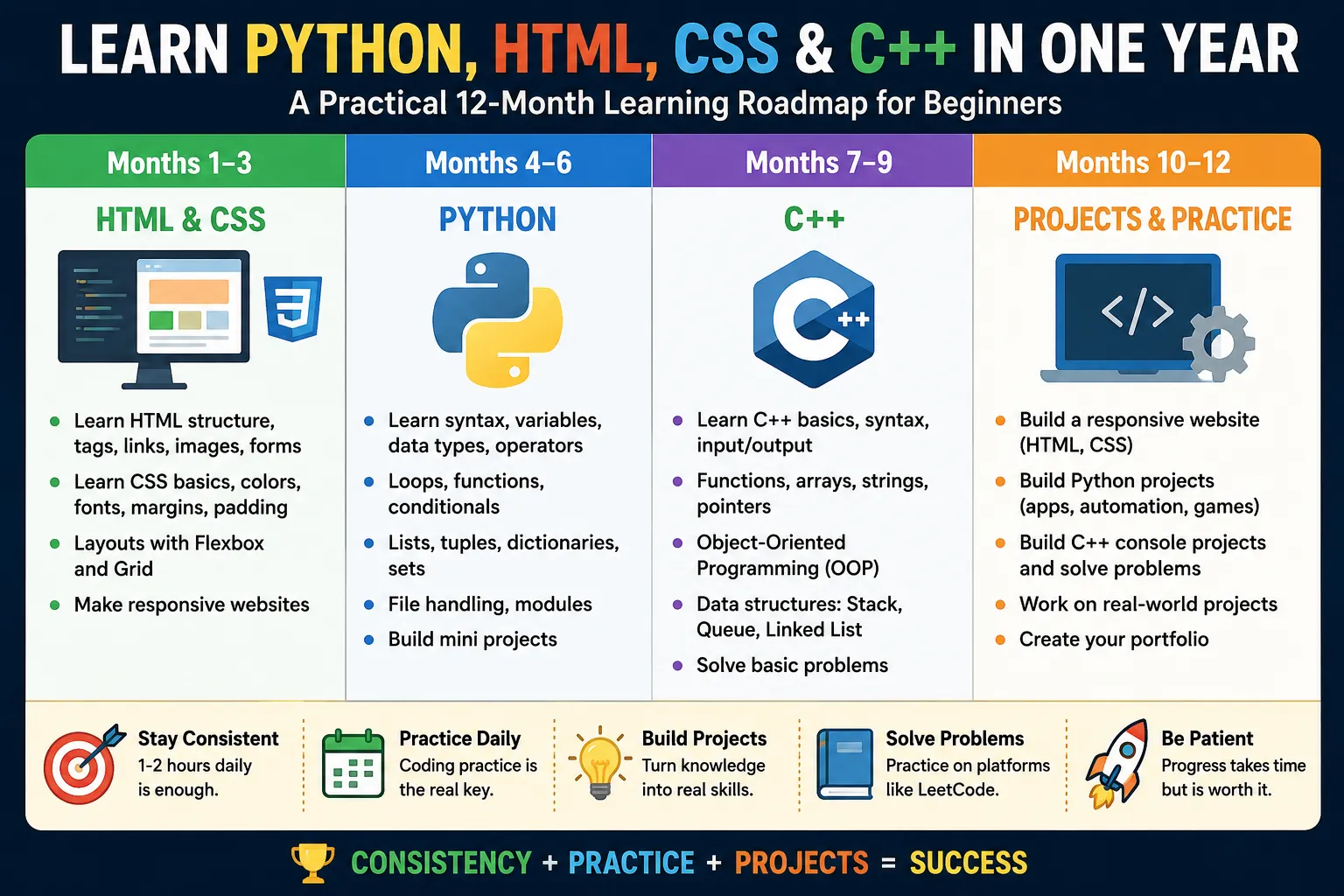
Yes, it is possible to learn Python, HTML, CSS, and C++ in one year, especially if you study consistently and practice through real projects. It may be difficult to become an expert in all four languages within 12 months, but you can build a strong beginner-to-intermediate foundation with a structured learning plan. HTML and CSS can usually be learned faster because they are focused on creating and styling web pages, while Python and C++ require more programming logic. A realistic approach is to learn the fundamentals first and then gradually move toward projects, problem-solving, and advanced concepts. Even 1–2 hours of focused practice each day can produce meaningful progress over a year.
A Practical One-Year Learning Plan
Period | Main Focus | What You Can Learn |
|---|---|---|
Months 1–3 | HTML + CSS | Web page structure, forms, layouts, responsive design, Flexbox and Grid |
Months 4–6 | Python | Variables, loops, functions, data structures, OOP and basic projects |
Months 7–9 | C++ | Syntax, functions, arrays, pointers, OOP and basic data structures |
Months 10–12 | Projects + Practice | Web projects, Python applications, C++ problems and portfolio development |
How Difficult Is It?
The difficulty depends mainly on your previous programming experience, study time, and consistency. HTML and CSS are generally easier to start with because you can see the results of your work immediately in a browser. Python has a relatively beginner-friendly syntax, making it a good first programming language for learning programming concepts.
C++ can be more challenging because it introduces concepts such as memory management, pointers, references, object-oriented programming, and more complex syntax. However, learning C++ after developing programming fundamentals with Python can make the transition easier.
You do not need to master every feature of these technologies. Instead, focus on understanding the fundamentals and using them to build practical projects.
What Should You Build?
Projects are one of the best ways to turn theoretical knowledge into practical skills. For example, you could create a responsive portfolio website with HTML and CSS, a calculator or automation tool with Python, and small console-based applications or data-structure programs with C++.
By the end of the year, you should aim to have several completed projects rather than simply finishing online courses.
Conclusion
Learning Python, HTML, CSS, and C++ in one year is achievable, but becoming highly advanced in all four is unrealistic for most beginners. A consistent schedule, hands-on projects, and regular problem-solving are more important than trying to study everything at once. If you study around 1–2 hours daily and follow a structured progression, you can develop a solid foundation and be ready to specialize in the technology that interests you most.
FAQs
1. Can a beginner learn Python, HTML, CSS, and C++ in one year?
Yes. A beginner can learn the fundamentals of all four within a year with consistent practice and a structured learning plan.
2. Which should I learn first, Python or C++?
Python is generally easier for beginners, so starting with Python can help you understand basic programming concepts before moving to C++.
3. How many hours should I study programming each day?
Around 1–2 focused hours per day can be enough to make steady progress. More important than the number of hours is maintaining consistency.
4. Can I get a programming job after learning these skills for one year?
It is possible, but knowing four technologies alone does not guarantee a job. Building a strong portfolio, practicing problem-solving, and developing job-relevant skills can significantly improve your chances.
Also read : Which is easy to learn, HTML or PHP?