V
Vikas joshi· 6 years ago
Providing reliable, well-researched content across diverse topics to inform, educate, and inspire readers.

Is noon 12AM or 12PM?

0
1K

Join this conversation

Sort By
Replying to the question above
Updated on06/27/26

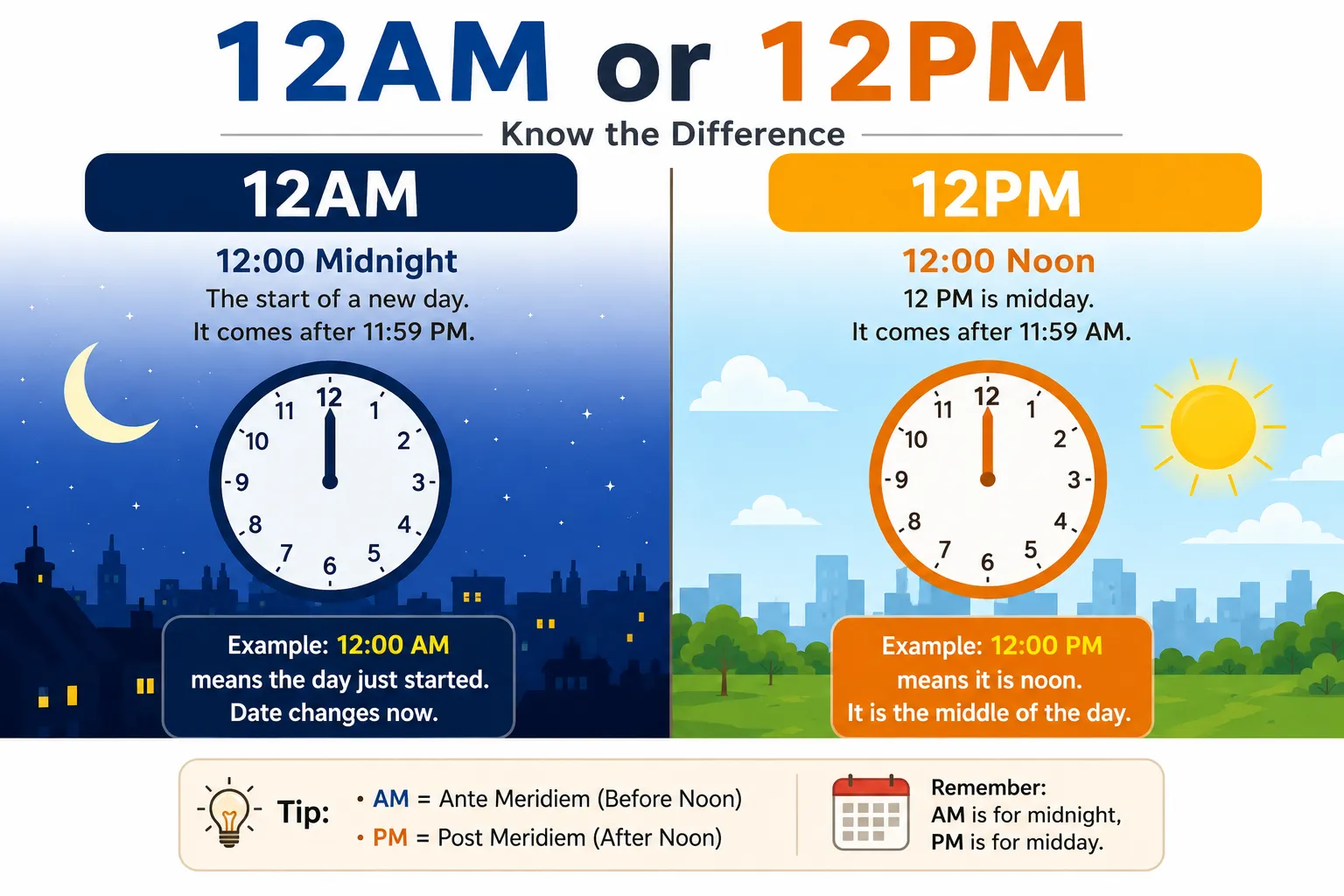
Noon is 12:00 PM.
Midnight is 12:00 AM.

This is one of those questions that confuses almost everyone at some point. I've even noticed airlines, event organizers, and businesses avoid writing 12:00 AM or 12:00 PM altogether because it's so easy to misinterpret. Instead, many simply write 12 noon or 12 midnight to eliminate confusion.

If you only remember one thing, remember this:

  • 12:00 PM = Noon

  • 12:00 AM = Midnight

Difference between 12 am and 12 pm

What Do AM and PM Mean?

The 12-hour clock divides a day into two parts.

  • AM stands for Ante Meridiem, a Latin phrase meaning "before midday."

  • PM stands for Post Meridiem, meaning "after midday."

A full day has 24 hours:

  • 12:00 AM → 11:59 AM = Morning (before noon)

  • 12:00 PM → 11:59 PM = Afternoon, evening, and night (after noon)

The interesting part is that 12 o'clock itself sits exactly at the transition, which is why people often get confused.

AM vs PM

TimeMeaningExample
12:00 AMMidnightStart of a new day
1:00 AM – 11:59 AMBefore noonMorning hours
12:00 PMNoonMiddle of the day
1:00 PM – 11:59 PMAfter noonAfternoon, evening, and night

A simple way to think about it is:

  • AM begins with midnight.

  • PM begins with noon.

Why Does the Confusion Exist?

The confusion comes from the meaning of AM and PM themselves.

Since:

  • AM means "before noon,"

  • PM means "after noon,"

people naturally wonder how 12:00 can be either before or after noon.

The reality is that 12:00 marks the exact moment of transition between the two halves of the day.

This is why many international style guides, digital calendars, and scientific organizations recommend writing:

  • 12 noon

  • 12 midnight

instead of 12 PM or 12 AM, especially in formal communication.

One small detail that many people don't know is that the 24-hour clock completely avoids this problem. Instead of using AM and PM, it simply uses:

  • 00:00 = Midnight

  • 12:00 = Noon

That's one reason why aviation, hospitals, railways, and the military often prefer the 24-hour time format.

Tips to Avoid Mistakes

Here are a few easy tricks that actually work:

Remember the Day Starts at Midnight

A new calendar day begins at 12:00 AM.

For example:

  • Monday starts at 12:00 AM Monday.

Noon Is Halfway Through the Day

Since noon marks the middle of the day, it's always 12:00 PM.

Use "Noon" and "Midnight"

When sending invitations, scheduling meetings, or booking appointments, it's often clearer to write:

  • 12 noon

  • 12 midnight

instead of relying on AM or PM.

Use the 24-Hour Clock

If accuracy is important, use:

  • 00:00 for midnight.

  • 12:00 for noon.

This completely removes ambiguity.

Noon and Midnight at a Glance

TimeCorrect Term
12:00 AMMidnight
12:00 PMNoon
AMBefore noon
PMAfter noon
24-Hour Format00:00 = Midnight, 12:00 = Noon

Noon is 12:00 PM, while midnight is 12:00 AM. Although these two times often cause confusion because they mark the transition between AM and PM, remembering that the day starts at midnight (12 AM) and reaches its midpoint at noon (12 PM) makes them much easier to distinguish. For formal communication, writing "12 noon" or "12 midnight" is often the clearest option.

Frequently Asked Questions (FAQs)

1. Is noon 12 AM or 12 PM?

Noon is 12:00 PM. It marks the middle of the day.

2. Is midnight 12 AM or 12 PM?

Midnight is 12:00 AM. It marks the beginning of a new calendar day.

3. Why do people confuse 12 AM and 12 PM?

Because 12:00 is the exact transition point between AM and PM, making the Latin meanings ("before noon" and "after noon") seem confusing.

4. Is it better to write 12 noon instead of 12 PM?

Yes. Many organizations prefer writing 12 noon and 12 midnight because they're less likely to be misunderstood.

5. What is 12:00 noon in the 24-hour clock?

12:00 noon = 12:00 in the 24-hour format, while midnight = 00:00.

Must Read: Who invented clock?

H
Six years of research-backed expertise — making well-sourced, reliable content that readers and platforms can depend on.
View Profile

Himani Sharma is a subject matter expert and content writer with over 6 years of experience covering travel, government schemes, and personal development across digital platforms in India. She holds a Master's degree in Social Sciences from Banaras Hindu University (BHU), an academic background that informs the research depth and analytical approach she brings to every topic she covers. Her content spans domestic and international travel guides, breakdowns of central and state government welfare schemes, and practical personal development resources for Indian readers navigating career, finance, and everyday life decisions. Her work has appeared on platforms including Nativeplanet, Sarkari Result Blog, and UrbanClap Stories, where she has built a reputation for content that is thoroughly researched, clearly structured, and genuinely useful. Over six years, Himani has published 200+ articles across her subject areas, developing a methodical content approach — verified sources, evidence-based arguments, and writing that serves the reader's actual information need rather than just ranking for keywords. Her subject matter grounding gives her a consistent edge in producing content that holds up to professional scrutiny across three distinct but equally research-intensive categories. Across all her writing, her standard remains the same — research first, clarity always, and content that serves the reader rather than just filling a page.

0
Replying to the question above
Updated on05/27/26

The question of whether noon is 12 AM or 12 PM is a common confusion in time notation, especially when using the 12-hour clock system. To understand it clearly, we first need to know how AM and PM work.

AM stands for “Ante Meridiem,” which means “before midday,” while PM stands for “Post Meridiem,” meaning “after midday.” Based on this system, the 12-hour clock divides the day into two parts: from midnight to noon (AM) and from noon to midnight (PM).

Now, the important point is that noon is 12 PM, not 12 AM. Noon refers to the middle of the day when the sun is at its highest point in the sky. Since PM represents the time after midday, 12 noon correctly falls under PM.

On the other hand, 12 AM is midnight, which marks the start of a new day. At 12 AM, the clock resets from 11:59 PM of the previous day and begins a new 24-hour cycle. So, midnight is the transition point between one day and the next.

The confusion happens because 12 is used for both midnight and noon, but they represent opposite points in time. To make it easier, remember this simple rule:

  • 12:00 AM = Midnight (start of the day)
  • 12:00 PM = Noon (middle of the day)

In the 24-hour clock system, this confusion does not exist. Noon is written as 12:00, and midnight is written as 00:00. This system is widely used in military, aviation, and many countries because it avoids ambiguity.

Understanding this difference is important in daily life, especially when scheduling meetings, flights, or events. A small mistake between AM and PM can lead to confusion or missed appointments.

In conclusion, noon is correctly referred to as 12 PM, while midnight is 12 AM. AM represents the morning hours before midday, and PM represents the afternoon and evening hours after midday. Knowing this simple rule helps avoid confusion and ensures accurate time interpretation in both personal and professional life.

 Continue reading another exciting discussion here:- Who invented clock?

M
View Profile
0
Replying to the question above
Updated on05/27/26

AM and PM are abbreviated forms of the Latin words Ante Meridian and Post Meridian respectively. where

AM (Ante Meridian) has English meaning Before Noon and Hindi meaning before noon or in the morning. This time is from 12 o'clock in the night to 12 o'clock in the day. Therefore, the term AM is used over time to indicate the mean time.
 
PM (Post Meridian) has English meaning After Noon and Hindi meaning after noon or afternoon. This time is from 12 o'clock in the day to 12 o'clock in the night. Therefore, the term PM is used over time to indicate the mean time.
 
So At noon 12 is PM.
C
View Profile

Hi , I am Chhavi Tyagi. Basically i have done B.tech from computer science . I am a Digital Marketer as a profession

0