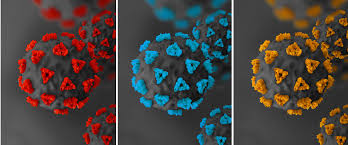
There are variants getting attention right now, but none is a genuine “new threat” so far. Health agencies don’t currently classify any of them as a variant of concern.
What WHO is tracking
WHO’s current list has JN.1 as a Variant of Interest, and XFG, NB.1.8.1, PQ.16.1.1 and BA.3.2 as Variants Under Monitoring. “Under monitoring” is the mildest category: it just signals to health authorities that a variant may need prioritized attention.
The two names you’ll see in headlines
XFG (“Stratus”) is the one actually dominating right now. The UK Health Security Agency says XFG remains the most common variant and is not new, having circulated in the UK and elsewhere for around a year. The “American Covid” label that some media use is just a nickname.
BA.3.2 (“Cicada”) is the more unusual one. It is a highly divergent descendant of the Omicron BA.3 lineage that re-emerged in South Africa in late 2024 and has since been detected sporadically across multiple continents. WHO designated it a variant under monitoring on 5 December 2025. The “Cicada” nickname comes from how it lay low for a long time before starting to spread.
Is it more dangerous?
Based on what I found, no evidence says so. WHO assesses the public health risk from BA.3.2 as low, with no evidence of increased severity, hospitalisation or mortality, though the evidence is still limited. UKHSA said on 8 October 2026 that current data doesn’t show these variants cause more severe illness than others circulating. Symptoms also look similar to earlier strains.
Vaccines
The US FDA recommended XFG as the preferred antigen for the 2026-27 COVID vaccine, and European regulators have also recommended updating vaccines to target XFG. I only found this on a secondary news site, so check the FDA or EMA announcements if you need certainty.
An honest caveat about the data
Be careful with any specific case numbers you see. WHO itself warns that declining and unrepresentative surveillance and sequencing make it harder to quickly assess known variants and detect new ones. So “no new dangerous variant” really means “none has been detected,” and the detection system is weaker than it used to be. Also, many health blogs and symptom-checker sites are repeating the same nicknames with some hype, so I’d rely on WHO and UKHSA over them.
What I’d actually do
This is my general advice, not from the sources above: if you’re older, pregnant, immunocompromised or have a chronic illness, ask your doctor about this season’s vaccine. Test if you have symptoms, stay home if you’re sick, and see a doctor if you have trouble breathing or symptoms that get worse. For healthy people, there’s no reason for alarm based on current data.
If you tell me which country you’re in, I can look up the local situation and vaccine guidance.