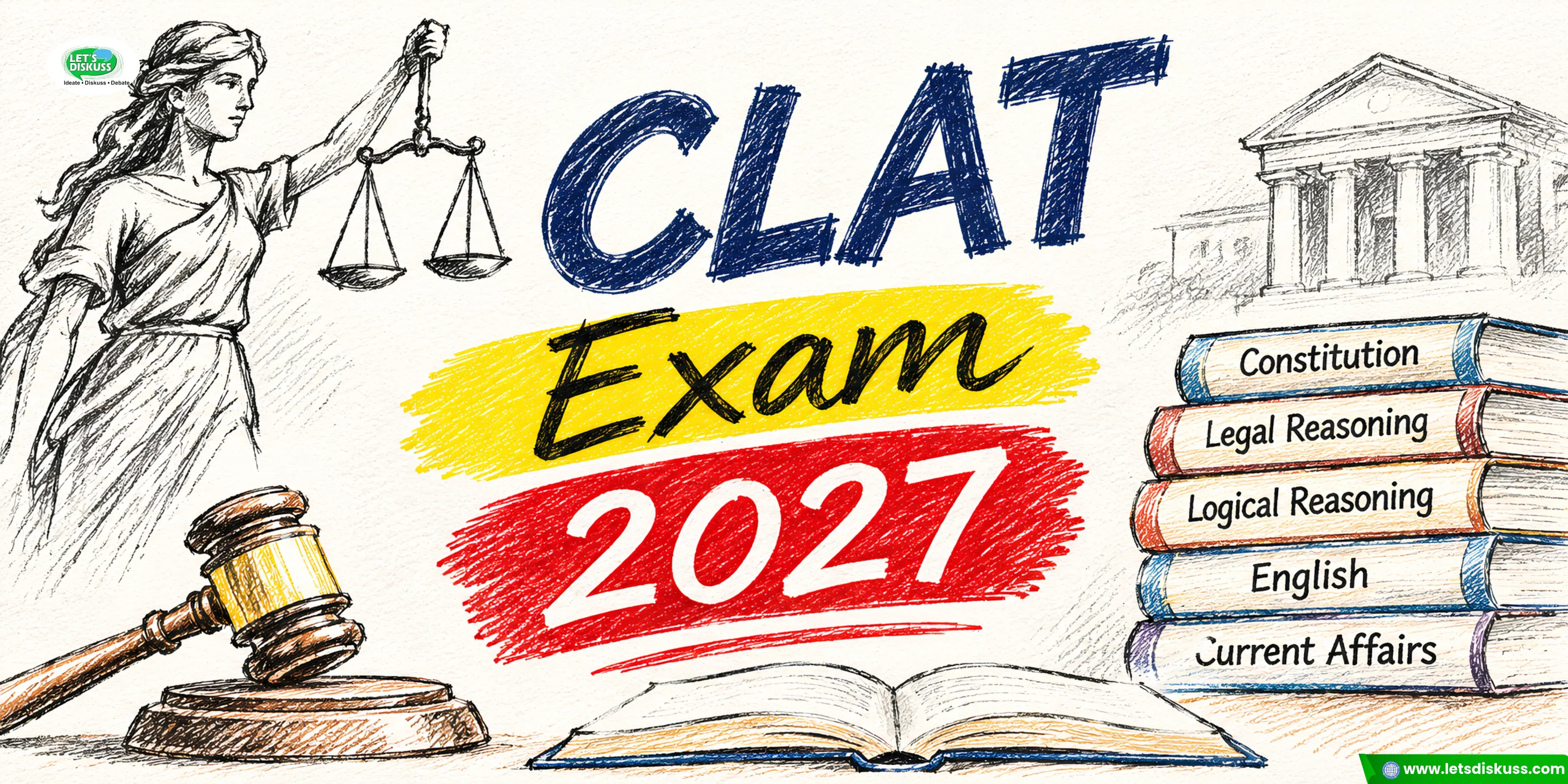
Quick Answer
CLAT 2027 takes place on Sunday, 6 December 2026, from 2:00 pm to 4:00 pm, in offline mode. The paper has 120 multiple-choice questions for 120 marks, with 0.25 marks deducted for each wrong answer. Admit cards went live on 21 November 2026 and stay available until 1:30 pm on exam day. Eligible candidates with disabilities get extra time until 4:40 pm.
What Is CLAT UG 2027?
The Common Law Admission Test is the national gateway to 26 National Law Universities, and the CLAT exam 2027 decides admission to their five-year programmes for academic year 2027-28. The undergraduate paper covers the BA LLB (Hons) integrated law course at most campuses, while the postgraduate paper handles the one-year LLM. The Consortium of NLUs runs the test, and several affiliate universities and organisations also use the scores.
Among the law entrance exams 2027, CLAT carries the widest reach, which explains why a single Sunday afternoon draws so much anxiety.
CLAT 2027 Notification and Key Dates
The Consortium issued its notification through a press release dated 22 July 2026, after its Executive Committee and Governing Body met on 18 July. Every official notice lives on consortiumofnlus.ac.in, so that site is the reference point for any date in this guide.
| Event | Date |
|---|---|
| Press release and notification | 22 July 2026 |
| Applications open | 3 August 2026 |
| Applications closed | 31 October 2026, 11:59 pm |
| Admit card (UG and PG) | 21 November 2026, 10:00 am, until 6 December, 1:30 pm |
| CLAT 2027 | Sunday, 6 December 2026 |
| Exam timing | 2:00 pm to 4:00 pm |
| Timing for eligible PwD candidates | 2:00 pm to 4:40 pm |
CLAT 2027 Exam Date and Timing
The test falls on Sunday, 6 December 2026, with the paper running from 2:00 pm to 4:00 pm. The Consortium adds that the schedule is subject to revision in case of necessity, which is a polite way of saying that only the admit card has the final word. Last cycle, the test took place on 7 December 2025, and the result followed on 16 December.
CLAT 2027 Eligibility
Indian nationals, NRIs, PIO card holders and OCI card holders can apply for the undergraduate programme. The Consortium sets no upper age limit for the undergraduate paper. Candidates need a pass in Class XII or an equivalent examination with at least 45% marks or the equivalent grade, relaxed to 40% for SC, ST and PwD candidates. Students appearing for the qualifying examination in March or April 2027 may also apply, but evidence of passing must be produced at admission, and without it a candidate loses the right to be considered.
Can I take CLAT after 12th drop year?
Yes. A gap year is not a barrier, because the Consortium sets no upper age limit and no cap on attempts is published. What counts is the Class XII result and the minimum marks. Droppers also enjoy one real advantage: they have already seen the pressure of a board year, and the CLAT paper rewards calm.
CLAT 2027 Exam Pattern
The Consortium's question format for 2027 matches recent years. The paper is a single two-hour sitting, and the CLAT 2027 pen and paper mode means answers go on an OMR sheet and not on a screen. Every question is passage-based and multiple-choice, which rewards fast, accurate reading.
| Section | Questions | Share |
|---|---|---|
| English Language | 22 to 26 | About 20% |
| Current Affairs, including General Knowledge | 28 to 32 | About 25% |
| Legal Reasoning | 28 to 32 | About 25% |
| Logical Reasoning | 22 to 26 | About 20% |
| Quantitative Techniques | 10 to 14 | About 10% |
| Total | 120 | 100% |
Each correct answer earns one mark, and each wrong answer costs 0.25 marks. Unattempted questions carry no penalty. If two candidates finish on the same score, the tie is broken first by marks in Legal Aptitude, then by age, and finally by a computerised draw of lots.
Notice the weight in the table: Current Affairs and Legal Reasoning together make up about half the paper. That is where a revision plan earns its keep.
How to Spend 120 Minutes on 120 Questions
The arithmetic is generous only on paper: one minute per question sounds comfortable until a long legal passage eats four of them. Passages in English and Legal Reasoning demand the most time, while Quantitative Techniques and many Logical Reasoning questions move faster. Candidates who bank quick marks early tend to reach the dense passages with time in hand and a calmer pulse.
The Consortium's expert committee reviewed reforms to be implemented from 2027, yet the published format for this cycle keeps the familiar structure of 120 questions in two hours.
CLAT 2027 Syllabus
The Consortium describes sections and weightage, while the topics below reflect what recent papers have drawn on:
- English Language: comprehension passages, with questions on meaning, inference, tone and vocabulary in context.
- Current Affairs, including General Knowledge: passages on recent national and international events, along with static facts.
- Legal Reasoning: passages stating legal principles, followed by fact situations that candidates must apply the principle to.
- Logical Reasoning: arguments, assumptions, inferences, analogies and logical sequences.
- Quantitative Techniques: basic mathematics from graphs, tables and short numerical passages.
CLAT 2027 Important Topics
Current affairs deserves the most attention, since it is both large and perishable. Focus on major court rulings, constitutional developments, international events and awards from the past year. In Legal Reasoning, practise principle-and-facts questions drawn from contract law, tort law, criminal law and constitutional law. Quantitative Techniques is the smallest section, so a handful of graph and ratio drills usually covers it.
CLAT 2027 Admit Card
The admit card for both UG and PG candidates went live on 21 November 2026 at 10:00 am, in a notice issued by the President of the Consortium. It can be downloaded from your application portal until 1:30 pm on 6 December, the same moment candidates must be seated, so leave it nowhere near the last minute. The download takes two steps:
- Log in to your CLAT 2027 account.
- Click the Download Admit Card button.
Print it on clean paper, and keep a spare copy in a separate folder. Candidates who face a problem can write to [email protected] or call 080-47162020, which answers from Monday to Saturday between 10:00 am and 5:00 pm.
CLAT 2027 Exam Day Guidelines
The Consortium publishes test-day instructions close to the exam, and the pattern in recent cycles has been consistent. Candidates may enter the centre from 1:00 pm and must be seated by 1:30 pm. A bell at 2:00 pm starts the paper, and entry closes at 2:15 pm. In the CLAT 2025 cycle, candidates could not leave the hall before 4:00 pm. Treat these as the working rhythm, and let the admit card settle any difference. A test centre or city can also be changed by the Executive Committee, so read the final admit card line by line.
What to carry to CLAT exam centre
- The printed admit card.
- A valid government-issued photo ID.
- Pens, since the OMR sheet is marked by hand.
- A transparent water bottle.
- A disability certificate or UDID, for candidates claiming extra time.
- Nothing electronic: phones, headphones and digital watches are not allowed in the hall.
Mistakes That Cost Candidates Marks
- Arriving after the 2:15 pm bell, which closes entry to the centre.
- Spending ten minutes on one stubborn passage while easier ones wait.
- Guessing blindly, when each wrong answer subtracts 0.25 marks.
- Marking the OMR sheet in a rush at the end and shading the wrong bubble.
- Treating current affairs as optional reading, even though it carries about a quarter of the paper.
CLAT 2027 Preparation Tips for the Final Stretch
Fifteen days sit between 21 November and the exam on 6 December. That is short, yet long enough to remove most avoidable mistakes.
How to revise for CLAT in 15 days
- Days 1 to 4: revise current affairs notes from the past year and finish two timed mocks. Record every wrong answer along with its cause, such as a misread passage or a rushed guess.
- Days 5 to 9: alternate Legal Reasoning and Logical Reasoning sets. Read two long passages daily to rebuild reading speed.
- Days 10 to 13: sit one full mock each day from 2:00 pm, since the body learns the exam hour. Spend an hour afterwards reviewing the paper.
- Days 14 and 15: stop new material, reread your error log and sleep properly.
Section-wise priorities
- Current Affairs and General Knowledge (28 to 32 questions): revise major court rulings, constitutional developments, international events and awards from the past year. This section is large and perishable, so give it daily time.
- Legal Reasoning (28 to 32 questions): practise principle-and-facts questions from contract law, tort law, criminal law and constitutional law. Train yourself to apply the stated principle and ignore outside knowledge.
- English Language (22 to 26 questions): read editorials and long-form articles every day. Focus on inference and tone, since passage questions reward understanding over vocabulary.
- Logical Reasoning (22 to 26 questions): drill arguments, assumptions and inferences, and note which question types cost you time.
- Quantitative Techniques (10 to 14 questions): this is the smallest section, so a few graph, table and ratio drills usually cover it.
Mock test habits
- Attempt mocks in the same 120-minute window you will face, with a pen and an OMR-style sheet for marking.
- Track accuracy as well as attempts, because every wrong answer costs 0.25 marks.
- Group your errors by section and fix the largest group first.
- Skip full mocks on Day 15 and revise short notes instead.
CLAT 2027 last minute tips
- Start with the section that costs you the least time, and bank those marks early.
- Skim the questions before reading a passage, so you know what to look for.
- Mark any question you plan to revisit and move on.
- Guess only when you can strike out at least two options.
- Fill the OMR sheet as you go, and keep ten minutes spare at the end.
- Treat 120 questions in 120 minutes as a pace, not a comfort. A long legal passage can take four minutes, so quick questions elsewhere buy that time back.
Mistakes to avoid
- Arriving after the 2:15 pm bell, which closes entry to the centre.
- Spending ten minutes on one stubborn passage while easier ones wait.
- Guessing blindly when wrong answers subtract marks.
- Shading the wrong bubble during a late rush.
- Treating current affairs as optional, even though it carries about a quarter of the paper.
The night before and exam morning
- Pack the printed admit card, a government photo ID and pens in one folder.
- Learn the route to the centre in advance.
- Leave phones, headphones and digital watches out of the bag, since they are not allowed in the hall.
- Sleep well, because reading accuracy drops quickly with tiredness.
- Eat a proper meal, and reach the centre before the 1:30 pm seating time.
- Use the first ten minutes of the paper for reading, not rushing.
After the Exam: Scorecard, Merit List and Seat Allotment
The Consortium publishes a scorecard, followed by a merit list that ranks candidates by marks. Seat allotment then runs through counselling rounds. Allotment and admission offers are provisional, which means an offer does not create a right to admission by itself.
CLAT 2027 Marks vs Rank
Marks convert to ranks differently each year, so every figure here is a guide and not a promise. These figures come from published analyses of recent cycles and not from the Consortium, and all refer to the general category.
Score bands and ranks
| Score range | Approximate rank range | What it has meant for NLU options |
|---|---|---|
| 100 to 102 | Up to about 120 to 170 | Top end of NLSIU Bengaluru and NALSAR Hyderabad |
| 97 to 98 | Around 340 | WBNUJS Kolkata (BA LLB) |
| 90 and above | 1 to 585 | Top-tier NLUs |
| 85 to 90 | 586 to 1,955 | Mid-tier NLUs |
Closing ranks at the top NLUs, CLAT 2026 cycle
| NLU | Closing rank after round 3 | Closing rank in round 5 | Approximate marks at round 5 |
|---|---|---|---|
| NLSIU Bengaluru | 108 | 120 | About 102 |
| NALSAR Hyderabad | 162 | 168 | About 100.5 |
| WBNUJS Kolkata | Not available | 343 | About 97.5 to 98 |
Year-on-year variation
| Cycle | NLSIU Bengaluru closing | NALSAR Hyderabad closing |
|---|---|---|
| CLAT 2025 regular round | Rank 112 at about 94.4 marks | Rank 159 at about 93.9 marks |
| CLAT 2026 round 5 | Rank 120 at about 102 marks | Rank 168 at about 100.5 marks |
CLAT 2027 Counselling
Counselling is where ranks turn into seats. In the last cycle's official instructions, eligible candidates were invited according to the rank list and each NLU's admissions matrix, then logged in to update their NLU preferences. Allotments followed in rounds. The previous cycle ran five rounds, and closing ranks at the top NLUs barely moved between them. At admission, originals of the photograph, signature and category certificates go to the allotted university.
CLAT 2027 NLU list
- The universities are NLSIU Bengaluru, NALSAR Hyderabad, NLIU Bhopal, WBNUJS Kolkata, NLU Jodhpur, HNLU Raipur, GNLU Gandhinagar, RMLNLU Lucknow, RGNUL Punjab, CNLU Patna, NUALS Kochi, NLU Odisha, NUSRL Ranchi, NLUJA Assam, DSNLU Visakhapatnam, TNNLU Tiruchirappalli, MNLU Mumbai, MNLU Nagpur, MNLU Chhatrapati Sambhajinagar, HPNLU Shimla, DNLU Jabalpur, DBRANLU Haryana, NLUT Agartala, RPNLUP Prayagraj, IIULER Goa and NLU Meghalaya Shillong.
- NLU Delhi is not on the list, because it admits through its own test, AILET.
- Each university publishes a brochure covering its NLU seat matrix, NLU fees and NLU placements. Compare these before ranking choices.
NLU seat matrix
| NLU | Seats |
|---|---|
| HNLU Raipur | 180 |
| NLU Jodhpur | 196 in total |
| RMLNLU Lucknow | 169 plus 22 supernumerary |
| CNLU Patna | 138 |
| WBNUJS Kolkata | 120 |
| NUSRL Ranchi | 120 plus 12 special category |
| NUALS Kochi | 60 |
| RPNLUP Prayagraj | 60 |
| NLIU Bhopal | 134 |
Reservation
- Category certificates are required at admission.
- Each NLU may change its seat numbers and its reservation policy.
- A candidate whose reservation claim proves incorrect can be considered in later rounds without that category.
- Domicile quotas differ by campus. For example, HNLU Raipur holds separate seats for Chhattisgarh domicile, and NLU Jodhpur reserves 25% horizontally for Rajasthan domicile.
Results and answer key
- Last cycle's paper on 7 December 2025 produced results on 16 December.
- A similar window after 6 December 2026 is plausible, though the Consortium sets the actual date.
- Provisional answer keys usually come first.
- Candidates can use the key to estimate scores and read the marks-versus-rank tables with a real number in hand.
CLAT vs the Other Law Entrance Exams
| Feature | CLAT 2027 | SLAT 2027 | AILET 2027 |
|---|---|---|---|
| Accepting institutes | 26 NLUs | Symbiosis Law Schools | NLU Delhi |
| Date | 6 December 2026 | 19 and 26 December 2026 | 13 December 2026 |
| Questions | 120 | 60 | 150 |
| Duration | 2 hours | 1 hour | 2 hours |
| Negative marking | 0.25 | None | 0.25 |
CLAT 2027 vs SLAT 2027
SLAT is shorter and has no negative marking, and it offers two attempts within the cycle. CLAT is twice as long and punishes errors, so accuracy counts as much as speed. Because SLAT's tests come after CLAT, a candidate can treat them as a second chance at law school.
CLAT 2027 vs AILET 2027
AILET has 150 questions across English, General Knowledge and Logical Reasoning, with no Legal Reasoning section. It falls a week after CLAT, so candidates can attempt both with one preparation plan. Keep in mind that AILET serves a single university, whereas CLAT opens the door to 26.
Also check this Discussion: Is CLAT 2027 harder than CLAT 2026?
Key Takeaways
- CLAT 2027 is on Sunday, 6 December 2026, from 2:00 pm to 4:00 pm.
- The paper has 120 questions for 120 marks, with 0.25 marks deducted per wrong answer.
- The format is offline, and every question is passage-based.
- Current Affairs and Legal Reasoning together carry about half the marks.
- Admit cards are live from 21 November and can be downloaded until 1:30 pm on exam day.
- Candidates need the printed admit card and a government photo ID.
- Droppers can apply, since no upper age limit applies.
- Tie-breaks begin with Legal Aptitude marks.
FAQs
Yes. Each wrong answer costs 0.25 marks, and each correct answer earns one mark. Unattempted questions carry no penalty.