
Quick Answer: CUET PG Eligibility Criteria 2027
To be eligible for CUET PG, a candidate must hold a bachelor's degree (or equivalent) from a recognized university; final-year students can also apply, provided they clear their qualifying exam before counseling. NTA sets no age limit for CUET PG, though individual participating universities may set their own minimum percentage, subject eligibility, and, for select professional programs, age criteria. Since NTA releases the CUET PG 2027 information bulletin only in December 2026, the details below reflect the confirmed CUET PG 2026 pattern and will be updated as soon as the 2027 bulletin is out.
CUET PG Eligibility at a Glance
Criteria | Requirement |
|---|---|
Educational Qualification | Bachelor's degree/equivalent from a recognised university |
Final-Year Students | Eligible provisionally; must clear qualifying exam before counselling |
Age Limit | None prescribed by NTA; some universities/programs set their own |
Minimum Marks | Not fixed by NTA for exam entry; universities commonly require 50% (45% for SC/ST/PwBD) at admission. Always verify with the target university. |
Nationality | Indian citizens; also Nepal/Bhutan citizens, pre-1962 Tibetan refugees, and specified settled foreign-national categories as per NTA norms |
Reservation | Per Government of India norms: OBC-NCL 27%, SC 15%, ST 7.5%, EWS 10%, PwBD 5% (horizontal) |
CUET UG Required? | No, CUET PG is independent of CUET UG |
2027 Bulletin Status | Not yet released; expected December 2026 |
The figures above reflect the latest confirmed NTA CUET PG pattern; always cross-check with the official Information Bulletin before applying.
What Is CUET PG and Who Sets the Eligibility Rules?
CUET PG is a national-level entrance exam, held in India, for admission to postgraduate programs. The CUET PG test is conducted by the National Testing Agency (NTA), and all the participating universities set the specific course eligibility rules for admission to various postgraduate programmes.
Role of the National Testing Agency (NTA)
The National Testing Agency (NTA) is the official conducting body to handle all technical and operational activities of the CUET PG test. The NTA, starting from handling registration, test execution, answer key processing, to result declaration, performs every aspect of a fair exam conduction process.
Oversight by UGC & Ministry of Education
CUET PG operates within the broader framework set by the UGC and the Ministry of Education. It is to standardize the process of postgraduate admissions across India to reduce the need for separate entrance exams across Universities and Colleges.
Why Confirming Eligibility Matters Before You Apply
Before applying and taking the CUET PG 2027 test, you must check the specific eligibility requirements of the university you are targeting. Even with an excellent score, you may not get the chance of securing admission if you don’t meet even one of the eligibility criteria set by your target university.
If you ignore university-specific criteria, it can cost you admission despite scoring high marks in the exam. Hence, do not wait to check these requirements after the exam, as it can often lead to disqualification.
Core CUET PG Eligibility Criteria 2027
CUET PG 2027 eligibility requires a bachelor’s degree or equivalent, final-year student status, minimum marks or percentage needed, and meeting specific university subject rules and marks. You can also visit the CUET PG portal to review official updates.
Educational Qualification (Bachelor's Degree / Equivalent)
Candidates must hold a bachelor’s degree or equivalent from a UGC-recognized university.
A degree can be from any discipline; however, specific university degree requirements may vary for different courses.
For example, an MCA program typically expects a background in computer science or mathematics, while an MA program is often (though not always) open to graduates from any stream.
Eligibility for Final-Year / Appearing Candidates
Students who are currently in their final year of graduation or awaiting results can apply for CUET PG 2027.
You must provide proof of having completed your degree with the required percentage before your target university’s admission or counseling deadline.
Always check your target university’s document-submission deadline in advance, as failing to do so can result in rejection of candidature even after a good score on the CUET PG exam.
Minimum Marks or Percentage Required
This is the part where most of the applicants get confused. NTA does not prescribe a fixed CUET PG eligibility percentage to appear for the 2027 exam. The minimum marks or percentage requirements question comes at the stage of admission in different universities rather than at the registration step.
Based on the CUET PG 2026 cycle, these were the figures:
Candidate Category | Minimum Aggregate Marks Required | Notes |
|---|---|---|
General / OBC-NCL / EWS | 50% | Most participating universities require at least 50% aggregate marks in the qualifying bachelor's degree. |
SC / ST / PwBD | 45% | A 5% relaxation is commonly provided compared to the General category requirement. |
Course-Specific Requirements | 55–60% (varies) | Some universities and competitive postgraduate programs, particularly at the University of Delhi (DU), may require 55–60% aggregate marks depending on the course and program-specific eligibility criteria. Always check the official eligibility requirements of your target university. |
So when someone asks "what is the minimum percentage required for CUET PG 2027?" The honest answer is there isn't one universal figure. It is entirely program- and university-dependent, which is exactly why checking your target university's own information bulletin matters so much.
Subject-Paper Eligibility (Linking Your UG Subject to PG Options)
CUET PG eligibility criteria, subject-wise, is one of the most searched and most misunderstood parts of the exam. Each participating university in the CUET PG 2027 exam will map subject-specific papers to particular PG programs.
These programs can be said to fall majorly into two buckets:
Subject-locked programs: Under this, your undergraduate background must match closely with the PG programs. For example, a PG program like MCA demands an applicant's background in BCA, BSc Computer Science, or BSc/BTech with Mathematics at the 10+2 or UG level.
Open or flexible programs: Where many universities accept graduates from unrelated disciplines. Several MA programs fall into this category, though a related undergraduate background can still help at the merit or interview stage.
There is no single subject-eligibility list that applies to every university; the safest approach is to open your specific target university's course-wise eligibility table and match your own UG subject against it before finalizing which CUET PG paper to register for.
Age Limit for CUET PG 2027
NTA does not specify any age limit for applicants appearing for the CUET PG 2027 Exam. There is no lower or upper age limit. However, individual participating universities may specify age limits or any kind of prerequisites during the admission stage.
NTA's Official Position (No Upper or Lower Age Limit)
When checking the CUET PG eligibility age limit, you will find that NTA has not set any upper or lower bound to appear for the Exam. Whether you are a working professional, a gap-year student, or an older applicant, you are still eligible to give the CUET PG exam, subject to you holding a bachelor’s degree or equivalent or being in the final year of graduation.
When University-Specific Age Restrictions Apply
While rare at the PG level, a handful of universities or specific professional programs may set their own age criteria as part of program-specific rules. This is uncommon for standard MA/MSc/MCom programs but worth double-checking if you're applying to a specialized professional course. If a program page doesn't mention an age clause at all, that generally means the NTA-level "no age limit" rule applies without any additional restriction.
Nationality & Citizenship Eligibility
Indian Nationals
Eligibility: All the participating universities are open for application to Indian Nationals without any restriction as to their state of origin.
NRI, OCI & Foreign Nationals
CUET PG Exam 2027 Eligibility: NRIs, OCIs, and Foreign Nationals can apply. However, admission to such candidates is subject to norms and regulations of the relevant university.
Documentation: The applicant may be needed to present documents such as a passport, visa details and any other certificates.
Supernumerary Seats: Many universities and colleges like Delhi University have supernumerary seats for foreign nationals in their various courses. It can be up to a certain percentage (say 10%).
Special Categories (Nepal/Bhutan Citizens, Tibetan Refugees, etc.)
Eligibility: As per the regular NTA/UGC guidelines, the CUET examinations generally allow applications from:
Citizens of Nepal
Citizens of Bhutan
Tibetan refugees who came to India before 1962
Certain other specified categories of Persons of Indian Origin (PIO) settled abroad
Important Note: The eligibility provisions for these categories may be revised from one admission cycle to another. Therefore, candidates should always refer to the latest official CUET PG Information Bulletin for the most up-to-date eligibility criteria.
Category-Wise Relaxation (SC / ST / OBC-NCL / EWS / PwBD)
You must know that reserved-category candidates are generally eligible for a 5% relaxation in qualifying marks. However, they need to have valid category certificates, which are mandatory. Missing or incorrect documents may lead to General category consideration.
Relaxation in Qualifying Marks
General / OBC / EWS: Minimum 50% to 55% aggregate marks in a bachelor's degree.
SC / ST / PwBD: Minimum 45% to 50% aggregate marks (granting a standard 5% relaxation from general thresholds).
Seat Reservation follows government-set norms, which are as follows:
Category | Reservation (%) | Remarks |
|---|---|---|
OBC-NCL | 27% | Reservation follows Government of India norms. |
SC (Scheduled Caste) | 15% | Applicable as per GoI reservation policy. |
ST (Scheduled Tribe) | 7.5% | Applicable as per GoI reservation policy. |
EWS (Economically Weaker Section) | Up to 10% | Applicable as per GoI reservation policy. |
PwBD (Persons with Benchmark Disabilities) | 5% | Horizontal reservation across all categories. A candidate can also belong to another reserved category, such as SC-PwBD or OBC-NCL-PwBD, where applicable. |
Note: These reservation percentages are based on the general reservation policy prescribed by the Government of India (UGC/GoI). The final seat distribution for each postgraduate programme is determined by the participating university, not the National Testing Agency (NTA).
Documents Required to Claim Category Benefit
SC / ST Category: A candidate must have a valid Caste/Tribe Certificate issued by a competent authority (such as Tehsildar or District Magistrate).
OBC-NCL Category: OBC-NCL Certificate based on the central list.
GEN-EWS Category: EWS Income and Asset Certificate. It must confirm that family income is below ₹8 lakh.
PwBD Category: UDID Card or official Certificate of Disability showing at least 40% of a specified benchmark for disability.
Important Instructions
Upload the correct category certificate while filling out the CUET PG application form.
The selected category cannot usually be changed after the application is submitted.
Verify all certificate details carefully before final submission.
Missing or incorrect documents may result in your application being treated under the General category.
This can affect both your minimum qualifying marks requirement and eligibility for reserved seats.
Want to Join Conversation about Category Elegibility.
NTA Eligibility vs. University-Specific Eligibility (Critical Distinction)
If you are giving the CUET PG 2027 exam, qualifying for NTA eligibility will only seat you for the exam; however, each university sets its own independent rules related to admission in postgraduate programs, which a candidate must qualify for to secure a seat.
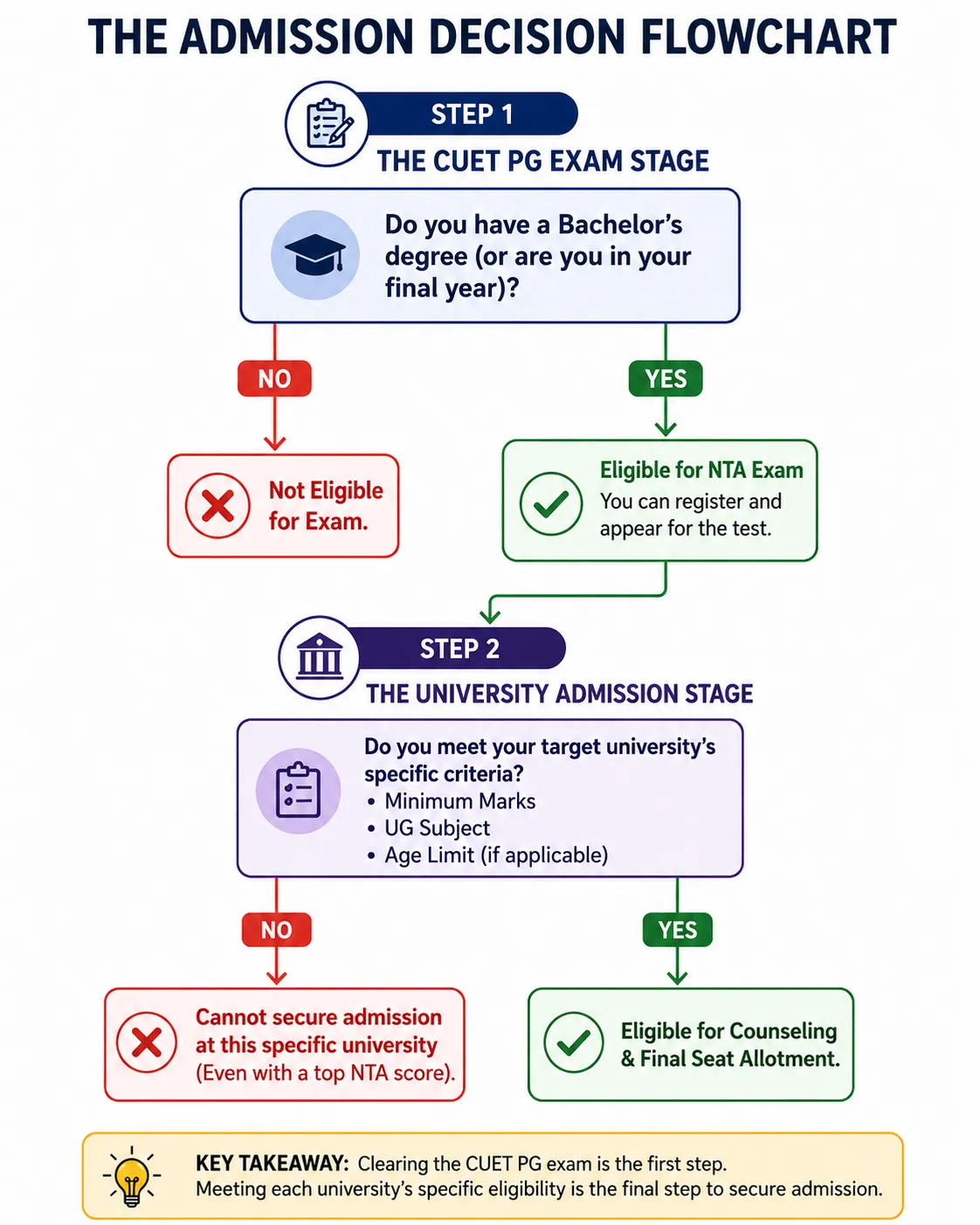
To resolve any confusion between NTA and University criteria, refer to this straightforward eligibility flow:
Why Meeting NTA's Criteria Alone Isn't Enough
NTA’s criteria alone are not enough to sit for the exam, as NTA has not set any age limit or minimum marks rule. However, different universities may consider their own rules related to age, minimum marks, and the undergraduate background of a candidate.
How to Check Your Target University's Extra Requirements
Ensure your undergraduate background is suitable for the requirements of the postgraduate programme for which you are applying before submitting your application. Please check the subject-wise credit or minimum marks criterion. Please confirm other limits or rules like age limit and check whether your selected CUET PG exam paper code matches your chosen course or not to avoid any issue at the time of admission or counseling thereafter.
Where to Find Each University's Admission Brochure
NTA CUET PG Portal: Go directly to the official NTA CUET PG Participating Universities Section. Then, click on any central, state, or deemed university link. You can now view their listed eligibility mappings.
Official University Admission Portals: Suppose you are targeting the University of Delhi or Banaras Hindu University; then go to their official admission website and look for tabs labeled “Admission 2027," “Postgraduate Admissions," or “Information Bulletin."
Samarth Portal Network: Search for (University Name) cuet.samarth.edu.in, where you can get the counseling infrastructure of many participating central universities. From there, you can access their admission booklets to check their CUET PG Eligibility criteria 2027.
University-Wise CUET PG Eligibility Criteria (2027)
All participating universities that accept CUET PG scores for postgraduate admission require at least 50% marks (45% for reserved categories). In many of these universities, program-specific criteria may vary. Each of these universities has its own admission process using CUET PG scores. Hence, a candidate must always cross-check the latest admission guidelines and procedure.
University | Minimum Marks Requirement | Subject-Specific Rules | Age Limit & Counselling Hub |
|---|---|---|---|
Delhi University (DU) | Most PG programs demand at least 50% in UG. 5% relaxation is given to SC, ST, OBC-NCL, EWS and PwBD groups. | Quite stringent. If pursuing an M.Sc. in Zoology, you must have a bachelor's degree in Zoology, Life Sciences, or Biological Sciences. | No age limit; follows NTA norms. Handled via official DU CSAS PG Portal. |
Banaras Hindu University (BHU) | You should have 50% aggregate marks in graduation. | E.g., an M.A. in Language/Social Arts requires having studied the topic as a major subject in all three years of your degree. | Internal age limits exist for some academic disciplines (verify in bulletin). Handled via BHU CAP PG Portal. |
Jawaharlal Nehru University (JNU) | Minimum aggregate requirement of 45% to 55%, depending upon the course and discipline. | Additional entry requirements apply. E.g., M.A. Economics candidates should have studied Mathematics at the 10+2 level. | Program-specific. Admissions are processed through its predefined counseling and evaluation process. |
University of Hyderabad (UoH) | The minimum percentage varies by programme. Always check UoH's official program-wise document. | No Separate Entrance Test; admission runs entirely on CUET PG scores (plus practical/interviews for select programs). | Varies by program. Run independently by UoH. |
Other Central, State, & Private Universities | Standard requirements like 50% general and 45% Reserved. | State universities may require local domicile/language proficiency. Private universities may include GD/PI rounds. | Specific to each institution. |
(Always verify these specific requirements with the official brochure of your target university, as per-program criteria may shift each cycle slightly).
Course-Wise Eligibility Criteria
Whether you are looking for the CUET PG MBA eligibility criteria, the CUET PG MCA eligibility criteria, or the CUET PG LLB eligibility criteria, remember that different master's programs have highly specific prerequisites.
(Important Note: NTA updates Test Paper Codes annually. The codes listed below are reflective of recent cycles. Always verify your exact code, e.g., COQP11 or SCQP09, against the official NTA CUET PG 2027 Information Bulletin (Appendix II) before submitting your registration.)
Program Track | Expected NTA Code | Qualifying Degree Requirement | Minimum Marks Requirement | Special Prerequisites & Rules |
|---|---|---|---|---|
MBA / Management | COQP12 (General MBA). COQP22 (Healthcare). | Any bachelor's degree (B.A., B.Sc., B.Com., B.Tech., BBA). | 50% General/OBC/EWS and 45% SC/ST/PwD. | None (open to any stream). Premium institutions (like BHU/DAVV) may prioritize work experience or specific math backgrounds during counseling. |
MCA / Computer Applications | SCQP09 (Computer Science & IT). | BCA, B.Sc. (Computer Science), B.Sc. (IT), or B.A./B.Sc./B.A. | 50% to 55% General, 5% relaxation for Reserved categories. | Mandatory: Non-Computer graduates should have studied Mathematics at the 10+2 level or graduated. |
LLB / Law Programs | COQP11 (General). | A Bachelor's degree in any discipline of 3 or 4 years. | Generally 45% to 50% aggregate for General category. | CUET PG is specifically for the 3-year LLB pursued after a bachelor's degree, not the 5-year integrated LLB. Universities adhere to Bar Council of India (BCI) regulations, generally requiring 45% for the General category, with several universities applying a 42% OBC / 40% SC-ST tier for law admission eligibility. |
MA Programs (Econ, Psych, History, etc.) | COQP10 (Economics), HUQP20 (Psychology), HUQP09 (History). | For general arts or the CUET PG psychology/economics eligibility, you need a Bachelor's degree in any discipline (though preference or lower mark cutoffs are often given to honors graduates) | Usually 50% in core subjects. Elevated to 55% for stream changers at universities like JNU. | Example: A B.Com. graduate applying for an M.A. in Economics at top universities (DU and JNU) frequently mandates Mathematics or Statistics as a core or elective subject at the undergraduate level. |
MSc / Science Programs | SCQP08 (Chemistry), SCQP24 (Physics), SCQP19 (Math). | B.Sc. (Honors/General) in the relevant science discipline. | Strictly 50% to 55% General/OBC, 45% to 50% SC/ST/PwD. | You must have studied the target subject for at least 4 to 6 semesters during graduation, accumulating the minimum university-specified academic credits. |
Can You Apply for CUET PG Without Having Given CUET UG?
Yes. CUET PG is a completely independent exam from CUET UG. As a CUET PG Applicant, you do not need to have any history of applying, appearing, or clearing the CUET UG Exam. The CUET PG eligibility criteria for 2027 mainly depends on holding a bachelor’s degree or equivalent or being in the final year of an undergraduate program.
What Happens If You Don't Meet the Eligibility Criteria?
Even if you are eligible for a seat, failing to meet the required eligibility standards may result in disqualification.
You can be disqualified in the counseling or admission process.
Your provisional offer can be withdrawn if you do not meet the particular course or university eligibility requirements.
Do not submit any wrong or missing category certificate. In that case, you will be evaluated in the general category, and this can affect your eligibility and cutoff also.
Review all paperwork and eligibility conditions carefully before applying.
Real Case: What Happened in the 2026 Cycle
During DU CSAS PG 2026 registration, many applicants faced portal-level glitches such as reserved category status (OBC/SC/ST) being automatically labeled as "General." In fact, the category field got locked, and the nationality is incorrectly showing as “Non-Indian/Foreigner.” Many students posted this on social media and telegram groups.
Also, one of the major issues that arose was the rejection of OBC-NCL and EWS certificates, even when they are genuine. It was because of these certificates coming from the previous financial year.

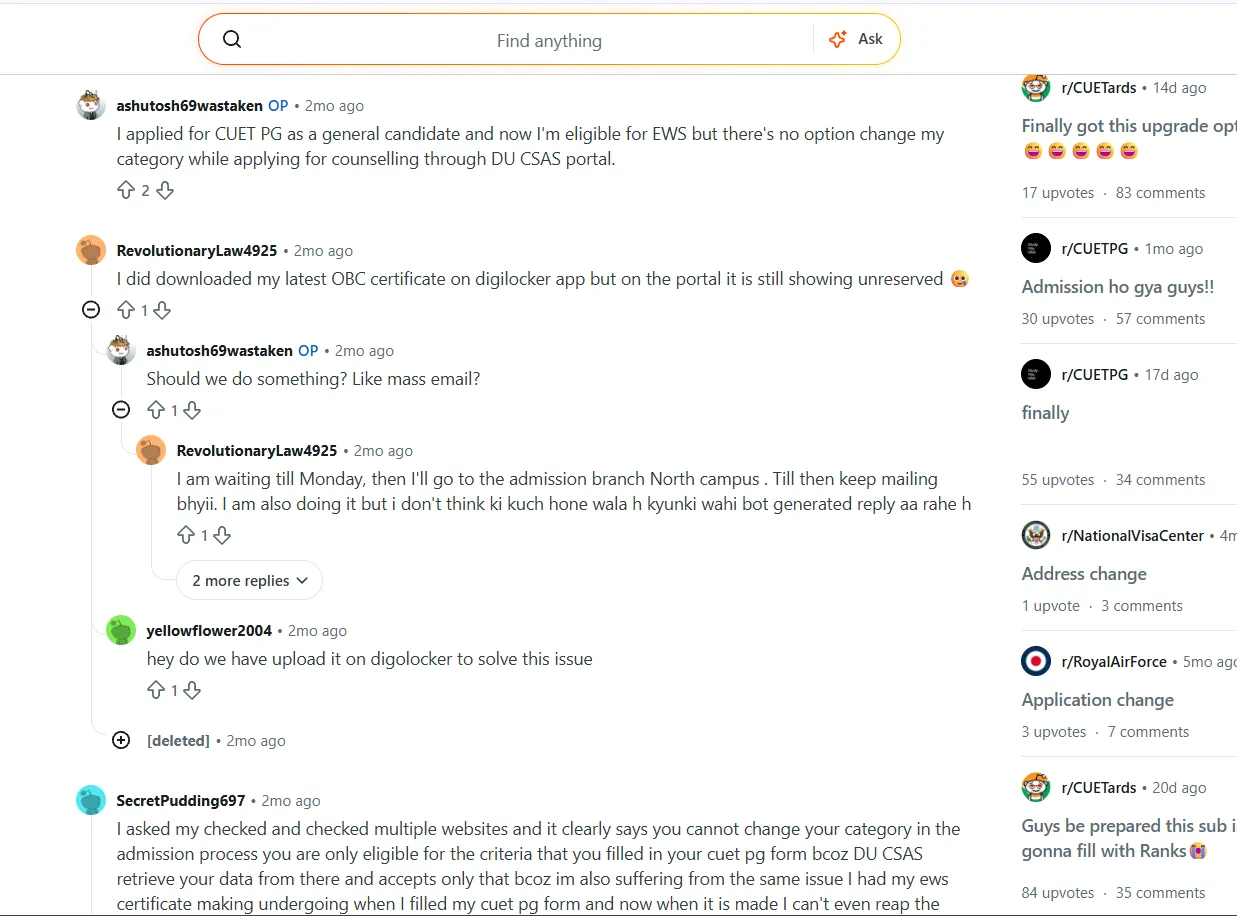
How to Check If You're Eligible: Step-by-Step
Firstly, confirm your degree status, as only candidates who have completed or are in their final year of graduation can apply to the CUET PG 2027 exam.
Kindly check if your aggregate marks are enough to apply against your category’s typical minimum marks for CUET PG.
Check the information bulletin or admission brochure of your target university separately.
Cross-check the subject/domain requirement for that specific PG program against your undergraduate background
Keep your nationality and category documentation ready and verified in advance
Confirm whether your specific program has any university-set age restriction (uncommon, but worth a quick check)
CUET PG Eligibility Criteria 2027 vs. 2026: What's Changed
Every year, applicants search for “what will actually be new in CUET PG.” The truth is, NTA's baseline framework has stayed stable since 2023. What genuinely changes every cycle is document validity windows, which is where most candidates actually trip up.
Parameter | 2023–2026 (across cycles) | 2027 (expected) |
|---|---|---|
Age limit (NTA level) | None: consistently, every cycle | None expected |
Educational qualification | Bachelor's/equivalent from a recognized university | Same |
Min %: General/OBC-NCL/EWS (university-set, not NTA) | 50% (common baseline across most universities) | Same expected |
Min %: SC/ST/PwBD | 45% | Same expected |
Reservation norms | OBC-NCL 27%, SC 15%, ST 7.5%, EWS 10%, PwBD 5% (fixed GoI policy, not exam-specific) | Same (GoI policy, won't shift with exam cycle) |
Participating universities | Around 200 universities conduct their own separate counselling using CUET PG scores | Expected similar or higher |
Info bulletin release | The 2026 bulletin was released on December 14, 2025 | Expected December 2026 |
Category certificate validity (the part that actually changes) | Must be from the current financial year. Older certificates get rejected regardless of correctness | Will reset again. Confirm the exact 2027 cutoff date once the bulletin releases |
The actual year-to-year difference is not in the eligibility criteria but definitely in the document dates. For example, DU CSAS PG 2026 required OBC-NCL and EWS certificates to be issued on or after March 31, 2026. Note that certificates dated earlier were rejected outright. Based on this, it can be expected that the 2027 cycle will likely repeat this pattern.
Frequently Asked Questions
Who is eligible for CUET PG?
Anyone holding a bachelor's degree (or equivalent) from a recognized university or currently in their final year of graduation is eligible to apply for CUET PG.
Can I give CUET PG without CUET UG?
Yes. CUET PG is fully independent of CUET UG. You don't need to have appeared for or cleared CUET UG to apply.
Is there an age limit for CUET PG?
No, NTA sets no upper or lower age limit for CUET PG, though a small number of universities or professional programs may set their own.
Can final-year students apply for CUET PG 2027?
Yes. Regarding the CUET PG eligibility for final-year students in 2027, candidates who are currently awaiting their results can apply provisionally, but they must prove eligibility before the university's admission deadline.
How do I know if I qualify for CUET PG?
Verify your degree status and minimum marks according to NTA’s baseline criteria for CUET PG 2027 eligibility. Then, review your preferred university’s eligibility requirements and application deadlines.
Is CUET PG mandatory for all universities?
No, CUET PG is not an obligatory entrance exam for admission to any of the postgraduate programmes. If the university you have chosen is a participating university in the CUET PG test, then it is necessary.
Can non-Indian nationals apply for CUET PG?
Yes, NRIs, OCI card holders and international citizens can apply subject to the university guidelines and supplementary papers like passport and visa data.
Key Takeaways
CUET PG 2027 requires a bachelor’s degree (or a final-year student status) from a UGC-recognized university.
CUET PG is an independent exam of CUET UG.
NTA has no minimum marks or age limit criteria. However, it varies by individual participating universities.
There is no centralized counseling system provided by the NTA. Each participating university has its own admission and seat finalization process.
Subject-specific eligibility varies by program. Degrees like an MCA are somewhat subject-locked, whereas others like an MA are more open.
Seat reservation follows the Government of India norms (OBC-NCL 27%, SC 15%, ST 7.5%, EWS 10%, PwBD 5%), with a standard 5% relaxation in qualifying marks.
NRI, OCI, and foreign nationals can apply, subject to university-specific documentation.
The CUET PG 2027 Information Bulletin is expected in December 2026. Always cross-check the latest official numbers before applying.