
Gurgaon, also known as Gurugram, and the wider NCR markets serve different mixes of buyers. Gurgaon is closely linked to corporate employment and premium housing, Delhi offers established neighbourhoods on limited land, Noida combines planned sectors with expressway and metro access, Greater Noida offers lower entry prices alongside the new Jewar airport, and Ghaziabad attracts buyers prioritising affordability and access to Delhi.
Which market is best depends on budget, purpose of purchase, commute, investment horizon, risk tolerance and rental requirements, not on any single city being universally better. Looking at Gurgaon real estate vs Delhi, Noida and other NCR markets side by side, the picture that emerges is one of overlapping but distinct strengths, rather than a single winner. Within Gurgaon itself, the Gurgaon residential real estate market varies almost as much corridor to corridor as the cities do against each other, so a citywide label rarely tells the whole story.
Quick Answer:
|
NCR Real Estate Market 2026 at a Glance
NCR is not one property market but five distinct ones sitting side by side. ANAROCK's Q1 2026 Residential Market Viewpoints report recorded Gurgaon's share of NCR's residential launches at 62% and its share of sales at 43%, the largest of any NCR city, while Noida and Greater Noida have a substantial pipeline of planned, infrastructure-led development.
| Factor | Delhi | Gurgaon | Noida | Greater Noida | Ghaziabad |
|---|---|---|---|---|---|
| Market character | Established, mature | Corporate-led, premium | Planned, infrastructure-led | Emerging, expansion-led | Affordability-led |
| Typical buyer | Long-term end users | Executives, investors | End users, investors | Long-term investors | First-time buyers, Delhi commuters |
| Main demand driver | Land scarcity, location | Jobs and rental demand | Metro, expressways | Jewar airport | Metro and affordability |
| Main risk | High acquisition cost | High entry cost | Project selection | Delivery delays | Infrastructure gaps |
Note: These markets are not directly interchangeable. A Gurgaon luxury apartment and a Ghaziabad mid-segment flat are not comparable simply because both are quoted per square foot; the decision should be made at the corridor and project level, not the city level.
Gurgaon vs Noida: Which Is Better for Real Estate?
Gurgaon is generally stronger for corporate-linked rental demand and premium housing, while Noida offers planned sectors and a wider range of entry points. Gurgaon's advantage is anchored by established office clusters such as Cyber City, Udyog Vihar, Golf Course Road and the Sohna Road corporate belt: JLL's Q2 2026 figures put Delhi NCR's share of India's total office leasing at 21.6%, and Cushman & Wakefield names Gurgaon as the dominant office market within that region.
Noida's advantage is planning and price:
- Sector 150 carried a Q1 2026 quoted rate slightly ahead of Gurgaon's Dwarka Expressway.
- Noida overall offers a wider spread of entry points across established and newer sectors.
- Connectivity is backed by metro coverage and, now, the Jewar airport.
Gurgaon is more developed in corporate employment and premium services, whereas Noida is more developed in planned urban layout and sector-based infrastructure. Neither city is uniformly ahead once the comparison is broken down this way. Neither market wins outright on the property question either; Gurgaon generally suits corporate-linked rental demand, Noida generally suits planned-sector buyers seeking a different price mix.
Gurgaon vs Noida Property Prices
A Gurgaon vs Noida property price per sq ft comparison shows the two cities are closer than their reputations suggest. Sector 150 in Noida and Dwarka Expressway in Gurgaon quoted rates of ₹14,600 and ₹14,000 per sq ft respectively in ANAROCK's Q1 2026 figures, with New Gurugram at ₹13,300, all up 2 to 4% quarter on quarter.
| Corridor | City | Q1 2026 quoted rate | Quarterly change |
|---|---|---|---|
| Sector 150 | Noida | ₹14,600/sq ft | +2% |
| Dwarka Expressway | Gurgaon | ₹14,000/sq ft | +4% |
| New Gurugram | Gurgaon | ₹13,300/sq ft | +4% |
| Greater Noida West | Greater Noida | ₹10,000/sq ft | +3% |
Note: figures cover only the corridors ANAROCK publishes quoted rates for each quarter; a citywide average would obscure the wide gap between established and emerging sectors within both cities.
Gurgaon vs Delhi Real Estate
Delhi's pricing is driven primarily by land scarcity in established neighbourhoods rather than by new supply, which sets this comparison apart from Gurgaon vs Noida. A Gurgaon vs Delhi property price comparison shows Delhi's premium localities commanding prices well above Gurgaon's corridor averages simply because very little new land is available for development, while Gurgaon continues to add large-scale new supply across Dwarka Expressway and New Gurugram.
- Gurgaon tends to suit buyers wanting modern housing near corporate employment hubs and stronger rental demand from professionals.
- Delhi tends to suit buyers who prioritise established neighbourhoods, public transport and proximity to central Delhi.
- Delhi's price range between an outer locality and South Delhi is far wider than Gurgaon's range between its cheapest and most expensive corridors.
- Buyers weighing whether it is better to buy in Gurgaon or Delhi should compare specific localities rather than the cities as a whole.
Delhi vs Noida vs Gurgaon: A Three-Way Snapshot
| Factor | Delhi | Gurgaon | Noida |
|---|---|---|---|
| Best known for | Established neighbourhoods | Corporate employment, premium housing | Planned sectors, infrastructure |
| Main advantage | Location, maturity | Jobs, rental demand | Planning, varied entry points |
| Main limitation | High prices, limited supply | High entry cost | Uneven performance across sectors |
| Best suited to | Long-term end users | Corporate-linked, rental investors | End users, infrastructure investors |
The three markets rarely compete for the same buyer directly. A household choosing between them is usually choosing between different priorities, established location, corporate access, planned infrastructure, or entry budget, rather than three versions of the same product.
Gurgaon vs Noida Real Estate Investment
For 2026, the better investment depends on whether the buyer prioritises rental income, capital appreciation, affordability or a longer holding period. For rental-led investment, Gurgaon's advantage lies in its established corporate corridors, its concentration of office employment around Cyber City and Golf Course Road, and its premium tenant pool. For buyers seeking a lower entry point and longer-term, infrastructure-led growth, Noida and Greater Noida have an edge, particularly with the Jewar airport now open.
Storyboard18's coverage of ANAROCK's Q2 2026 figures adds useful context to that timing:
- NCR-wide new launches fell 40% year on year in the second quarter of 2026.
- Noida-Greater Noida saw the sharpest correction of any NCR micro-market, with launches down 72% and sales down 20%.
- NCR sales overall fell a much milder 6%, outpacing new supply.
- Available inventory stayed roughly flat, pointing to steady underlying demand against a sharper pullback in supply.
This points to a Noida-Greater Noida market where developers have pulled back on new launches more sharply than buyers have pulled back on demand, a pattern worth watching rather than a reason to avoid the market outright. On balance, Gurgaon vs Noida investment potential looks split by objective rather than tilted decisively to one side.
Greater Noida vs Gurgaon Investment
Greater Noida may offer stronger infrastructure-led appreciation, but it carries more project-delivery and occupancy risk than Gurgaon. It is not simply a cheaper version of Gurgaon; it is the more infrastructure-dependent of the two markets. Business Standard's analysis of ANAROCK data reported a 98% price increase for Greater Noida against Gurgaon's 84% between Q1 2020 and Q1 2025, helped by the Jewar airport project and metro expansion.
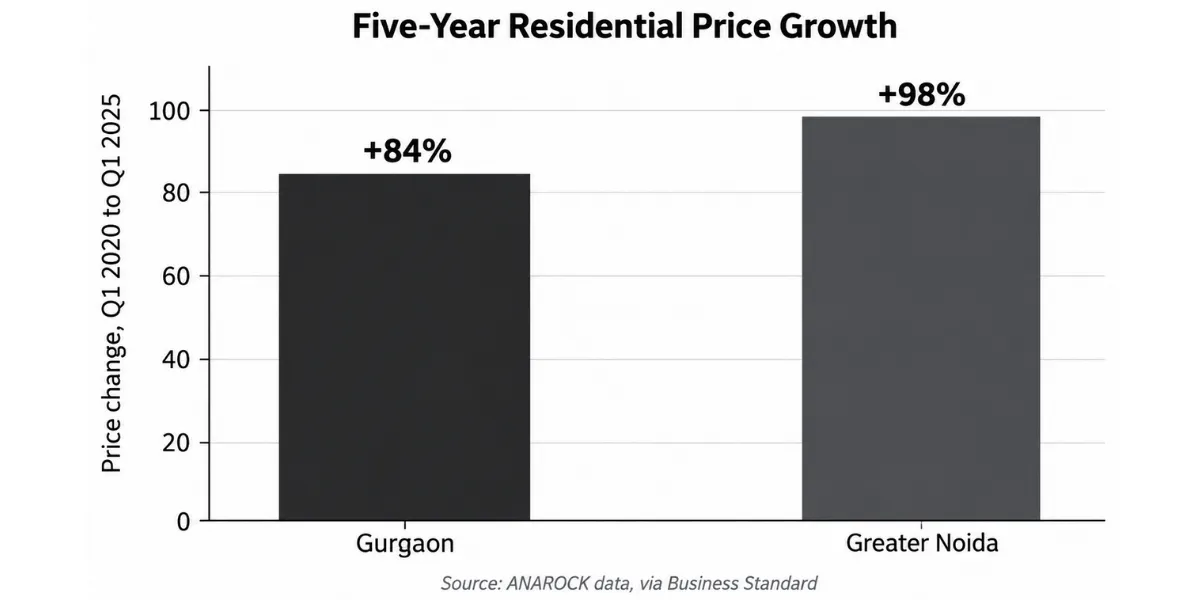
Five-year residential price growth in Gurgaon and Greater Noida, Q1 2020 to Q1 2025, based on ANAROCK data reported by Business Standard
- Gurgaon remains the more mature market, with deeper established corporate demand and premium housing activity already in place.
- Greater Noida's investment case depends more heavily on project delivery, occupancy and the timing of infrastructure benefits actually reaching residents.
- This makes Greater Noida a longer-horizon, higher-execution-risk proposition than Gurgaon, rather than simply a discounted one.
Ghaziabad Real Estate vs Gurgaon
Affordability and access sit on one side of this trade-off; corporate employment and rental depth sit on the other. Ghaziabad's NH-24 and Raj Nagar Extension corridors quoted ₹7,000 and ₹6,750 per sq ft respectively in ANAROCK's Q1 2026 figures, roughly half of Gurgaon's Dwarka Expressway rate, with a 2BHK renting for considerably less too.
- Ghaziabad suits buyers who need a lower purchase budget and reasonable access to Delhi.
- Gurgaon remains the stronger choice for buyers prioritising corporate employment and stronger rental demand near business districts.
- Ghaziabad is a weaker fit for buyers chasing premium rental yields or luxury resale value.
- Higher prices in Gurgaon do not automatically mean better returns, since rental yield is a function of rent relative to price, not price alone.
Gurgaon vs Noida Rental Yield and Rental Demand
Rental values are closer than the sale-price comparison suggests. As per ANAROCK's Q1 2026, a standard 700 sq ft 2BHK put monthly rents at:
- Dwarka Expressway: ₹25,000 to ₹37,000 per month.
- New Gurugram: ₹22,000 to ₹35,000 per month.
- Noida's Sector 150: ₹23,000 to ₹35,000 per month.
- Greater Noida West: ₹19,000 to ₹26,000 per month.
Any Gurgaon vs Noida rental yield comparison needs to control for entry price, not just rent. Gross rental yield is the annual rent divided by the purchase price before deducting maintenance, vacancy, property tax, brokerage and financing costs. This tends to favour whichever corridor has the lower entry price relative to achievable rent, which is why Greater Noida West and Ghaziabad can sometimes show a higher headline yield than premium Gurgaon corridors despite lower absolute rents, even though a higher yield on paper does not automatically make one city better for rental income than the other.
Rental demand near Gurgaon employment hubs holds up best, close to established clusters such as Cyber City, Udyog Vihar, Golf Course Road and the Sohna Road corporate belt, where tenant demand is tied to corporate leasing rather than price speculation and tends to be comparatively steady through downturns, though it is not immune to a broader slowdown in corporate hiring.
Gurgaon vs Noida Connectivity
Connectivity splits along two different axes here:
- Gurgaon's strength: proximity to Delhi's IGI Airport and an established expressway network reaching Cyber City, Udyog Vihar and Golf Course Road.
- Noida's strength: metro coverage, the Noida-Greater Noida Expressway, and now direct road access to Jewar via the Yamuna Expressway.
Gurgaon generally has the more direct relationship with Delhi's existing airport because of its location southwest of Delhi, while Noida and Greater Noida residents now have a genuinely shorter route to Jewar than to IGI for domestic travel. Which NCR city has better connectivity to Delhi airport depends on which airport the buyer means, since Gurgaon and Noida are now each closer to a different one.
Noida International Airport and NCR Real Estate
Noida International Airport at Jewar was inaugurated on 28 March 2026, at an investment of around ₹11,200 crore. Commercial domestic flights followed in phases over the following months, though the exact rollout has varied by airline and is worth checking independently for the latest schedule. It is one of the most important infrastructure developments affecting Noida, Greater Noida and the Yamuna Expressway corridor, and it sits closer to Greater Noida than to Gurgaon.
The best NCR city to invest in after the Jewar airport opens is not automatically Greater Noida by default; the airport supports logistics, warehousing, hospitality and industrial demand in its immediate vicinity, but the benefit will not be uniform across every project in the wider region.
Buyers should weigh distance to the airport against:
- Distance to actual employment clusters, not just to the airport itself.
- Current occupancy levels in the specific project.
- Each project's delivery record.
- The pace of surrounding infrastructure, rather than assuming proximity to Jewar alone guarantees appreciation.
Will the Gurgaon Property Bubble Burst?
The available evidence does not point to a city-wide bubble, though pressure in specific segments is real:
- Luxury segment:Over 80% of Gurgaon's new launches in the first nine months of 2025 above the premium threshold, specifically ₹2.5 crore and up, concentrating risk in this bracket.
- Affordable segment: According to ANAROCK figures reported by The Tribune, affordable housing sales in Gurgaon fell by around 15% in the first half of 2025.
These are genuine, data-backed pressure points rather than signs of an imminent citywide collapse. The available evidence is more consistent with segment-specific pressure in some luxury and affordable projects than with an immediate citywide collapse, and Gurgaon's corporate employment base has not shown the broad-based demand failure a genuine bubble would require.
Gurgaon vs Noida for Families vs Investors
The two buyer types split along different lines than the investment comparison alone:
- Families weighing commute, schools, healthcare access and daily convenience often find Gurgaon's established corridors more turnkey, since social infrastructure has matured over a longer period.
- Families in newer Noida sectors may need more patience as amenities catch up to the housing supply.
- Rental-focused investors benefit from Gurgaon's corporate density, which supports steadier tenant demand.
- Longer-horizon, infrastructure-led investors currently have more room for the thesis to play out in Noida and Greater Noida, particularly post-Jewar.
Neither profile should treat this as a universal rule. A family relocating for a Noida-based employer will reasonably prioritise Noida regardless of this general pattern, and an investor targeting Gurgaon's ultra-luxury segment specifically takes on a different risk profile than either broad category suggests.
Cost of living in Gurgaon vs Noida vs Delhi feeds directly into this decision. Living costs are often higher in Gurgaon's premium corporate and lifestyle corridors than in comparable Noida sectors, largely because rent, schooling, retail and daily transport all price in proximity to the corporate employment base. Noida can offer a more planned residential environment across a wider range of housing budgets, while Delhi varies sharply by locality, from some of the most expensive real estate in the country to considerably more affordable outer areas. Cost of living should be calculated for the specific neighbourhood a buyer or tenant is actually considering, not for the city as a whole; a Gurgaon sector far from Cyber City can be cheaper to live in than a well-connected part of Noida, and the reverse holds just as often.
NCR Property Buying Checklist
Whichever market a buyer ultimately chooses, the same practical checks apply across Gurgaon, Delhi, Noida, Greater Noida and Ghaziabad:
- Distance from the actual workplace, not just from a landmark or the nearest metro station on a map.
- Project delivery and occupancy, checked against the developer's own track record on previous projects.
- Maintenance charges, which vary widely between societies and materially affect the real cost of ownership.
- Rental demand in the specific society, not just the corridor, since demand can differ between adjacent projects.
- Metro, road and airport access, measured at actual peak-hour travel times rather than straight-line distance.
- Builder track record, including past delivery timelines and the quality of after-possession support.
- RERA registration and approvals, verified directly on the relevant state RERA portal rather than taken on trust.
- Resale liquidity, based on how quickly comparable units in the same project have actually sold or rented.
Frequently Asked Questions (FAQ)
Is Gurgaon more expensive than Delhi?
Is Noida cheaper to live in than Gurgaon?
Which city is better for living, Delhi or Gurgaon?
What is the typical rent for a 2BHK in Gurgaon?
What is the typical rent for a 2BHK in Noida?
Which is better for rental income, Gurgaon or Noida?
Which NCR city is best for real estate investment?
Is it better to buy property in Gurgaon or Delhi?
Is there a risk of a Gurgaon real estate correction?
Which NCR corridor has the strongest rental demand?
Does the Jewar airport make Noida a better investment than Gurgaon?
Which is safer, Gurgaon or Noida?
Which is bigger, Gurgaon or the Noida-Greater Noida region?
Key Takeaways
- Gurgaon accounted for 62% of NCR's residential launches and 43% of its sales in Q1 2026, the largest share of any NCR city.
- Noida's Sector 150 and Gurgaon's Dwarka Expressway were the two most expensive quoted corridors in Q1 2026, both ahead of New Gurugram and Greater Noida West.
- Greater Noida's five-year price growth of 98% outpaced Gurgaon's 84%, per Business Standard's analysis of the same period.
- NCR-wide launches fell 40% year on year in Q2 2026, with Noida-Greater Noida seeing the sharpest correction at 72%, per ANAROCK figures carried by Storyboard18.
- Noida International Airport opened on 28 March 2026, strengthening the case for parts of Noida and Greater Noida, though the benefit will not be uniform across every project.
- Rental rates for a standard 2BHK are broadly comparable between Gurgaon and Noida's premium corridors, with Greater Noida and Ghaziabad meaningfully cheaper.
- Across Gurgaon real estate vs Delhi, Noida and other NCR markets, no single city is automatically better for every buyer; the right choice depends on budget, purpose, commute and holding period rather than city reputation.