
How does CS:GO Community Market Work?

0
13.4K

Table of Contents

aHow does CS:GO Community Market Work?

The CS:GO economy is a testament to the game's ability to extend its influence beyond the virtual battlegrounds. In-game items, particularly skins, have become a form of currency among players. These items are obtained in various ways, such as through random drops during gameplay, by opening cases with keys, or by purchasing them directly from the Community Market. The rarity, condition, and demand for these skins can significantly affect their market value, with some rare items selling for hundreds or even thousands of dollars.

Getting Started with the Market

Before diving into the bustling csmarket, players must first meet certain requirements and understand the restrictions in place. To start, you need a valid Steam account with a purchase history of at least $5 to remove any limitations. Additionally, Steam Guard Mobile Authenticator must be activated on your account for at least 15 days, ensuring an extra layer of security.

Once these prerequisites are met, here’s how to begin:

  1. Log in to Steam: Access your Steam account either through the desktop client or the website.
  2. Enable Steam Guard: This is a necessary step to protect your account and transactions.
  3. Wait for the Initial Hold: New accounts have a 15-day waiting period after activating Steam Guard before they can use the market.
  4. Make a Purchase: Spend at least $5 within the Steam platform to unlock full access to the Community Market features.
  5. Familiarize with the Market Interface: Navigate to the Community Market through your Steam interface and explore the layout.
  6. Deposit Funds: Add funds to your Steam Wallet if you intend to purchase items. This can be done via credit card, PayPal, or other supported payment methods.
  7. Understand the Fees: Be aware that Valve imposes a transaction fee on every sale, which is a combination of a general Steam fee and a game-specific fee.

By following these steps, players can ensure they have secure and unrestricted access to the CS:GO Community Market.
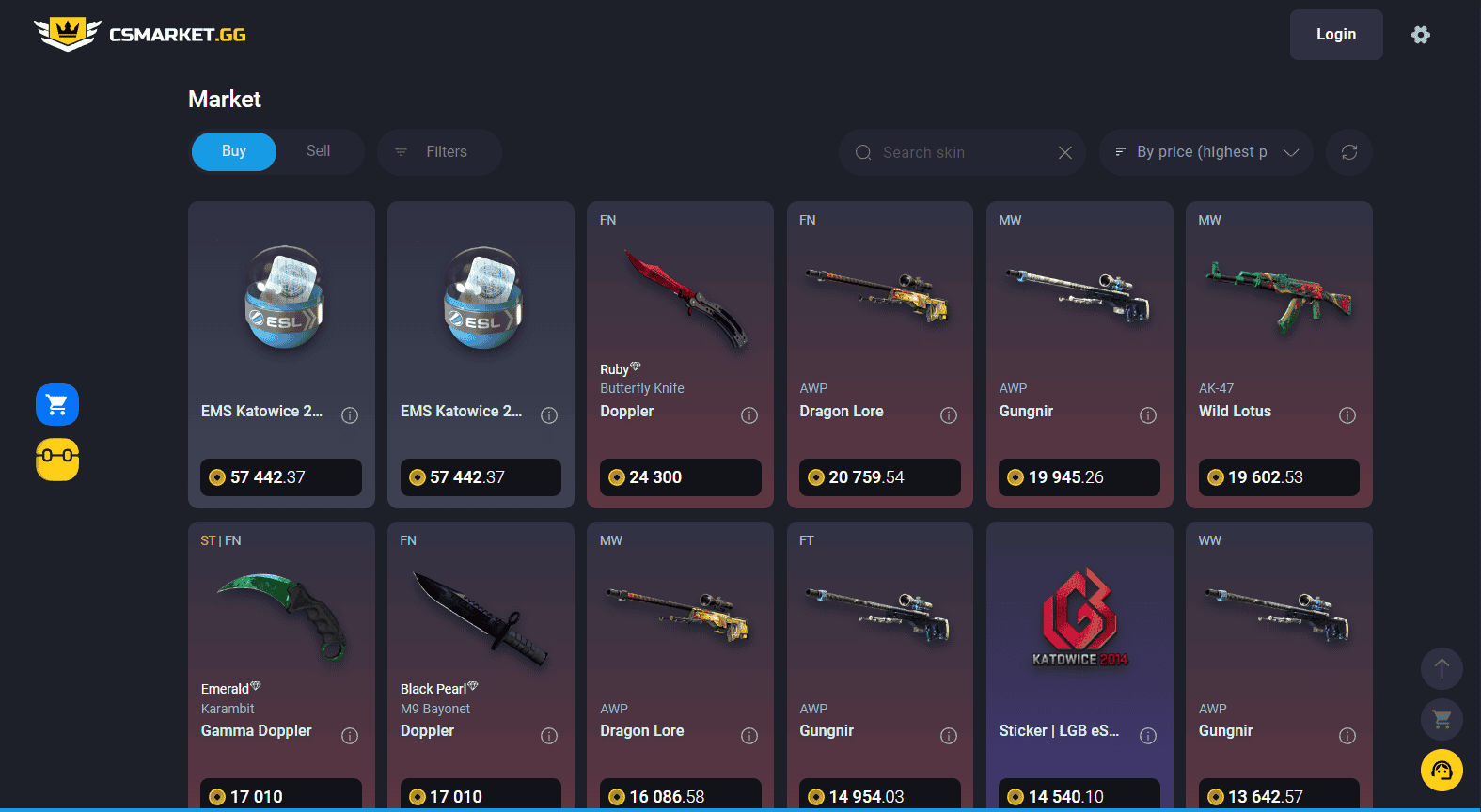
How does CS:GO Community Market Work?

Types of Items Available on the Market

The CS:GO Community Market is a treasure trove of virtual items that players can trade. The types of items available include, but are not limited to:

  • Weapon Skins: These change the appearance of the various guns available in CS:GO. They range from common skins to exceedingly rare and valuable ones.
  • Stickers: Players can apply these to their weapons for customization. Stickers can be standard or holographic, and some are event-specific, which can increase their value.
  • Music Kits: These alter the in-game music, and like skins, they come in various rarities.
  • Cases and Keys: Cases contain random skins and require a key to open. Both can be bought and sold on the market.
  • Graffiti: This allows players to spray tags onto surfaces within the game for a limited number of uses.
  • Agent Skins: These skins change the appearance of the player's character model.
  • Patches: Similar to stickers, patches can be applied to the player's agent to customize their look.

Each item's market value is determined by factors such as rarity, demand, and the item's condition (e.g., "Factory New" or "Battle-Scarred"). The market is dynamic, with prices fluctuating based on supply and demand, trends, and changes within the CS:GO community. Understanding the types of items and their potential value is key to becoming a savvy trader on the CS:GO Community Market.

How to Buy Items on the Community Market

Purchasing items on the CS:GO Community Market is straightforward. Follow these steps to secure your desired in-game assets:

  1. Access the Market: Log into your Steam account and navigate to the Community Market.
  2. Search for Items: Use the search function to find specific items or browse categories for skins, stickers, and more.
  3. Check Listings: Examine the listings for the item you want, paying attention to the price, condition, and seller reputation.
  4. Review the Item: Click on an item to view details such as its float value, which indicates wear and tear.
  5. Make a Purchase: Once you've selected an item, click 'Buy' to proceed. Ensure you have sufficient funds in your Steam Wallet.
  6. Confirm the Transaction: Review the details, including the total cost with fees, and confirm your purchase.

To find good deals and avoid scams, consider the following tips:

  • Compare Prices: Look at multiple listings to find a competitive price for the item you want.
  • Inspect the Seller: Check the seller's history and feedback to ensure they are reputable.
  • Be Patient: Prices can fluctuate, so wait for the right moment to buy if you're not in a rush.
  • Use Price Trackers: External websites can track the history of item prices, helping you make an informed decision.
  • Beware of Scams: Only use the official Community Market to conduct transactions to avoid scams and phishing attempts.

Selling Items on the Community Market

To sell items on the Community Market, you'll need to list them. Here’s how to do it:

  1. Inventory Selection: Go to your Steam inventory and select the item you wish to sell.
  2. Choose 'Sell': Click the 'Sell' button on the item's detail page.
  3. Set Your Price: Enter the price you want buyers to pay, keeping in mind the current market value and how quickly you want to sell.
  4. Understand the Fees: Valve takes a percentage of each sale, comprising a Steam transaction fee and a game-specific fee.
  5. List the Item: Confirm the listing details, including your desired price and the fees, then list your item on the market.

When setting prices and selling items, consider the following:

  • Market Trends: Monitor the market for price trends that can affect how much buyers are willing to pay.
  • Pricing Strategy: Price your item competitively to sell quickly or higher if you're willing to wait for the right buyer.
  • Transaction Fees: Remember that the price you set will be reduced by Valve's fees, so factor this into your asking price.
  • Item Visibility: Newly listed items appear at the top of the market, so timing your sale can impact visibility.
  • Stay Informed: Keep an eye on game updates and community news, as they can influence the demand and value of your items.

By understanding the buying and selling processes, you can confidently navigate the CS:GO Community Market, making profitable transactions and enhancing your gameplay experience.

Trading Items with Other Players

The CS:GO Community Market isn't the only avenue for players to acquire new skins and items. Direct trading between players is an alternative that offers a more personal transaction process. Here's how it works:

  • Initiate a Trade: Players can send trade offers to friends or other users within the Steam community.
  • Select Items: Both parties choose items from their respective inventories to create a trade offer.
  • Negotiate Terms: Players can communicate to agree on the terms of the trade, including any additional items or Steam Wallet funds to balance the exchange.
  • Confirm the Trade: Once both parties are satisfied, they confirm the trade, and the items are exchanged directly between the two accounts.

Trading directly with other players differs from the Community Market in several ways:

  • No Transaction Fees: Unlike market sales, direct trades do not incur any fees, meaning players can exchange items at their full value.
  • Personal Negotiation: Prices are not set by the market, so players can negotiate deals that may better reflect the perceived value of the items being traded.
  • Instant Transfer: Items are transferred immediately upon trade confirmation, without the waiting period associated with market sales.

However, direct trading also requires a higher level of trust between players and carries a greater risk of scams. Always verify the items and terms before confirming a trade.


K

Written By Kavya Sharma

Covering the culture, trends, and everyday choices that define how modern India lives.|0 followers
View Profile

Kavya Sharma is a lifestyle expert and content writer with over 4 years of experience covering entertainment and lifestyle across digital platforms in India. She holds a Bachelor's degree in Media Studies from Mumbai University, which shaped her understanding of audience behaviour, cultural trends, and how content connects with readers at a personal level. Her writing spans Bollywood and OTT entertainment, fashion, wellness, travel, relationships, and modern living — topics she approaches with both cultural awareness and editorial discipline. Her work has appeared on platforms including Femina.in, Pinkvilla, and Lifestyle Asia India, where she has developed a consistent voice that resonates with urban Indian readers navigating contemporary life. Over four years, Kavya has published 250+ articles covering trend-driven and evergreen lifestyle content. She understands what audiences in this space actually want — content that is relatable, well-researched, and reflective of the way people in India are living, consuming, and making choices today. Across all her work, she maintains a standard of accuracy and cultural sensitivity — ensuring that entertainment and lifestyle conte

Please sign in to join the discussion.

Comments

No comments yet. Be the first to comment!

More from Kavya Sharma

View All
K
Kavya SharmaCovering the culture, trends, and everyday choices that define how modern India lives. | 0 followers

The Clothing Mistakes That Waste Money — and Why Most People Can’t See Them Coming

Here is a situation most people recognise: you open your wardrobe, scan every rail and shelf, and still feel like you have nothing to wear. The wardrobe is not empty. If anything, it is overflowing. But somehow the clothes in it never quite add up to an outfit you actually want to put on. That feeling is not a coincidence. It is the result of specific, repeatable decisions made in shops, on apps, during sale countdowns that quietly drain your clothing budget without ever flagging themselves as mistakes. The good news is that once you know which decisions those are, they are surprisingly easy to stop. The Clothing Mistakes That Waste Money Start Before You Open the App Most overspending on clothes does not happen at checkout. It happens in the ten minutes before you even start browsing, when you open an app or walk into a store without a specific reason to be there. Shopping without a clear gap to fill almost always produces the same result: you buy something that looks appealing in the moment but has nowhere to go in your actual wardrobe. It does not match the shoes you own. It needs a layer you do not have. It is one half of an outfit, and the other half never arrives. The fix is mundane but effective: before you open any shopping app, name one specific thing your wardrobe is missing. Not a vague feeling. A real gap. If you cannot name one, you probably do not need to shop today. Buying for the Occasion That Never Quite Arrives Around wedding season, festival shopping and family events, the pressure to buy something special can feel almost unavoidable in India. The issue is not the occasion wear itself. The mistake is buying it speculatively: seeing a lehenga or sharara set during a big app sale, imagining three possible events, and buying before any one of them is certain. Then one event gets cancelled, another has a colour requirement you did not expect, and the third is easy enough to attend in something already in your wardrobe. The purchase hangs there for two years. A more reliable approach: wait until a specific invitation is in hand before buying for it. The two weeks between receiving an invitation and the event are enough time to find something, and the constraint forces you to buy something you will actually wear. Letting the Sale Season Make the Call for You Big app sales on platforms such as Myntra and Ajio can be useful for planned purchases. They become expensive when the discount becomes the reason to buy, rather than a timing advantage for something you already knew you needed. A shirt marked down from ₹1,200 to ₹499 is not a saving of ₹701 if you would not have bought it at ₹499 without the sale prompt. It is an expense of ₹499 that did not need to happen. The mental accounting feels like a win, but the wardrobe outcome is the same: one more item you reach past every morning. Sales are worth using when you already know what you need. The habit worth building is making your shopping list before the sale starts, not after you open the app and see what is discounted. What the Fabric Label Is Actually Telling You Fabric composition is one of the most useful pieces of information on any garment, and most people skip it entirely. The result is buying something that looks good on a hanger and feels uncomfortable within two hours of wearing it, or pilling after three washes, or losing its shape by the end of the season. Learning to read fabric labels does not require specialist knowledge. It mostly means recognising a few patterns: polyester-heavy blends can feel warmer in humid weather and may pill depending on weave and finish; cotton and other natural fibres often feel more breathable; loosely woven or heavily dyed fabrics may need more careful washing. A useful benchmark for basic everyday fabric is calico cotton : a plain-weave cotton that feels simple, breathable and relatively sturdy in the hand. If you have ever chosen cloth for a kurta, lining, tote or home sewing project, that plain cotton feel gives you a useful reference point. When another garment feels thinner, slacker or rougher than that, the label and the hand-feel together tell you more than the product photo does. You do not need to become an expert. You just need to check the label before you buy. Why Getting It Made Often Beats Getting It Delivered In many Indian neighbourhoods, tailoring is still accessible in a way that online shopping cannot replace. A local darzi or boutique tailor can make a kurta, salwar, blouse or simple formal piece to your measurements, using fabric you actually chose. It may take longer than one-click delivery, but it often solves the fit problem that makes ready-made clothes sit unworn. This matters for budgeting because made-to-measure can reduce one of the common reasons clothes go unworn: poor fit. Ready-made clothes are cut to standard sizes that rarely match everybody exactly. A kurta that fits at the shoulder but pulls across the hips will always feel like a compromise, no matter how good it looked on the mannequin. When you buy fabric by the yard and have a piece made to your actual measurements, the result is more likely to become a garment you actually wear. The upfront process takes slightly longer than one-click delivery, but if the piece fits well and gets repeated wear, the cost per wear usually becomes easier to justify. The Clothing Mistakes That Waste Money Are Easier to Break Than They Look These mistakes look different on the surface a sale buy, an occasion outfit, a poor fabric choice, a bad fit, or a missing wardrobe gap but they usually come from the same habit: buying before the need is clear. The easiest fix is not to stop shopping altogether. It is to pause long enough to ask what the purchase will do inside the wardrobe you already own. If the answer is vague, the item can probably wait.

June 29, 2026
0
082

Related Blogs

A
Amelia GarciaTen years translating financial complexity into writing that informs decisions — not just fills pages. | 1 followers

How to Start a US LLC from India: What to Actually Do First

For founders in India selling to global customers, a US company can open doors a local entity cannot — cleaner payments, more trust from overseas clients, and access to platforms that prefer a US business. The practical question is where to begin. If you are wondering how to start an LLC in America from India, the encouraging part is that you can do all of it from home; the important part is doing the steps in the right order. What to do first Before filing anything, get three decisions straight. They shape everything that follows. Confirm an LLC is the right entity: For most Indian founders running a software, services, or e-commerce business, a limited liability company is the natural fit: it protects your personal assets and, by default, is not taxed as a separate layer. Choose the state deliberately: You are not tied to any location, so pick on cost, privacy, and simplicity rather than a familiar name. Wyoming is a common choice for non-residents because it charges no state income tax on a normal small LLC, keeps fees low, and does not publish owner names. Line up the pieces you must have as a non-resident: A registered agent, a US business address, and an EIN from the IRS. The filing sequence Once those are settled, the order is straightforward: appoint your registered agent and US address, file the Articles of Organization with the state, and then apply for the EIN. Non-residents apply for the EIN using Form SS-4 without a Social Security Number, so a missing SSN is not a barrier — it just changes how the application is submitted. Do you need to fly to the US? No. Every step above is remote. You do not need a US visit, a US visa, or a US partner to own a US LLC as an Indian resident. What you do need is accurate paperwork and a reliable address for official mail, which is why the registered agent matters more than it first appears. Do it yourself or use a service? You can assemble the parts individually, but many founders would rather hand the mechanics to a US company formation service and keep their attention on the business. CORPBOLT is one such option built for non-resident founders: it forms Wyoming LLCs without an SSN or a US visit, with formation, a registered agent, and a US business address starting from $349 per year, or a complete package with the EIN included at $599 per year. Two honest caveats: a US bank account is a separate approval and not guaranteed, and a foreign-owned LLC carries its own annual IRS filing. The short answer Start with the decisions, not the paperwork: confirm the LLC, choose the state on merit, and get your registered agent, address, and EIN in the right sequence. Handle those cleanly — yourself or through a service — and starting a US LLC from India is a genuinely straightforward, fully remote process.

July 21, 2026
0
05
A
Amelia GarciaTen years translating financial complexity into writing that informs decisions — not just fills pages. | 1 followers

Why Banks Reject Crypto Companies: Global Approval Strategies

A payment processor gets flagged without explanation. Overnight, a trading platform's account freezes, and the compliance letter says only "risk appetite." Founders running crypto businesses face this outcome more often than almost any other sector in finance in 2026. Global rejection rates for VASP banking applications sit far above the average for traditional companies, and the pattern repeats across nearly every jurisdiction, not just the UK or the EU. This article skips that regional detour and breaks down why banks reject crypto companies worldwide, then hands founders a practical blueprint for building a compliance evidence package that actually gets accounts approved. The Global Shift in Traditional Banking Attitudes Traditional banks did not always distinguish between types of crypto businesses. A decade ago, most institutions applied a blanket ban: any company touching digital assets received an automatic decline, regardless of its real risk profile. That approach has shifted. FATF guidelines now push regulators worldwide toward a risk-based assessment model. Banks must evaluate each VASP banking applicant on its own merits instead of rejecting an entire sector outright. Well-documented, transparent crypto businesses now have a real path to approval that didn't exist five years ago. Fiat-to-crypto transactions still draw scrutiny, but scrutiny is not the same as an automatic no. Five Main Reasons Banks Deny Crypto Accounts Rejection letters rarely explain themselves, often citing vague phrases like risk appetite without naming the actual gap. The following five recurring issues account for most corporate account declines worldwide: Opaque corporate structures and hidden UBOs Missing or weak AML and KYC frameworks Unverified source of funds and liquidity gaps Exposure to high-risk jurisdictions and sanctions risk Absent or incomplete transaction monitoring systems None of these gaps are permanent. Each one is fixable well before an application reaches a bank's desk, and the sections below show exactly what closes them. Opaque Corporate Structures and Hidden UBOs Complex holding structures raise immediate red flags. When a crypto company routes ownership through three or four shell layers across different jurisdictions, compliance officers cannot verify who actually controls the business. Banks need one clear ownership chart tracing every Ultimate Beneficial Owner (UBO) back to a real person, never a nominee director or another shell entity. Any UBO holding more than 10-25% of the company, depending on jurisdiction, must also include full identification and source-of-wealth documentation. Incomplete charts remain the fastest route to a decline in corporate governance review. Missing or Weak AML and KYC Frameworks A basic identity-verification tool does not satisfy institutional due diligence. Banks expect a board-approved AML/CFT policy, complete with a documented risk-scoring methodology that assigns tiers based on jurisdiction, transaction volume, and product type. Active sanctions screening against current global lists must run continuously, not only at onboarding. Crypto-friendly banks look for evidence that KYC procedures extend past the initial signup. Ongoing monitoring, periodic re-verification, and clear escalation protocols signal a program built for scale rather than a one-time checkbox. Unverified Source of Funds and Liquidity Issues Financial institutions evaluate two separate funding questions: where the company's operating capital came from, and where customer deposits originate. Vague answers like "investor funds" rarely pass review. Three forms of proof consistently satisfy compliance teams: Audited financial statements covering the last two fiscal years Signed term sheets or shareholder agreements naming each investor Bank statements tracing the original transfer of seed capital Presenting any of these documents at the application stage removes the single biggest reason source-of-funds reviews stall for weeks. Exposure to High-Risk Jurisdictions and Sanctions Cross-border transaction volume tied to high-risk jurisdictions invites deeper scrutiny; it does not automatically block approval. What matters is documented evidence of enhanced due diligence for every counterparty flagged against FATF-referenced high-risk lists. A crypto business serving clients in restricted regions must show a clear escalation process, transaction caps, and sanctions screening tools that cross-reference OFAC, UN, and EU consolidated lists at once. Banks reject applications less for the exposure itself and more for the absence of a plan to manage it. Lack of Proper Transaction Monitoring Systems Ongoing surveillance separates approved accounts from declined ones. Banks want proof that a crypto business tracks patterns like structuring, rapid fund movement, and unusual counterparty behavior in real time. Implementing the Travel Rule correctly, so sender and receiver information travels with every qualifying transaction, demonstrates operational maturity to a reviewing institution. Setting clear escalation thresholds, where transactions above a defined value trigger manual review automatically, closes the final gap most applications leave open. How to Build Winning VASP Compliance Packages Compliance teams review applications faster when an applicant hands over one organized file covering all global institutional requirements. The table below outlines the essential documentation that belongs in a winning submission package: Document Global Purpose Importance Ownership chart with UBO details Verifies control structure and beneficial ownership Mandatory Board-approved AML/CFT policy Shows a documented, active compliance framework Mandatory Sanctions screening subscription proof Confirms ongoing checks against global lists Mandatory Audited financial statements Establishes the source of operating funds Mandatory Transaction monitoring documentation Demonstrates real-time risk detection Mandatory Legal opinion on regulatory status Clarifies VASP licensing position in each market Optional Sample customer risk-scoring matrix Shows practical use of the AML policy Optional None of these documents needs to be flawless on day one. A package missing more than one or two mandatory items signals an unprepared applicant before a compliance officer even opens the business plan. Best Global Alternatives to Traditional Crypto Banking Tier-1 banks reject even well-prepared applications, particularly from early-stage companies without an operating history. Three categories of institutions actively serve applicants that traditional banks decline: Digital-asset specialist banks: Built specifically as a digital asset service provider partner, though fees run higher and minimum balances can be steep EMI alternative platforms: Faster onboarding and lower fees, though they often cap fiat-to-crypto transaction volumes Fintech payment platforms: Flexible integration and multi-currency support, though they typically add their own layer of compliance requirements Each option trades one advantage for another, so the right choice depends on transaction volume, target jurisdiction, and how quickly the business needs an account live. Reducing Reliance on a Single Banking Relationship A rejected application is not the end of the story; it is a signal to diversify. Businesses depending on one banking relationship carry the same concentration risk that de-risking policies exist to flag in the first place. Therefore, spreading payment infrastructure across multiple rails, currencies, and providers protects a crypto business from the disruption that follows when any single relationship ends abruptly. For companies operating across Europe, adding region-specific rails alongside a primary bank account removes the single point of failure behind most sudden cash-flow emergencies. TODA Pay's European local methods give founders that redundancy directly, letting a business accept payments through local rails instead of depending entirely on one bank's willingness to keep an account open. Achieving Long-Term Stability in Crypto Banking Navigating the banking ecosystem in 2026 requires continuous adaptation, meticulous compliance preparation, and strategic infrastructure redundancy. By addressing systemic risks early and diversifying payment routes, crypto companies can secure the financial stability necessary for long-term global growth.

July 21, 2026
0
010

More Recommendations