A staff reference letter is a formal recommendation written by a manager, supervisor, or employer to support an employee’s future job applications or career opportunities. To write an effective staff reference letter, include the employee’s job title, employment duration, key skills, notable achievements, work ethic, and a clear recommendation.
A well-written staff reference letter helps prospective employers assess the candidate’s qualifications, professionalism, and suitability for a role while providing credible evidence of their workplace performance. It is commonly requested during hiring processes to help employers evaluate a candidate’s professional abilities and workplace conduct.
Staff Reference Letter Essentials (Checklist)
Before sending the staff reference letter, check for these essentials:
✔ Employee's full name and job title
✔ Employment duration and role responsibilities
✔ Key skills, strengths, and professional qualities
✔ Notable achievements or contributions
✔ Work ethic, reliability, and attitude
✔ Clear recommendation for future opportunities
✔ Relationship between the referee and employee
✔ Contact details of the referee for verification
Table of Contents
- Introduction
- What to Include in a Staff Reference Letter
- Common Questions Asked During Reference Checks
- The STAFF Framework: A Quick Self-Check Before Sending a Staff Reference Letter
- How to Write a Staff Reference Letter Step by Step
- Staff Reference Letter Format
- Professional Staff Reference Letter Sample
- Weak Staff Reference Letter Sample (Example of What to Avoid)
- Strong vs Neutral vs Employment Verification Letter
- Common Mistakes to Avoid When Writing a Staff Reference Letter
- Professional Tips for Writing an Effective Staff Reference Letter
- Frequently Asked Questions (FAQ)
- Conclusion
- Sources and Professional References
Introduction
A staff reference letter (also known as a letter of recommendation or employee reference letter) is a formal document that an employer writes for an employee for future opportunities. It serves as a professional validation of an employee's skills, achievements, and workplace performance for future employers.
Companies often rely on employee reference letters to gain additional insights into a candidate's credibility and work ethic. The letter serves as a professional endorsement from a previous employer, helping prospective employers assess the candidate's skills, reliability, and workplace performance.
In this guide, you'll learn what a staff reference letter is, what information it should include, how to write one step by step, common mistakes to avoid, and ready-to-use templates and examples.
When Is a Staff Reference Letter Needed?
A staff reference letter can be useful in several professional and academic situations where an individual's qualifications, work ethic, or employment history need to be verified.
Many organizations use background checks to verify candidate information and reduce hiring risks. According to SHRM, 92% of employers conduct background checks, most commonly during the pre-employment stage (87%). A smaller percentage also perform checks on existing employees, such as during annual reviews (15%) or before promotions (10%).
| Situation | Why a Reference Letter Helps |
|---|---|
| Applying for a new job | Verifies skills and work ethic |
| Internal promotion | Supports leadership potential |
| Freelance contract | Builds client trust |
| Immigration application | Demonstrates employment history |
| Scholarship application | Confirms academic or professional achievements |
What to Include in a Staff Reference Letter
A strong staff reference letter should clearly mention the relationship between the referee and the employee (for example, a Sales Manager who supervised the employee for three years), along with the employee's job title, employment duration, responsibilities, and notable achievements.
Employee Details and Job Role
An employee reference letter must provide employee details and job role information. It should include the employee's full name, job title, duration of employment, and primary responsibilities.
Providing Employee Details and the Job Role is of utmost importance because it helps in assessing the context of the skills, achievements, and accomplishments that will be mentioned later in the document.
Example:
Sophia Rose worked as a Content Marketing Specialist at ABC Solutions from March 2021 to May 2025. During her tenure, she was responsible for creating SEO-focused content, managing editorial calendars, and collaborating with the marketing team to improve organic website traffic.
Pro Tip: Include the employee's exact job title, employment dates, and key responsibilities. Specific details make the staff reference letter more credible and help prospective employers better understand the candidate's professional background.
Skills, Experience, and Work Ethics
A staff reference letter should highlight the relevant skills of the employee, 2-3 measurable achievements, successful projects, and the employee's work conduct. It should showcase how the employee usually handles their workload, their reliability, and their adaptability.
Whenever possible, support skills with measurable achievements, such as productivity improvements, revenue growth, project completion rates, or leadership contributions. It helps in assessing the relevance of the candidate and how they approach their responsibilities.
Example:
Throughout his employment, Noah demonstrated excellent communication, leadership, and project management skills. He successfully led multiple client projects, consistently met deadlines, and contributed to a 15% improvement in team productivity. His professionalism, reliability, and commitment to delivering high-quality work made him an invaluable member of the organization.
Pro Tip: Focus on specific achievements and measurable results instead of generic statements such as “hardworking” or “good employee.” Quantifiable accomplishments make the recommendation stronger and more convincing.
Professional Recommendation and Closing
At the end of the letter, a professional recommendation should be provided. It should be clearly mentioned and must resonate with confidence. Provide your contact information in case the employer wants to connect and verify information.
A good professional closing of the employee reference letter acts as a direct endorsement of the employee and gives trust signals to the prospective employers.
Example:
Based on his performance, professionalism, and dedication, I confidently recommend Noah for future employment opportunities. He has consistently demonstrated the skills, work ethic, and reliability required to succeed in a professional environment. I am confident that he will be a valuable asset to any organization he joins.
Should you require any additional information regarding Noah's employment or qualifications, please feel free to contact me. I would be happy to provide further details.
Sincerely,
Michael Anderson
Senior Operations Manager
ABC Solutions
Pro Tip: End the staff reference letter with a confident and direct recommendation. Avoid vague phrases and clearly state why you believe the employee would be an asset to future employers while providing your contact information for verification.
What Hiring Managers Look for in a Staff Reference Letter
The most effective staff reference letters go beyond generic praise and provide evidence that helps employers evaluate a candidate's suitability for a role.
✔ Specific achievements and accomplishments
✔ Quantifiable results and measurable impact
✔ Evidence of reliability and professionalism
✔ Examples of workplace contributions
✔ A clear and confident recommendation
✔ Consistency between the reference letter and the candidate's resume
Key Insight
Hiring managers are generally more influenced by specific examples and measurable outcomes than broad statements such as “hardworking” or “excellent employee.”
Common Questions Asked During Reference Checks
Hiring managers often ask referees:
-
What was the employee's role?
-
What were their main responsibilities?
-
What were their biggest strengths?
-
What areas could they improve?
-
Would you hire them again?
-
How did they perform under pressure?
-
How did they work with colleagues and clients?
Understanding these questions can help employers write stronger and more useful staff reference letters.
The STAFF Framework: A Quick Self-Check Before Sending a Staff Reference Letter
Before submitting a staff reference letter, use the STAFF Framework to ensure your recommendation is accurate, credible, and professional.
| Letter | Checkpoint | Question to Ask |
|---|---|---|
| S | Specificity | Have I included specific skills, responsibilities, and achievements instead of generic praise? |
| T | Truthfulness | Are all claims accurate and supported by facts? |
| A | Achievements | Have I highlighted measurable accomplishments or meaningful contributions? |
| F | Fairness | Is the recommendation honest, balanced, and free from exaggeration? |
| F | Follow-Up Readiness | Would I be comfortable verifying these statements if a future employer contacts me? |
Why Use the STAFF Framework
The strongest staff reference letters are specific, truthful, and evidence-based. Following the STAFF Framework helps ensure your recommendation remains professional while giving prospective employers meaningful insights into the candidate's qualifications and workplace performance.
How to Write a Staff Reference Letter Step by Step
Writing a staff reference letter becomes easier when you follow a structured approach. By including the right information in the correct order, you can create a professional recommendation that accurately reflects the employee's skills, achievements, and suitability for future opportunities.
Start with a Professional Introduction
When you start writing the employee reference letter, introduce yourself, mention your position, and mention your professional relationship with the employee. Then, mention the employee’s job title and employment tenure clearly. This provides context for your recommendation.
Example:
I am pleased to recommend Harry Winfield, who worked under my supervision as a Marketing Coordinator at ABC Solutions from January 2022 to April 2025. During this time, I had the opportunity to closely observe his work ethic, communication skills, and contributions to our marketing team.
Tip: Clearly explain your relationship with the employee, as it strengthens the credibility of the recommendation.
Highlight Achievements with Evidence
After the introduction, describe the employee's key skills, responsibilities, and achievements. Focus on specific accomplishments, successful projects, leadership contributions, or measurable results whenever possible.
Generic praise won’t help much. Hence, provide evidence-based points that help the prospective employer to assess the impact created by the employee.
Example:
During his tenure, Harry played a significant role in improving the company's content marketing strategy. He helped increase organic website traffic by 25% within one year, consistently met project deadlines, and successfully collaborated with cross-functional teams to achieve marketing objectives.
Tip: Replace generic statements like “hardworking” or “dedicated” with measurable achievements and real examples.
End with a Clear Recommendation
Conclude the staff reference letter with a direct recommendation. Clearly state your confidence in the employee's abilities and explain why they would be a valuable addition to another organization.
A strong closing reinforces your endorsement and provides prospective employers with confidence in the candidate's qualifications.
Example:
Based on his performance, professionalism, and dedication, I confidently recommend Harry Winfield for future employment opportunities. I am certain that he will bring the same level of commitment and excellence to any organization he joins.
Tip: Avoid vague recommendations. Use confident language that clearly communicates your support for the employee.
Review Before Sending
Before submitting the staff reference letter, review it carefully for accuracy, clarity, and professionalism. Verify employment dates, job titles, achievements, and contact details to ensure all information is correct.
A well-reviewed reference letter helps maintain credibility and prevents misunderstandings during the hiring process.
Staff Reference Letter Review Checklist
✔ Employee name and job title verified
✔ Employment dates are accurate
✔ Achievements are supported by facts
✔ Recommendation is clear and specific
✔ Grammar and formatting have been checked
✔ Contact information is included
Before You Send
Read the letter from the perspective of a hiring manager and ask yourself whether the recommendation provides enough evidence to support the employee's qualifications.
Staff Reference Letter Format
Staff reference letter format is as important as the content inside it. If you follow a proper format, it will look professional, verifiable, and maintain credibility with future employers.
Standard Business Letter Structure
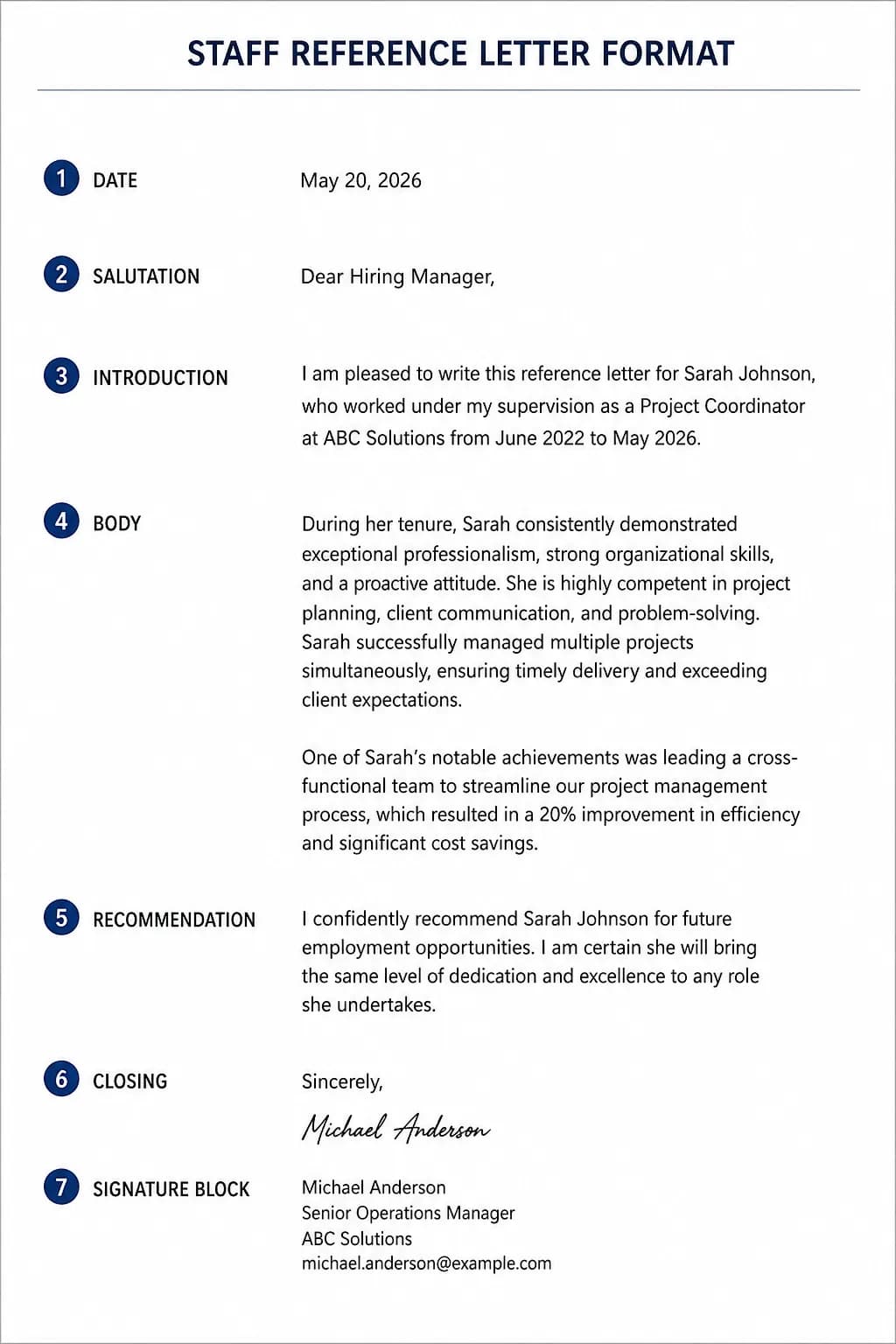
A professional staff reference letter should generally follow this structure:
-
Date
-
Recipient Information (if known)
-
Professional Salutation
-
Introduction
-
Employee Skills and Achievements
-
Recommendation Statement
-
Closing and Signature
-
Contact Information
Example Structure
Quick Tip
Follow a clear business letter format to make the staff reference letter easier to read and verify.
Demo Template:
Formatting and Tone Guidelines
A staff reference letter should maintain a professional, positive, and objective tone throughout. Avoid overly emotional language, slang, or exaggerated claims that cannot be supported.
Best Practices
✔ Use professional business language
✔ Keep paragraphs concise
✔ Use specific examples instead of vague praise
✔ Maintain a positive but honest tone
✔ Limit the letter to one page whenever possible
Avoid
❌ "Best employee ever"
❌ "Perfect in every way"
❌ Unsupported claims
❌ Informal language
Example
Weak:
Olivia was amazing, and everybody loved her.
Strong:
Olivia consistently demonstrated professionalism, strong communication skills, and the ability to meet project deadlines under pressure.
Key Formatting Tip
Focus on facts and evidence rather than personal opinions. Hiring managers trust specific examples more than general praise.
Why Each Section Matters
| Section | Purpose |
|---|---|
| Date | Verifies when the recommendation was written |
| Introduction | Establishes the credibility of the referee |
| Skills & Achievements | Demonstrates employee value |
| Recommendation | Shows confidence in the candidate |
| Contact Information | Allows verification of the reference |
Every section should contribute to proving the employee's qualifications. If a section doesn't add value or credibility, consider removing it.
Professional Staff Reference Letter Sample
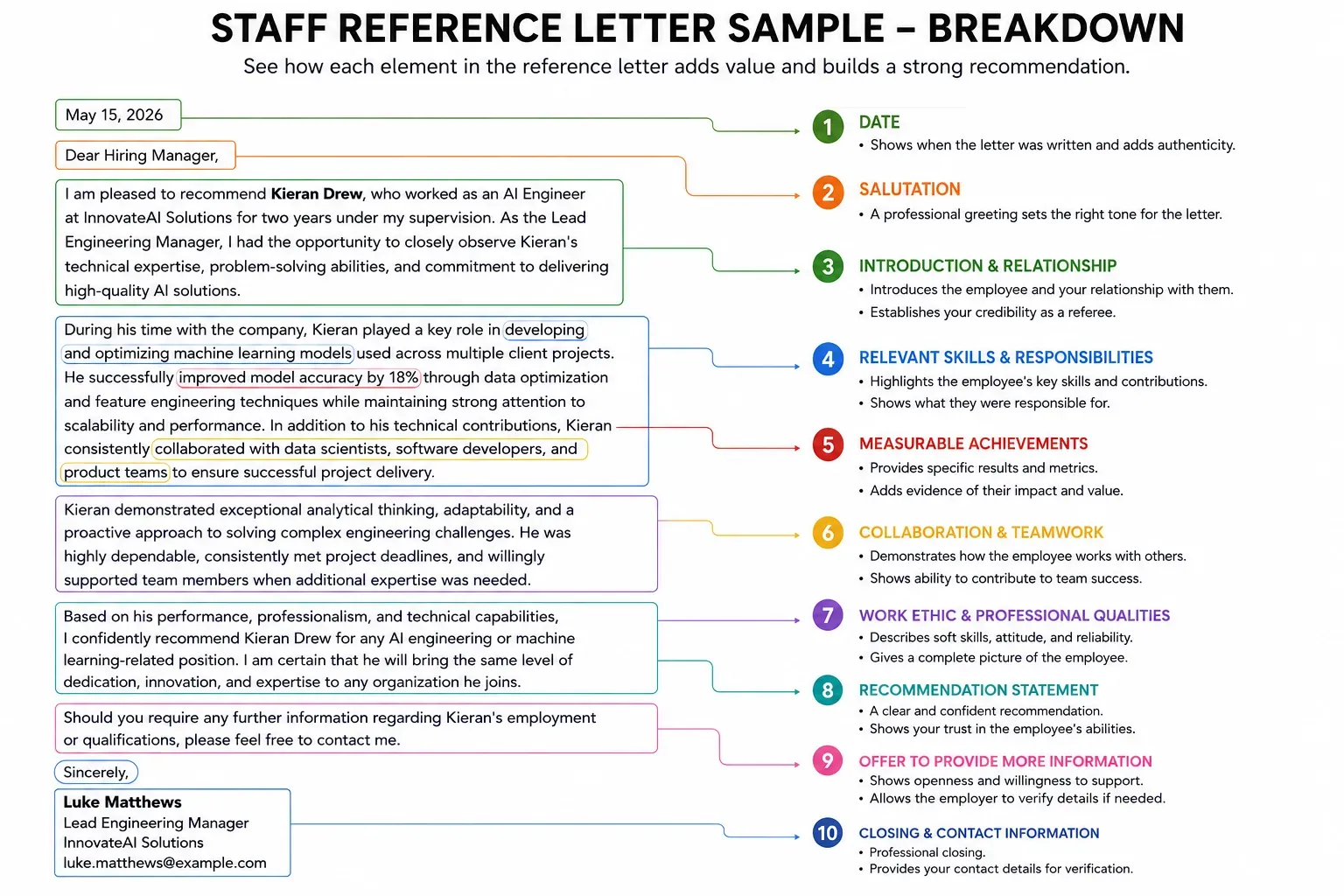
The following employee reference sample demonstrates how a strong recommendation combines specific achievements, measurable impact, and a clear endorsement.
May 15, 2026
Dear Hiring Manager,
I am pleased to recommend Kieran Drew, who worked as an AI Engineer at InnovateAI Solutions for two years under my supervision. As the Lead Engineering Manager, I had the opportunity to closely observe Kieran's technical expertise, problem-solving abilities, and commitment to delivering high-quality AI solutions.
During his time with the company, Kieran played a key role in developing and optimizing machine learning models used across multiple client projects. He successfully improved model accuracy by 18% through data optimization and feature engineering techniques while maintaining strong attention to scalability and performance. In addition to his technical contributions, Kieran consistently collaborated with data scientists, software developers, and product teams to ensure successful project delivery.
Kieran demonstrated exceptional analytical thinking, adaptability, and a proactive approach to solving complex engineering challenges. He was highly dependable, consistently met project deadlines, and willingly supported team members when additional expertise was needed.
Based on his performance, professionalism, and technical capabilities, I confidently recommend Kieran Drew for any AI engineering or machine learning-related position. I am certain that he will bring the same level of dedication, innovation, and expertise to any organization he joins.
Should you require any further information regarding Kieran's employment or qualifications, please feel free to contact me.
Sincerely,
Luke Matthews
Lead Engineering Manager
InnovateAI Solutions
[email protected]
Check the breakdown of this sample below:
Weak Staff Reference Letter Sample (Example of What to Avoid)
May 15, 2026
Dear Hiring Manager,
I am writing this letter for Kieran Drew. He worked at our company as an AI Engineer for around two years.
Kieran was a good employee and worked hard during his time with us. He completed his tasks and got along well with his colleagues. He was always willing to help others when needed and generally performed his job duties satisfactorily.
He had good technical skills and was responsible for various AI-related projects. Kieran was reliable and professional in his work. I believe he would do well in another company and should be considered for employment.
If you have any questions, feel free to contact me.
Sincerely,
Luke Matthews
Lead Engineering Manager
InnovateAI Solutions
[email protected]
Template 1 – Strong Staff Reference Letter
Best for high-performing employees
[Date]
Dear Hiring Manager,
I am pleased to recommend [Employee Name], who worked as a [Job Title] at [Company Name] from [Start Date] to [End Date]. During this time, I had the opportunity to closely observe their professional growth, technical expertise, and contributions to our organization.
[Employee Name] consistently demonstrated exceptional [Skill 1], [Skill 2], and [Skill 3]. One of their most notable achievements was [Achievement], which resulted in [Measurable Result]. They also played a key role in [Project/Initiative], helping the team achieve [Outcome].
Beyond their technical abilities, [Employee Name] was highly dependable, proactive, and collaborative. They consistently met deadlines, communicated effectively with colleagues, and maintained a high standard of work.
Based on my experience working with [Employee Name], I confidently recommend them for [Position/Industry]. I am certain they will bring the same level of professionalism, dedication, and expertise to any organization they join.
Should you require any additional information, please feel free to contact me.
Sincerely,
[Your Name]
[Your Position]
[Company Name]
[Contact Information]
If you are searching for a professional reference template for employee recommendations, this format is suitable for high-performing employees with measurable achievements.
Template 2: Neutral Reference Letter
For employees who performed satisfactorily but whom you do not wish to strongly endorse.
[Date]
Dear Hiring Manager,
I am writing to confirm that [Employee Name] worked as a [Job Title] at [Company Name] from [Start Date] to [End Date].
During their employment, [Employee Name] was responsible for [Primary Responsibilities]. They fulfilled the duties associated with their role and contributed to the day-to-day operations of the team.
Throughout their tenure, [Employee Name] demonstrated professionalism and completed assigned tasks in accordance with company expectations. They worked collaboratively with colleagues and maintained a professional approach to their responsibilities.
This reference is provided based on my experience working with [Employee Name]. Should you require additional information regarding their employment history, please feel free to contact me.
Sincerely,
[Your Name]
[Job Title]
[Company Name]
[Contact Information]
This type of reference for employee leaving is commonly used when an employer wants to confirm employment details without providing a strong endorsement.
Template 3: Employment Verification Letter (When You Prefer Not to Recommend)
For situations where you do not want to provide a recommendation but still need to confirm employment details.
[Date]
To Whom It May Concern,
This letter confirms that [Employee Name] was employed by [Company Name] as a [Job Title] from [Start Date] to [End Date].
During this period, [Employee Name] performed duties related to [Key Responsibilities] and was employed in accordance with company policies and procedures.
This letter is provided solely for employment verification purposes and confirms the employee's position and dates of employment.
Should you require additional verification, please contact us using the information below.
Sincerely,
[Your Name]
[Job Title]
[Company Name]
[Contact Information]
Pro Tip
Not every staff reference letter needs to be a glowing recommendation. If you cannot confidently endorse an employee, it is often better to provide a neutral reference or an employment verification letter rather than making exaggerated or inaccurate claims.
Strong vs Neutral vs Employment Verification Letter
The right format depends on the situation. For example, a strong recommendation may be appropriate for a high-performing employee, while a neutral letter may be more suitable as a reference for an employee leaving an organization without a formal endorsement. The comparison below explains the differences.
| Feature | Strong Reference Letter | Neutral Reference Letter | Employment Verification Letter |
|---|---|---|---|
| Purpose | Actively recommend the employee | Confirm employment with a limited endorsement | Verify employment only |
| Recommendation Strength | Strong and explicit | Moderate or implied | None |
| Skills Mentioned | Yes, with specific examples | General mention only | Usually not included |
| Achievements Included | Yes, preferably measurable | Rarely included | Not included |
| Performance Evaluation | Detailed assessment | Basic assessment | No assessment |
| Measurable Results | Included whenever possible | Usually omitted | Not included |
| Suitability for Future Roles | Clearly stated | Not strongly emphasized | Not addressed |
| Risk to Referee | Higher because performance claims are made | Moderate | Lowest |
| Best Used When | The employee was a high performer | Employee met expectations but wasn't exceptional | You prefer not to provide a recommendation |
| Example Statement | “I confidently recommend Kieran for future employment opportunities.” | “Kieran fulfilled her responsibilities professionally during her tenure.” | “This letter confirms Kieran's employment from 2022 to 2025.” |
Quick Guide
| Situation | Best Choice |
|---|---|
| Employee consistently exceeded expectations | Strong Reference Letter |
| Employee performed satisfactorily, but you cannot strongly endorse them | Neutral Reference Letter |
| Company policy limits recommendations, or you prefer not to recommend | Employment Verification Letter |
Common Mistakes to Avoid When Writing a Staff Reference Letter
Even experienced managers can make mistakes when writing a staff reference letter. While some mistakes simply reduce the effectiveness of the recommendation, others can damage credibility or create legal and professional risks.
Most Common Mistakes
-
Generic Praise Without Evidence
Bad:
Luke was hardworking and dedicated.
Good:
Luke improved customer satisfaction scores by 18% over one year.
-
Missing Key Employment Details
-
no job title
-
no employment dates
-
no responsibilities
-
Using Vague Recommendations
Bad:
I think Colin would do well.
Good:
I confidently recommend Colin for future marketing roles.
Less Common but Serious Mistakes
-
Exaggerating Achievements
Claim:
Increased revenue by 300%
without proof.
-
Including Irrelevant Personal Information
Age
Religion
Family status
Political views
etc.
-
Copy-Pasting Generic Templates
Hiring managers often notice when letters feel impersonal and generic.
Intentional Mistakes That Can Damage Credibility
-
Providing False Information
Giving inaccurate achievements.
-
Writing an Overly Positive Recommendation for an Unqualified Employee
This can damage your professional credibility.
-
Hiding Important Context
Example:
Employee terminated for misconduct.
Manager writes:
Outstanding employee.
Not ethical.
-
Signing a Letter Without First Reviewing It
Sometimes managers sign drafted letters without verifying claims.
Professional Tips for Writing an Effective Staff Reference Letter
You do not need to go through hundreds of staff reference letter templates on Google to write an effective recommendation. Most successful reference letters follow the same core principles: they are specific, honest, evidence-based, and tailored to the employee's actual performance.
Instead of searching for the “perfect template,” focus on the following best practices.
Use Measurable Achievements
Whenever possible, support your recommendation with measurable achievements rather than generic compliments. Hiring managers are more likely to trust specific results than broad statements about an employee's performance.
Weak Example:
Emma was a hardworking employee.
Strong Example:
Emma helped reduce customer response times by 22% and consistently exceeded monthly performance targets.
Pro Tip: Numbers, percentages, project outcomes, and performance metrics make a staff reference letter more persuasive and credible.
Match the Recommendation to the Employee's Role
The strongest staff reference letters highlight skills and accomplishments that are relevant to the employee's target role. Focus on the qualities that future employers are most likely to value.
Example:
-
For a Sales Executive: Revenue growth, client acquisition, and negotiation skills.
-
For an AI Engineer: Model performance improvements, technical expertise, problem-solving skills.
-
For a Project Manager: Leadership, project delivery, and stakeholder management.
Pro Tip: Tailoring the recommendation to the employee's profession makes the letter more relevant and impactful.
Frequently Asked Questions (FAQ)
What should a staff reference letter include?
How long should a staff reference letter be?
Who can write a staff reference letter?
How do you write a reference for an employee leaving a company?
What is the difference between a reference letter and an employment verification letter?
Should a staff reference letter include measurable achievements?
Do staff reference letters still matter today?
Conclusion
A strong staff reference letter does more than confirm employment; it validates an employee's skills, achievements, and professional reputation. The most effective recommendations are specific, evidence-based, and honest. Whether you're writing a recommendation, a neutral reference, or an employment verification letter, credibility matters more than praise. A well-written staff reference letter can become a powerful trust signal that influences hiring decisions, career opportunities, and long-term professional growth.
Sources and Professional References
This guide references hiring and employment best practices discussed by HR and recruitment organizations, including SHRM, LinkedIn Hiring Research, Indeed Employer Resources, and CIPD.
About the Author:
Emily Parker is a business and workplace communications writer who covers hiring practices, employee relations, professional documentation, and career development. Her work focuses on creating practical, research-backed resources that help employers and professionals communicate more effectively.