Vinyl fencing has expanded well beyond the basic white privacy panel that most homeowners picture when they hear the term. The range of available colors, profiles, and styles has grown significantly, and the options now cover everything from traditional picket fences to lattice-top privacy panels in tan, gray, and wood-tone finishes. Understanding what the vinyl fence market actually offers — and what factors determine whether a specific look is achievable — helps homeowners narrow their choices before talking to a contractor.
Color Options in Vinyl Fencing Go Beyond White
White remains the most common vinyl fence color, but it is no longer the only widely available option. Tan, almond, gray, and wood-look finishes have become standard offerings from most major manufacturers. Wood-grain vinyl uses an embossed texture to approximate the appearance of natural wood while retaining the maintenance advantages of vinyl — no painting, sealing, or staining required.
The color in vinyl fencing is integral to the material rather than applied as a surface coating — this means it will not peel or chip the way painted wood does. The trade-off is that the color cannot be changed after installation; a homeowner who wants to repaint a vinyl fence to a different color later will find that most paints do not adhere reliably to vinyl without significant surface preparation. Choosing a color that works with the home's exterior at the time of installation is important because that choice is effectively permanent for the life of the fence.
Style Categories in Vinyl Fencing
Vinyl fence styles fall into a few broad categories, each suited to different purposes and aesthetic goals.
Style | Description | Best For
|
|---|---|---|
Privacy panel | Solid boards with no gaps; available in flat-top and scalloped profiles | Backyard privacy; screening from neighbors or street |
Semi-privacy | Boards with small gaps or lattice top section above solid lower panels | Privacy with some airflow; decorative top detail |
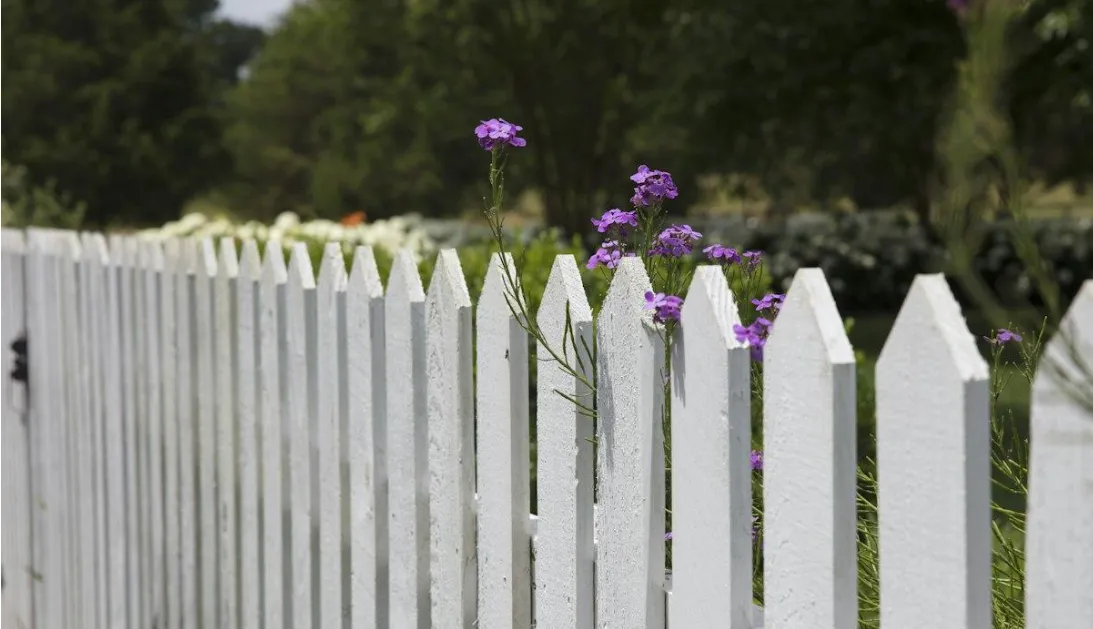
Picket | Individual pointed or flat-top pickets on two or three rails | Front yard definition; traditional residential appearance |
Ranch rail | Horizontal rails without pickets; open structure | Property boundaries on larger lots; split-rail aesthetic |
Lattice top | Solid lower panel with a diagonal lattice section at the top | Decorative upper detail; allows airflow and partial visibility above fence height |
Panel Profile and Height: What Affects the Look
The profile of the fence panel — flat-top, dog-eared, scalloped, or arched — changes the appearance of the fence along its run and affects how it reads from the street. Flat-top panels have a uniform height from post to post, which creates a clean horizontal line that suits contemporary or minimal architectural styles. Scalloped panels dip between posts and rise at the post, creating a repeating arch that reads as more traditional. Arched tops, where the entire panel rises slightly in the center, add a curved detail that reads as more formal.
Standard fence heights in vinyl privacy panels are typically six feet, though shorter heights are available for side-yard applications and taller options are sometimes available from manufacturers for specific products. The panel height interacts with the top profile to produce the overall visual proportion of the fence — a taller fence with a scalloped top reads very differently from a shorter fence with a flat top, even using the same material and color.
How Post Caps and Decorative Elements Factor In
Post caps are the finishing detail at the top of each fence post, and they have more visual impact than homeowners often realize before installation. Standard flat caps are included with most fence systems. Pyramid caps add a peaked detail. Ball-top caps add a rounded finial. Solar post caps combine a decorative cap with a low-level LED light that charges during the day and illuminates at dusk — a popular addition for fences that border pathways or patios.
Routed post caps — where the post is shaped into a decorative profile rather than topped with a separate cap — are available on some premium vinyl systems and add a furniture-like quality to the finished fence. These details are selected during the design phase and specified in the product order, so the choices made before installation determine what arrives on site. Changes after installation are difficult because vinyl fence posts are typically hollow and the caps fit specific post dimensions.
What Affects Color Consistency Over Time
Vinyl fencing is UV-stabilized to resist fading, but all colored materials change in appearance over time with sun exposure. White vinyl tends to show yellowing more visibly than other colors. Dark colors — particularly dark gray or brown — may fade more noticeably in Seattle's high-UV summer months than lighter neutral tones. Tan and light gray are often cited as the most color-stable options because fading in either direction — toward lighter or darker — is less visible than with white or very dark tones.
Manufacturers' warranties typically cover significant discoloration, but the definition of "significant" varies between product lines. Reviewing warranty terms for the specific product being considered is part of the pre-installation process. Homeowners in Seattle exploring vinyl fence options can review the range of available styles and colors through Rare Bears Fencing and get details on current product lines through the vinyl fence installation services available for the area.
Frequently Asked Questions
Can vinyl fence panels be custom-sized, or are they limited to standard dimensions?
Most vinyl fence panels are manufactured in standard lengths — typically six or eight feet between posts — and standard heights. Custom panel lengths are available from some manufacturers but add cost and lead time. For most residential installations, the contractor accounts for property dimensions by adjusting the last panel in each run to fit, which may involve cutting the panel to a non-standard length. Not all vinyl fence styles can be cut cleanly — privacy panels can be trimmed, but decorative styles with pre-formed tops cannot always be modified without affecting their appearance.
How does vinyl fence hold up in high wind?
Vinyl fence panels are rigid and catch wind load as a solid surface — this makes post setting depth and spacing especially important in areas exposed to sustained winds. Posts set in concrete to adequate depth and at proper spacing distribute wind load effectively. In extreme wind events, any solid-panel fence — wood or vinyl — faces structural stress. The framing within the vinyl panels and the quality of the post-to-panel connection determine how the fence performs under load.
Is vinyl fencing suitable for a property with a dog?
Yes, for most applications. Privacy panel vinyl fencing provides secure containment and no handholds for climbing, making it effective for most dog breeds and sizes. The solid construction means there are no gaps for a dog to push through. The main limitation is at the bottom of the fence — vinyl privacy panels typically sit close to but not flush with the ground, and a determined digger can create a gap. Adding a concrete mow strip or ground-level board along the base of the fence addresses this without modifying the panels.
Does vinyl fencing require any maintenance in the Pacific Northwest climate?
Vinyl does not require painting, sealing, or staining, but it does require periodic cleaning. In the Pacific Northwest's wet climate, algae and mildew buildup on north-facing or shaded fence sections is common and gives the fence a green or gray cast that is not damage — it wipes off with a mild cleaning solution. Annual or biannual cleaning keeps the fence looking maintained. The hardware — gates, hinges, and latches — should also be checked periodically and lubricated if needed.