A duplicate check is the process of identifying identical or very similar data, files, records, or content that already exists in a system. Its primary purpose is to prevent unnecessary duplication, improve accuracy, and maintain data quality. Depending on the context, duplicate checks may be used to detect duplicate documents, customer records, emails, database entries, files, or even similar written content.
For example:
-
An HR system checks if the same employee has been registered twice.
-
A CRM checks whether a customer already exists before creating a new profile.
-
A plagiarism checker identifies content that closely matches existing sources.
-
An e-commerce website prevents duplicate product listings.
Although the concept is simple, duplicate checking plays a crucial role in reducing errors and keeping information organized.
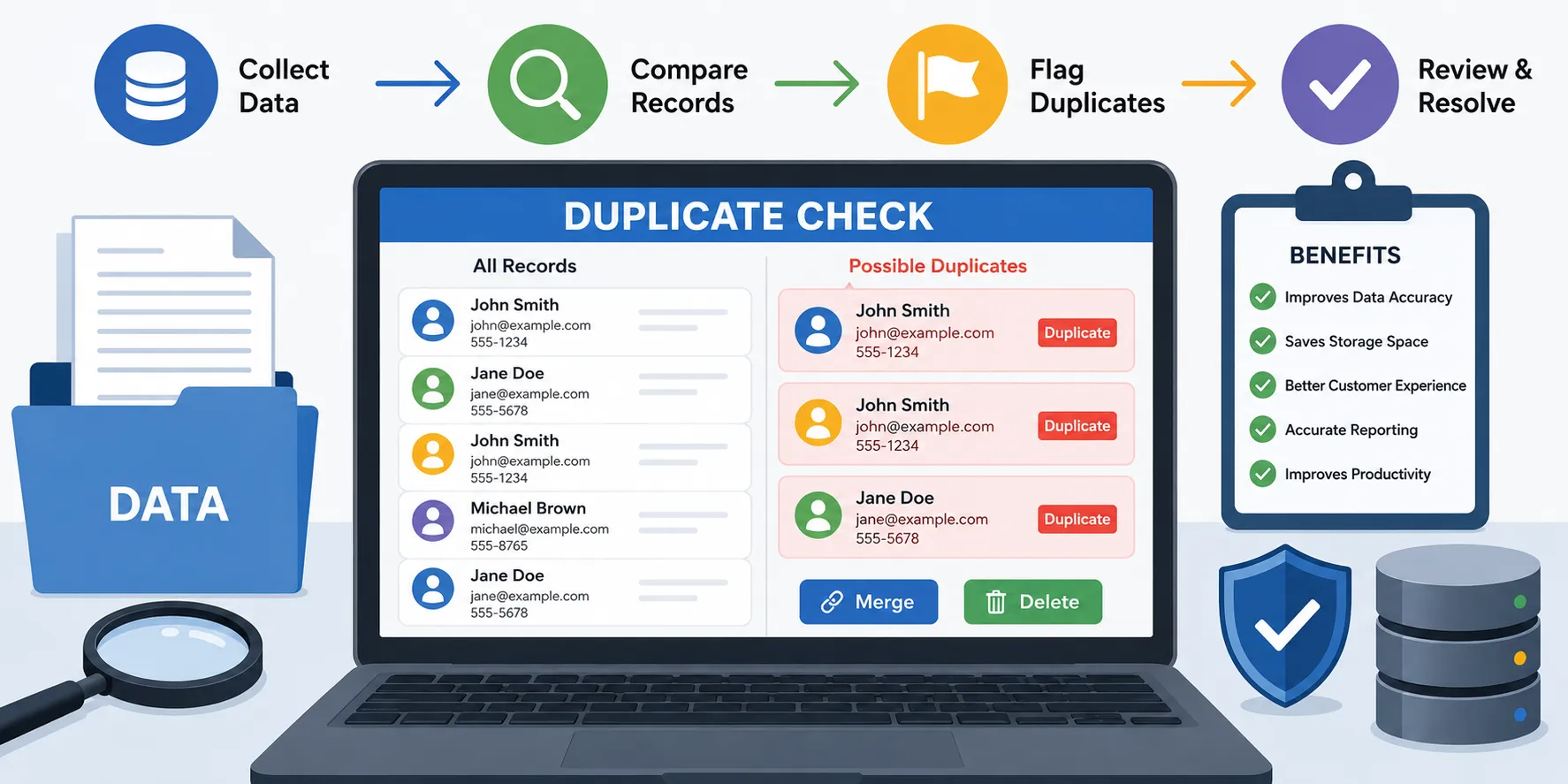
How It Works
While the exact process depends on the software, most duplicate check systems follow a similar workflow.
Step 1: Collect Data
The system gathers the information you want to check, such as:
-
Text
-
Files
-
Customer records
-
Product details
-
Email addresses
Step 2: Compare Records
It then compares the new data with existing records using one or more matching methods.
These may include:
-
Exact matches
-
Partial matches
-
Similar names
-
Email addresses
-
Phone numbers
-
IDs
-
Keywords
More advanced systems also use fuzzy matching and AI-based similarity detection to identify records that aren't identical but are highly similar.
Step 3: Flag Possible Duplicates
If similarities are found, the software marks them for review.
Depending on the system, it may:
-
Block the duplicate.
-
Merge the records.
-
Ask the user to confirm.
-
Generate a duplicate report.
This helps prevent multiple versions of the same information from being stored.
Types of Duplicate Checks
Different industries use duplicate checks in different ways.
| Type | Purpose |
|---|---|
| Database Duplicate Check | Finds repeated customer or employee records |
| Document Duplicate Check | Detects identical or similar documents |
| Plagiarism / Content Similarity Check | Compares written content with existing sources |
| File Duplicate Check | Finds duplicate photos, videos, PDFs, or documents |
| Product Duplicate Check | Prevents duplicate listings in e-commerce |
| Email Duplicate Check | Removes repeated contacts or mailing list entries |
Although the technology differs, the objective remains the same: identify duplicate information before it creates problems.
Common Use Cases
Duplicate checks are used almost everywhere.
Customer Relationship Management (CRM)
Businesses prevent the same customer from being added multiple times.
This keeps reports accurate and avoids duplicate communication.
Healthcare
Hospitals use duplicate checks to avoid creating multiple patient records for the same individual, reducing the risk of medical errors.
Education
Universities use plagiarism detection tools to identify matching or highly similar text in assignments and research papers. It's important to note that these tools identify text similarity, while determining plagiarism requires human judgment.
E-commerce
Online marketplaces use duplicate checks to prevent sellers from creating multiple listings for the same product.
Data Management
Organizations regularly perform duplicate checks during data cleaning projects to improve data quality and eliminate redundant records.
Benefits
A good duplicate checking process offers several advantages.
Improves Data Accuracy
Duplicate records often create confusion.
Removing them helps maintain reliable information.
Saves Storage Space
Duplicate files and records consume unnecessary storage.
Identifying and removing them improves efficiency.
Better Customer Experience
Imagine receiving the same marketing email three times because your profile exists three times in a company's database.
Duplicate checks help prevent situations like this.
Better Reporting
Reports become much more accurate when duplicate records are eliminated.
This leads to better business decisions.
Improves Productivity
Employees spend less time searching, correcting, and managing duplicate information.
Limitations
Duplicate checks are extremely useful, but they aren't perfect.
Some limitations include:
-
Similar records may not always be true duplicates.
-
Different spellings can make duplicate detection more difficult.
-
Manual review is often needed before deleting records.
-
Poor-quality data reduces matching accuracy.
For this reason, many organizations combine automated duplicate detection with human verification.
Common Misconceptions
"Duplicate check only means plagiarism checking."
No.
Plagiarism detection is just one application.
Duplicate checks are also widely used in databases, healthcare, banking, e-commerce, customer management, and file storage.
"If two records look similar, they're definitely duplicates."
Not always.
For example:
-
Raj Sharma
-
Rajesh Sharma
may represent two completely different people.
Good duplicate-checking systems compare multiple fields before identifying duplicates.
"Duplicate checks automatically delete data."
Usually not.
Most systems simply identify potential duplicates and allow users or administrators to review them before taking any action.
Frequently Asked Questions (FAQs)
1. What is the purpose of a duplicate check?
The purpose is to identify repeated or highly similar records, files, or content so that data remains accurate, organized, and free from unnecessary duplication.
2. Are duplicate checks the same as plagiarism checks?
No. Plagiarism or content similarity checking is one type of duplicate checking. Duplicate checks are also used for databases, customer records, products, emails, and digital files.
3. How do duplicate checks identify similar records?
They compare fields such as names, email addresses, IDs, phone numbers, keywords, or text similarity using exact and fuzzy matching techniques.
4. Why are duplicate checks important for businesses?
They improve data quality, reduce storage waste, enhance reporting accuracy, prevent duplicate communication, and support better decision-making.
5. Can duplicate checks make mistakes?
Yes. Automated systems may flag records that are only similar rather than truly identical, which is why human review is often recommended before deleting or merging data.
Duplicate Checks at a Glance
| Feature | Summary |
|---|---|
| Purpose | Identify duplicate or highly similar data |
| Common Uses | Databases, CRM, healthcare, education, e-commerce, file management |
| How It Works | Compares records using matching rules and similarity algorithms |
| Main Benefits | Better data quality, fewer errors, improved efficiency |
| Key Limitation | Some flagged duplicates require manual verification |
Must Read:Is Dr. Fone safe for Data Recovery?
 Answered by