A hydraulic press is a machine that uses hydraulic fluid and Pascal's Law to generate a large amount of compressive force from a relatively small input force. These machines are widely used for bending, forming, stamping, forging, molding, straightening, punching, and assembling materials such as metal, rubber, plastics, and composites.
One thing I found particularly interesting while researching hydraulic presses is that many people think there's just one type. In reality, manufacturers design different hydraulic presses for different jobs. A compact workshop press isn't built for the same purpose as a massive forging press used in heavy industries. Choosing the right type depends entirely on the application.
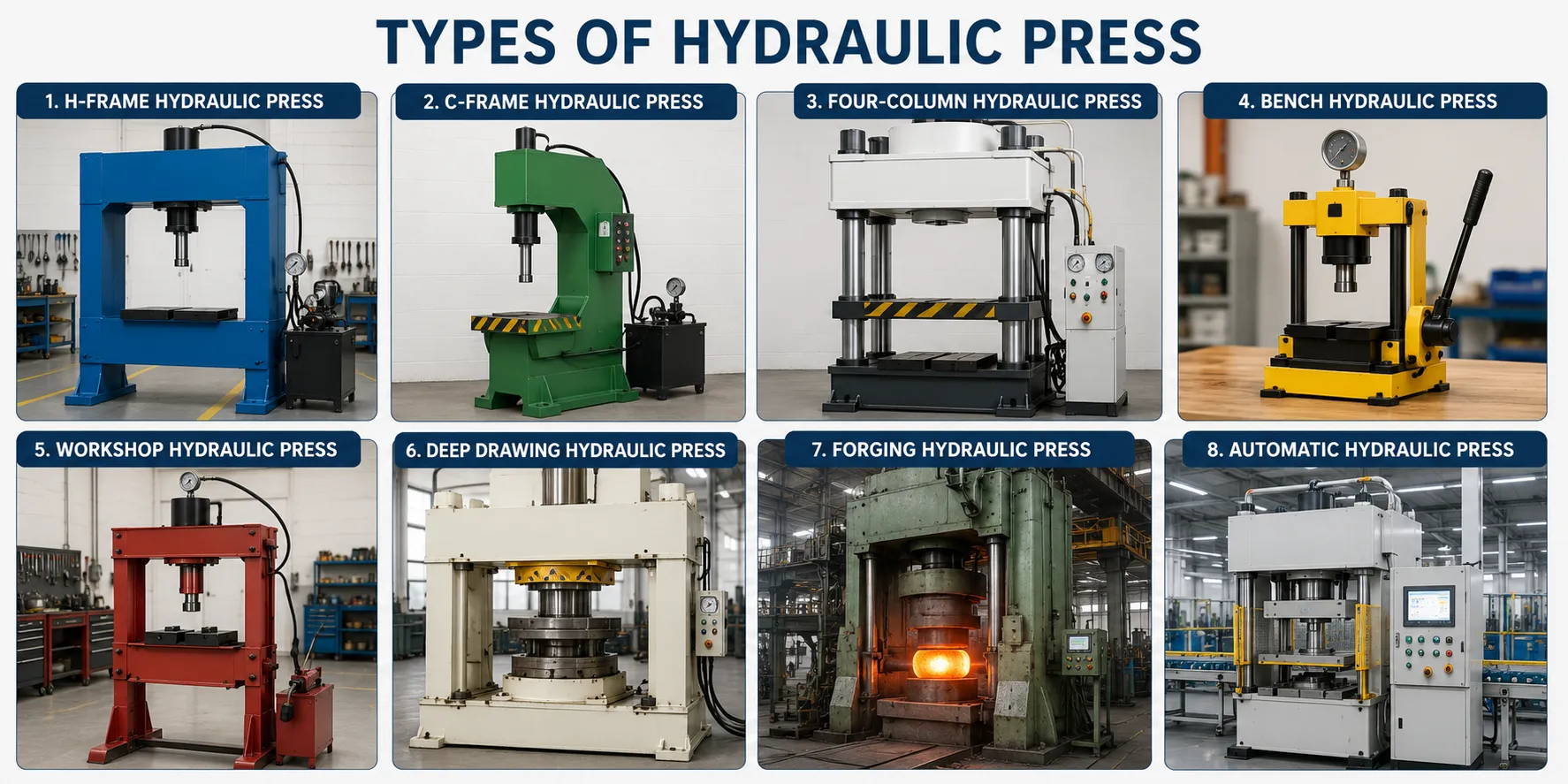
Main Types
1. H-Frame Hydraulic Press
This is one of the most common hydraulic presses.
Its frame resembles the letter H, making it extremely strong and stable.
Best for:
-
Bearing installation
-
Straightening metal
-
Assembly work
-
Heavy repair jobs
-
General workshop applications
Because of its strength, it's commonly found in automotive workshops and manufacturing plants.
2. C-Frame Hydraulic Press
Also called a single-column press.
The C-shaped frame provides easy access to the workpiece.
Ideal for:
-
Punching
-
Riveting
-
Light assembly
-
Small manufacturing operations
Its compact design makes it popular where floor space is limited.
3. Four-Column (Four-Post) Hydraulic Press
This press uses four vertical columns to distribute pressure evenly.
Applications include:
-
Compression molding
-
Plastic molding
-
Rubber molding
-
Large metal components
-
Precision forming
It offers excellent stability and accuracy for large workpieces.
4. Bench Hydraulic Press
A smaller hydraulic press designed for workbenches.
Commonly used in:
-
Laboratories
-
Small workshops
-
Educational institutes
-
Light assembly work
Although compact, it can still generate impressive force for smaller jobs.
5. Hydraulic Workshop Press
These presses are widely used for repair and maintenance work.
Typical uses include:
-
Removing bearings
-
Installing gears
-
Pressing bushings
-
Straightening shafts
They are available as both manual and power-operated models.
6. Deep Drawing Hydraulic Press
Designed specifically for forming sheet metal into deep shapes.
Used for manufacturing:
-
Kitchen sinks
-
Fuel tanks
-
Automotive panels
-
Metal containers
7. Forging Hydraulic Press
One of the most powerful types.
These machines shape heated metal under extremely high pressure.
Common industries:
-
Aerospace
-
Automotive
-
Heavy engineering
-
Defense manufacturing
8. Automatic Hydraulic Press
Instead of relying on manual controls, these machines use programmable systems.
Suitable for:
-
High-volume manufacturing
-
Repetitive production
-
Industrial automation
They improve consistency while reducing manual effort.
Classification by Application
Different hydraulic presses are designed for different industrial tasks.
| Application | Recommended Hydraulic Press |
|---|---|
| Workshop repairs | H-Frame / Workshop Press |
| Metal stamping | C-Frame Press |
| Deep drawing | Deep Drawing Press |
| Forging | Forging Hydraulic Press |
| Plastic molding | Four-Column Press |
| Rubber molding | Four-Column Press |
| Laboratory testing | Bench Hydraulic Press |
| High-volume production | Automatic Hydraulic Press |
How It Works
Every hydraulic press works on the same basic principle: Pascal's Law.
Here's the process:
Step 1
The operator applies force to a small piston.
Step 2
Hydraulic oil inside a sealed cylinder transmits that pressure equally in all directions.
Step 3
The pressure reaches a much larger piston.
Step 4
Because the larger piston has a greater surface area, it generates a significantly larger output force.
This allows a relatively small input force to produce enormous pressing power. That's why hydraulic presses can shape thick metal, compress industrial materials, and perform heavy-duty manufacturing operations.
Advantages
Hydraulic presses offer several important benefits.
Extremely High Force
They can generate hundreds or even thousands of tons of pressure.
Precise Control
Operators can accurately control pressure, speed, and stroke length.
Versatile
A single hydraulic press can perform many different operations simply by changing the tooling.
Uniform Pressure
Unlike some mechanical presses, hydraulic presses provide consistent force throughout the pressing stroke.
Suitable for Heavy Materials
They're ideal for working with thick metals, composites, plastics, and rubber.
Limitations
Despite their advantages, hydraulic presses also have some drawbacks.
-
Slower operating speed than mechanical presses.
-
Require regular maintenance of hydraulic fluid and seals.
-
Hydraulic oil leaks can reduce efficiency.
-
Generally consume more energy during continuous heavy-duty operation.
These factors should be considered before selecting a press for production environments.
Common Misconceptions
"Every hydraulic press is the same."
Not true.
Different hydraulic presses are designed for completely different applications, from laboratory testing to heavy industrial forging.
"Bigger tonnage is always better."
Not necessarily.
Choosing excessive tonnage increases cost, energy consumption, and operating expenses without improving productivity for smaller jobs.
"Hydraulic presses are only used in factories."
While large presses are common in manufacturing, smaller hydraulic presses are also widely used in repair shops, automotive garages, research laboratories, and educational institutions.
Frequently Asked Questions (FAQs)
1. What is the most common type of hydraulic press?
The H-frame hydraulic press is one of the most widely used because of its strength, versatility, and suitability for workshop and industrial applications.
2. Which hydraulic press is best for metal forming?
For heavy metal forming and forging, forging hydraulic presses and four-column hydraulic presses are commonly used.
3. What principle does a hydraulic press use?
A hydraulic press operates according to Pascal's Law, which states that pressure applied to a confined fluid is transmitted equally throughout the fluid.
4. What's the difference between an H-frame and a C-frame hydraulic press?
An H-frame press is stronger and better suited for heavy-duty work, while a C-frame press is more compact and provides easier access for lighter manufacturing operations.
5. Which industries commonly use hydraulic presses?
Hydraulic presses are widely used in:
-
Automotive
-
Aerospace
-
Manufacturing
-
Construction
-
Metal fabrication
-
Rubber processing
-
Plastic molding
-
Research laboratories
Hydraulic Press Types at a Glance
| Category | Best Choice |
|---|---|
| Most Common | H-Frame Hydraulic Press |
| Compact Design | C-Frame Hydraulic Press |
| Large Workpieces | Four-Column Hydraulic Press |
| Workshop Repairs | Workshop Hydraulic Press |
| Heavy Metal Forming | Forging Hydraulic Press |
| High-Volume Manufacturing | Automatic Hydraulic Press |
Hydraulic presses may all operate on the same principle, but they're far from identical. The right machine depends on the job you're trying to accomplish. A workshop repairing bearings doesn't need the same press as an automotive factory producing body panels. Understanding the different types, their applications, and their strengths helps businesses choose equipment that's more efficient, cost-effective, and suited to their production needs.
Must Read: Who are the Top Hydraulic Cylinder Manufacturers in India?