
Forests cover about one-third of Earth's land surface and are among the most important ecosystems on the planet. They regulate the climate, store carbon, produce oxygen, conserve water, prevent soil erosion, and provide habitat for millions of plant and animal species. Scientists generally classify forests based on climate, latitude, rainfall, and the dominant types of trees growing in them.
Globally, forests are grouped into three major forest types:
-
Tropical Forests
-
Temperate Forests
-
Boreal Forests (Taiga)
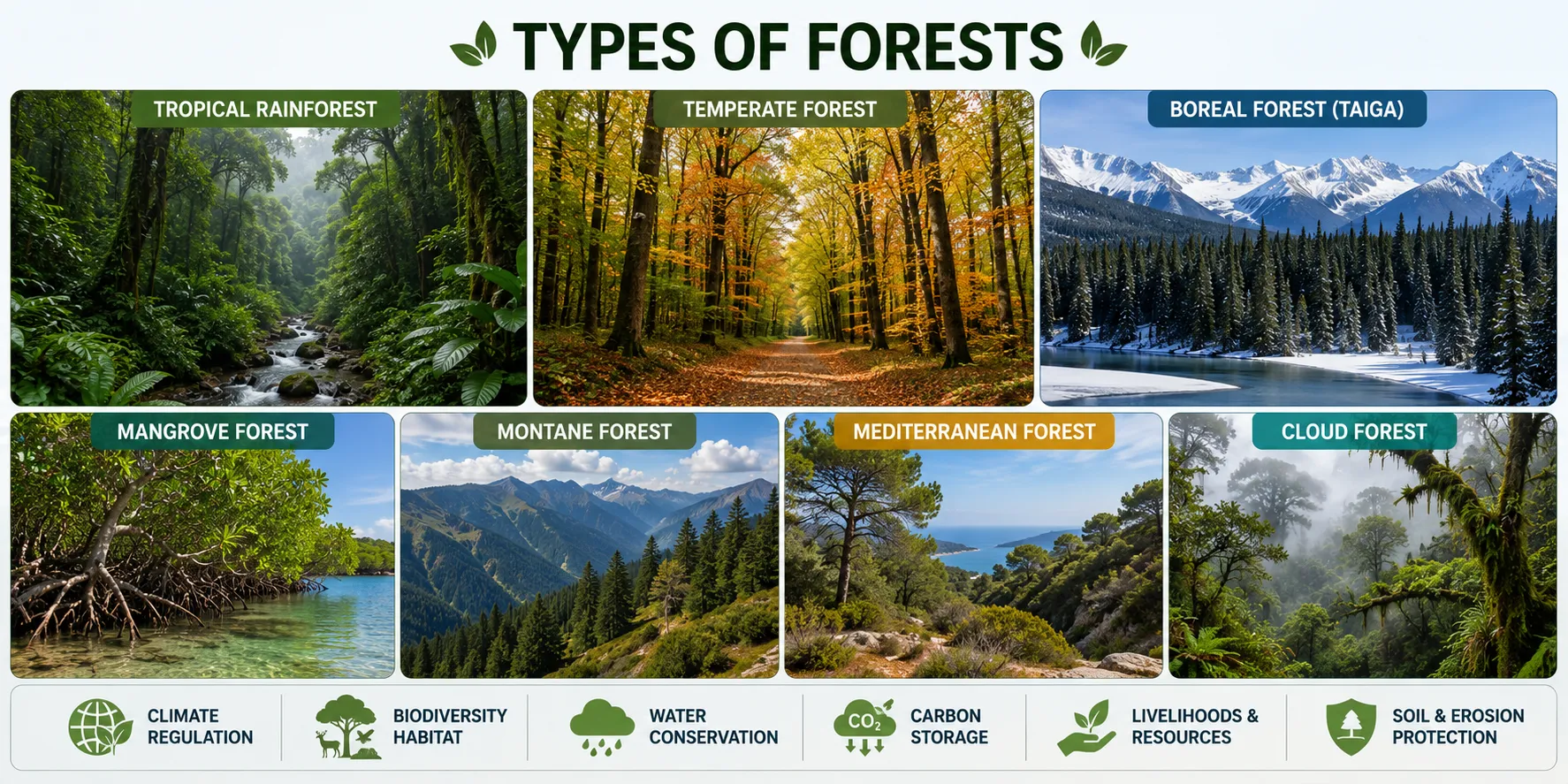
Within these broad categories, there are several specialized forest types, such as mangrove forests, cloud forests, Mediterranean forests, and montane forests.
Main Types
1. Tropical Forests
Tropical forests are found near the equator, where temperatures remain warm throughout the year and rainfall is abundant.
They include:
-
Tropical Rainforests
-
Tropical Dry Forests
-
Tropical Moist Forests
Examples:
-
Amazon Rainforest
-
Congo Basin
-
Southeast Asian Rainforests
These forests contain the highest biodiversity on Earth, with countless species of plants, birds, mammals, reptiles, and insects.
2. Temperate Forests
Temperate forests occur in regions with four distinct seasons.
Depending on rainfall and climate, they may consist of:
-
Deciduous trees (oak, maple, beech)
-
Evergreen trees
-
Mixed forests
Examples include forests across:
-
Europe
-
Eastern North America
-
China
-
Japan
During autumn, many deciduous trees shed their leaves before winter.
3. Boreal Forests (Taiga)
Boreal forests are the world's largest terrestrial forest biome.
They are located across:
-
Canada
-
Alaska
-
Russia
-
Scandinavia
These forests experience:
-
Long, extremely cold winters
-
Short summers
-
Heavy snowfall
Common trees include:
-
Pine
-
Spruce
-
Fir
Wildlife includes moose, wolves, lynx, bears, and many migratory birds.
4. Mangrove Forests
Mangrove forests grow along tropical and subtropical coastlines.
Their trees have specialized roots that tolerate salty water and changing tides.
They play an important role in:
-
Protecting coastlines
-
Preventing erosion
-
Supporting fish breeding grounds
-
Reducing storm damage
The Sundarbans, in India and Bangladesh, is the world's largest mangrove forest.
5. Montane Forests
Montane forests develop in mountainous regions.
As elevation increases, temperature decreases, creating unique ecosystems that support plants and animals specially adapted to cooler climates.
These forests are found in:
-
Himalayas
-
Andes
-
Rocky Mountains
-
East African Highlands
6. Mediterranean Forests
Mediterranean forests occur in regions with:
-
Hot, dry summers
-
Mild, wet winters
They contain drought-resistant vegetation and are commonly found in:
-
Mediterranean Basin
-
California
-
Chile
-
South Africa
-
Southwestern Australia
7. Cloud Forests
Cloud forests are high-altitude tropical forests that remain covered in mist for much of the year.
They support exceptional biodiversity and many species found nowhere else on Earth.
These forests are especially important for maintaining freshwater supplies because they capture moisture directly from clouds.
Classification
Forests can be classified in several different ways.
| Classification Basis | Examples |
|---|---|
| Climate | Tropical, Temperate, Boreal |
| Leaf Type | Evergreen, Deciduous, Mixed |
| Rainfall | Rainforest, Dry Forest |
| Altitude | Montane, Cloud Forest |
| Location | Mangrove, Coastal Forest |
| Dominant Trees | Coniferous, Broadleaf |
Different scientific organizations may use more detailed classification systems, but climate-based classification remains the most widely used globally.
Importance
Forests are much more than collections of trees.
They are essential for life on Earth.
Their importance includes:
Climate Regulation
Forests absorb large amounts of carbon dioxide, helping slow climate change.
Biodiversity
More than 80% of terrestrial biodiversity depends on forest ecosystems.
Oxygen Production
Through photosynthesis, forests contribute significantly to maintaining atmospheric oxygen.
Water Cycle
Forests regulate rainfall, groundwater recharge, and river systems.
Economic Value
Millions of people depend on forests for:
-
Timber
-
Medicine
-
Food
-
Livelihoods
-
Tourism
One of the reasons forests are so fascinating is that no two forest types are exactly alike. A tropical rainforest filled with towering evergreen trees has almost nothing in common with a snow-covered boreal forest, yet both are equally important to Earth's ecological balance. Each supports different species, regulates climate in its own way, and provides resources that millions of people depend on every day.
Threats
Despite their importance, forests face increasing pressure from human activities.
Major threats include:
-
Deforestation
-
Illegal logging
-
Wildfires
-
Climate change
-
Agricultural expansion
-
Urbanization
-
Mining
-
Habitat fragmentation
According to global conservation organizations, protecting forests is one of the most effective ways to conserve biodiversity and combat climate change.
Common Misconceptions
"All forests are rainforests."
No.
Rainforests are only one category of forest. Temperate, boreal, mangrove, and montane forests are equally important.
"Every forest is full of dense trees."
Not necessarily.
Some forests have open canopies, sparse vegetation, or widely spaced trees depending on climate and rainfall.
"Forests only provide timber."
Forests also regulate climate, protect wildlife, conserve water, improve soil health, support agriculture, and provide countless ecosystem services that humans rely on every day.
Frequently Asked Questions (FAQs)
1. What are the three main types of forests in the world?
The three primary forest types are Tropical Forests, Temperate Forests, and Boreal Forests (Taiga).
2. Which is the largest forest biome on Earth?
The Boreal Forest (Taiga) is the largest forest biome, stretching across northern North America, Europe, and Asia.
3. Which forest has the highest biodiversity?
Tropical rainforests contain the greatest variety of plant and animal species anywhere on Earth.
4. What is a mangrove forest?
A mangrove forest is a coastal ecosystem where salt-tolerant trees grow in tidal areas, protecting shorelines and supporting marine life.
5. Why are forests important?
Forests regulate climate, absorb carbon dioxide, produce oxygen, protect biodiversity, conserve water, prevent soil erosion, and support millions of livelihoods worldwide.
Forest Types at a Glance
| Forest Type | Climate | Key Feature |
|---|---|---|
| Tropical Forest | Hot & Wet | Highest biodiversity |
| Temperate Forest | Moderate | Four distinct seasons |
| Boreal Forest (Taiga) | Cold | Largest forest biome |
| Mangrove Forest | Coastal | Salt-tolerant trees |
| Montane Forest | Mountainous | High-altitude ecosystem |
| Mediterranean Forest | Dry Summers | Drought-resistant vegetation |
| Cloud Forest | Cool & Humid | Constant mist and rich biodiversity |
Forests are among the most diverse ecosystems on Earth, and understanding their different types helps us appreciate how climate, geography, and biodiversity are interconnected. From the lush tropical rainforests near the equator to the frozen boreal forests of the north and the unique mangrove forests protecting coastlines, each forest plays a vital role in maintaining the planet's ecological balance. Protecting these ecosystems is essential not only for wildlife but also for climate stability, clean water, and the well-being of future generations.
Must Read: Suggest some approaches towards the conservation of forests
