
Magento is one of the world's most popular eCommerce platforms, used by businesses ranging from small online stores to large global enterprises. Since its launch in 2008, Magento has gone through several major versions and editions, each introducing new technologies, better performance, stronger security, and improved scalability. In 2018, Magento was acquired by Adobe, and its commercial edition was later rebranded as Adobe Commerce.
Many people think Magento simply has "Version 1" and "Version 2." In reality, Magento has evolved through multiple editions, naming changes, and release branches over the years. Understanding these versions is important because features, support, and security vary significantly between them.
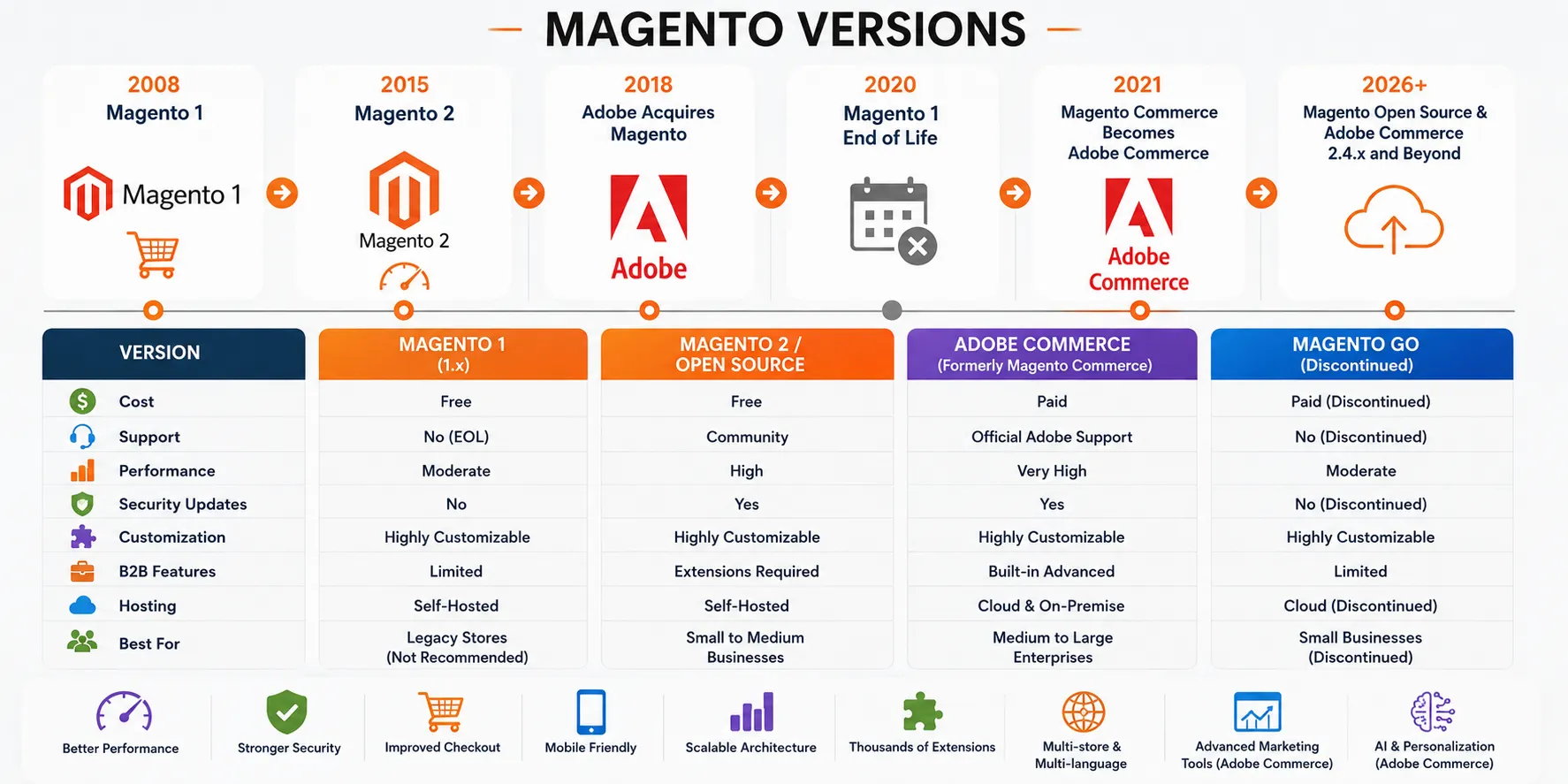
Editions
1. Magento 1 (Magento 1.x)
Released in 2008, Magento 1 quickly became one of the most widely used open-source eCommerce platforms.
Major editions included:
-
Magento Community Edition (Free)
-
Magento Enterprise Edition (Paid)
-
Magento Professional Edition (Discontinued)
-
Magento Go (Cloud version, discontinued)
Key features:
-
Open-source architecture
-
Flexible customization
-
Large extension marketplace
-
Multi-store management
Magento 1 officially reached its end of life (EOL) in June 2020, meaning it no longer receives official security updates.
2. Magento 2 (Magento 2.x)
Magento 2 was released in 2015 as a complete redesign rather than a simple upgrade.
It introduced major improvements in:
-
Performance
-
Security
-
Checkout experience
-
Scalability
-
Mobile responsiveness
-
Admin interface
Magento 2 also adopted modern development tools like Composer and Dependency Injection, making it much easier for developers to build and maintain online stores.
3. Magento Open Source
Magento Open Source is the free version of Magento 2.
It's ideal for:
-
Small businesses
-
Startups
-
Developers
-
Companies wanting complete customization
Features include:
-
Product management
-
Order management
-
Customer accounts
-
SEO tools
-
Multi-store support
Businesses can extend functionality using thousands of third-party extensions.
4. Adobe Commerce (Formerly Magento Commerce)
After Adobe acquired Magento, the commercial edition was renamed Adobe Commerce.
It's designed for medium and large businesses that need advanced enterprise features such as:
-
AI-powered product recommendations
-
B2B functionality
-
Advanced marketing tools
-
Business intelligence
-
Cloud hosting options
-
Enhanced security
-
Premium technical support
Adobe Commerce shares the same core platform as Magento Open Source but includes many enterprise-only capabilities.
Timeline
| Year | Version / Event |
|---|---|
| 2008 | Magento 1 released |
| 2011 | eBay acquired Magento |
| 2015 | Magento 2 launched |
| 2018 | Adobe acquired Magento |
| 2020 | Magento 1 reached End of Life |
| 2021 | Magento Commerce officially rebranded as Adobe Commerce |
| 2026 | Magento Open Source and Adobe Commerce continue on the 2.4.x release line with ongoing feature and security updates. |
Feature Comparison
| Feature | Magento 1 | Magento Open Source | Adobe Commerce |
|---|---|---|---|
| Current Support | ❌ No | ✅ Yes | ✅ Yes |
| Cost | Free (EOL) | Free | Paid |
| Performance | Moderate | High | Very High |
| Security Updates | No | Yes | Yes |
| Cloud Hosting | No | No | Yes |
| B2B Features | Limited | Extensions Required | Built-in |
| AI & Personalization | No | Limited | Advanced |
| Official Support | No | Community | Adobe |
Which Version Should You Choose?
The right version depends on your business requirements.
Choose Magento Open Source if:
-
You're starting a new online store.
-
You have a limited budget.
-
You want full customization.
-
Your development team can manage updates.
Choose Adobe Commerce if:
-
You operate a large eCommerce business.
-
You need enterprise-level security.
-
You require advanced marketing features.
-
You manage multiple stores globally.
-
You want official Adobe support.
If you're still running Magento 1, upgrading should be a priority because unsupported software exposes your store to security risks and compatibility issues.
Common Misconceptions
"Magento 1 and Magento 2 are almost the same."
Not at all.
Magento 2 is a complete rebuild with a modern architecture, better performance, and improved scalability.
"Adobe Commerce is a completely different platform."
No.
Adobe Commerce is built on the same core foundation as Magento Open Source, with additional enterprise features and commercial support.
"Magento Open Source isn't suitable for serious businesses."
Many successful online stores use Magento Open Source. Whether it's the right choice depends on business requirements, available development resources, and scalability needs—not simply company size.
Frequently Asked Questions (FAQs)
1. What are the main versions of Magento?
The major versions are Magento 1, Magento 2, Magento Open Source, and Adobe Commerce (formerly Magento Commerce).
2. Is Magento 1 still supported?
No. Magento 1 reached its official End of Life (EOL) in June 2020, so it no longer receives security updates from Adobe.
3. What is the difference between Magento Open Source and Adobe Commerce?
Magento Open Source is the free edition, while Adobe Commerce is the paid enterprise version with advanced B2B, AI, cloud, analytics, and support features.
4. Is Magento 2 better than Magento 1?
Yes. Magento 2 offers better performance, stronger security, improved checkout, a modern codebase, and ongoing support, making it the recommended choice for new and existing stores.
5. Which Magento version should a new business use?
For most new businesses, Magento Open Source is a great starting point. Larger enterprises with complex requirements typically benefit more from Adobe Commerce.
Magento Versions at a Glance
| Version | Best For |
|---|---|
| Magento 1 | Legacy stores (no longer supported) |
| Magento 2 | Modern eCommerce platform |
| Magento Open Source | Small to medium businesses wanting flexibility |
| Adobe Commerce | Enterprise businesses requiring advanced features and official support |
Magento has evolved significantly over the years, from a flexible open-source shopping cart to a comprehensive enterprise commerce platform under Adobe. While Magento 1 played a major role in shaping modern eCommerce, today's businesses should focus on Magento Open Source or Adobe Commerce, both of which continue to receive regular performance improvements, security updates, and new features. Choosing the right version ultimately comes down to your budget, technical resources, and long-term business goals.
Must Read: How Ai made a place in smarter E-Commerce?