
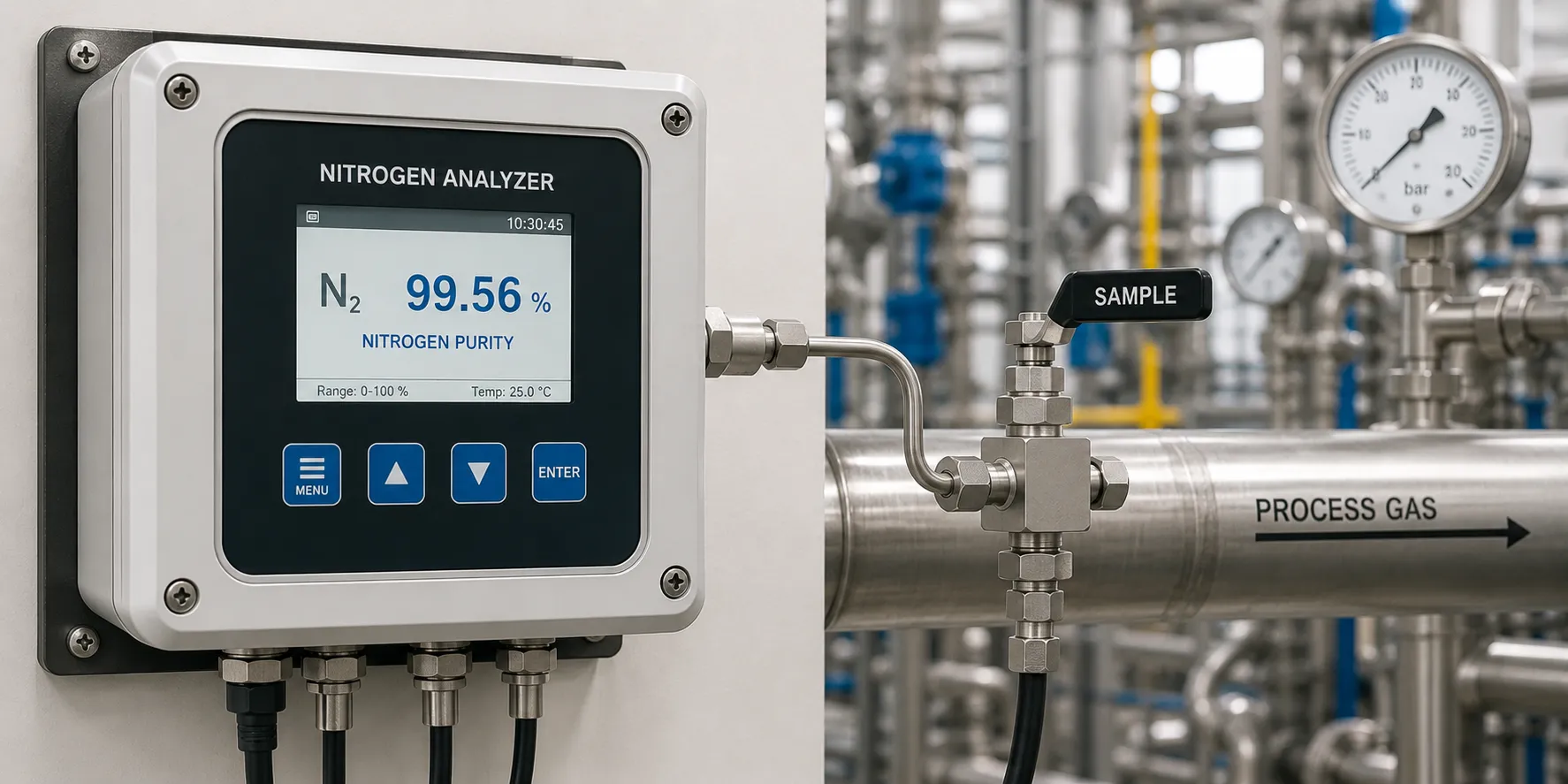
A nitrogen analyzer is an instrument that measures the concentration, purity, or percentage of nitrogen (N₂) in a gas mixture. It helps industries continuously monitor nitrogen levels to ensure product quality, process efficiency, workplace safety, and regulatory compliance. Depending on the application, nitrogen analyzers may measure high-purity nitrogen, detect nitrogen in mixed gases, or verify that the correct gas composition is maintained during industrial operations.
Nitrogen analyzers are widely used in industries such as oil and gas, chemical processing, food packaging, pharmaceuticals, electronics manufacturing, power generation, metallurgy, and industrial gas production. Since nitrogen is colorless, odorless, and cannot be detected by human senses, accurate monitoring with specialized analyzers is essential to prevent process failures, maintain gas purity, and reduce safety risks associated with oxygen displacement or incorrect gas mixtures.
A nitrogen analyzer measures nitrogen concentration by drawing a gas sample into the instrument, where one or more sensors analyze its composition and convert the measurement into a digital reading.
The basic process typically involves:
-
Gas Sampling – The analyzer collects a gas sample from a pipeline, process vessel, storage tank, or surrounding environment.
-
Gas Detection – A sensor measures the nitrogen concentration using an appropriate detection technology.
-
Signal Processing – The measured signal is converted into a nitrogen concentration or purity value.
-
Display & Monitoring – Results are displayed in real time and can also be transmitted to industrial control systems for continuous monitoring and automated process control.
Different analyzers use different measurement principles depending on the required accuracy, response time, and application.
Types
Several types of nitrogen analyzers are available, each designed for specific industrial applications.
| Type | Working Principle | Common Applications |
|---|---|---|
| Thermal Conductivity (TCD) Analyzer | Measures differences in thermal conductivity between gases | High-purity nitrogen, industrial gas production |
| Electrochemical Analyzer | Uses electrochemical reactions to determine gas concentration | Process monitoring and industrial safety |
| Paramagnetic/Oxygen-Based Analyzer | Measures oxygen and calculates nitrogen by difference in certain applications | Nitrogen generators and purity verification |
| Mass Spectrometry Analyzer | Identifies gases based on molecular mass | Laboratories, research, high-precision analysis |
| Process Nitrogen Analyzer | Designed for continuous online monitoring | Chemical plants, pipelines, manufacturing |
Among these, thermal conductivity analyzers (TCD) are widely used for measuring nitrogen because nitrogen has distinct thermal conductivity characteristics compared with many other gases.
Importance
Nitrogen analyzers play a critical role in industrial gas monitoring because even small variations in gas composition can affect product quality, operational safety, equipment performance, and regulatory compliance.
Their importance includes:
-
Verifying nitrogen purity during production.
-
Preventing contamination in sensitive manufacturing processes.
-
Supporting worker safety in enclosed industrial environments.
-
Improving process efficiency through continuous monitoring.
-
Reducing product waste caused by incorrect gas mixtures.
-
Helping industries meet environmental and quality standards.
-
Detecting abnormal gas concentrations before they become operational problems.
For industries that rely on inert atmospheres, accurate nitrogen measurement is often essential rather than optional.
Applications
Nitrogen analyzers are used across a wide range of industries.
| Industry | Application |
|---|---|
| Food & Beverage | Verifying nitrogen purity in modified atmosphere packaging (MAP) |
| Pharmaceuticals | Maintaining inert manufacturing environments |
| Chemical Industry | Process control and gas composition monitoring |
| Oil & Gas | Pipeline monitoring and gas quality verification |
| Electronics & Semiconductor | High-purity nitrogen monitoring during manufacturing |
| Power Generation | Monitoring industrial process gases |
| Metallurgy | Heat treatment and protective atmosphere control |
| Industrial Gas Plants | Nitrogen production, storage, and purity testing |
They are also commonly integrated into automated process control systems that provide continuous, real-time gas monitoring.
Benefits
Using a nitrogen analyzer offers several advantages.
-
Provides continuous real-time nitrogen measurement.
-
Improves industrial safety by identifying abnormal gas conditions.
-
Helps maintain consistent product quality.
-
Supports regulatory and quality compliance.
-
Reduces process downtime through early detection of gas-related issues.
-
Improves production efficiency by maintaining the desired gas composition.
-
Minimizes product losses caused by contamination or incorrect nitrogen purity.
-
Can be integrated with industrial automation and SCADA systems for continuous monitoring.
Limitations
Although highly effective, nitrogen analyzers also have certain limitations.
-
Different sensor technologies are suitable for different applications.
-
Accuracy may be influenced by pressure, temperature, humidity, or other gases if the analyzer is not properly configured.
-
Some analyzers require regular calibration to maintain measurement accuracy.
-
High-precision industrial analyzers can be expensive.
-
Sensor lifespan varies depending on operating conditions and gas exposure.
Selecting the correct analyzer technology is therefore essential for obtaining reliable results in a specific industrial process.
Maintenance
Routine maintenance helps ensure long-term accuracy and reliable operation.
Recommended maintenance practices include:
-
Calibrate the analyzer according to the manufacturer's schedule.
-
Inspect sampling lines and filters regularly.
-
Replace worn or expired sensors when required.
-
Keep the instrument clean and free from dust or contaminants.
-
Verify readings periodically using certified calibration gases.
-
Follow the manufacturer's operating and maintenance guidelines.
Regular maintenance not only improves measurement accuracy but also extends the service life of the analyzer and reduces unexpected downtime.
Frequently Asked Questions (FAQs)
1. What is a nitrogen analyzer?
A nitrogen analyzer is an instrument that measures the concentration or purity of nitrogen gas in a gas mixture for industrial, laboratory, or process-monitoring applications.
2. Why is nitrogen monitoring important in industry?
Nitrogen monitoring helps maintain product quality, improve process efficiency, ensure workplace safety, verify gas purity, and comply with industry regulations.
3. Which industries use nitrogen analyzers?
They are widely used in food processing, pharmaceuticals, chemical manufacturing, oil and gas, semiconductor production, metallurgy, power generation, and industrial gas plants.
4. Which technology is commonly used in nitrogen analyzers?
Common measurement technologies include thermal conductivity (TCD), electrochemical sensors, mass spectrometry, and oxygen-based measurement methods, depending on the application and required accuracy.
5. Do nitrogen analyzers require calibration?
Yes.
Like most industrial gas analyzers, nitrogen analyzers require periodic calibration and maintenance to ensure accurate and reliable measurements over time.
A nitrogen analyzer is an essential instrument for measuring nitrogen concentration and purity in industrial gas systems. By providing accurate, real-time measurements, it helps industries maintain product quality, optimize manufacturing processes, improve workplace safety, and comply with quality and environmental regulations. Whether used in food packaging, chemical processing, pharmaceutical manufacturing, or industrial gas production, a properly selected and well-maintained nitrogen analyzer plays a vital role in reliable industrial gas monitoring and process control.
Must Read: What are the uses of Liquid Nitrogen?