
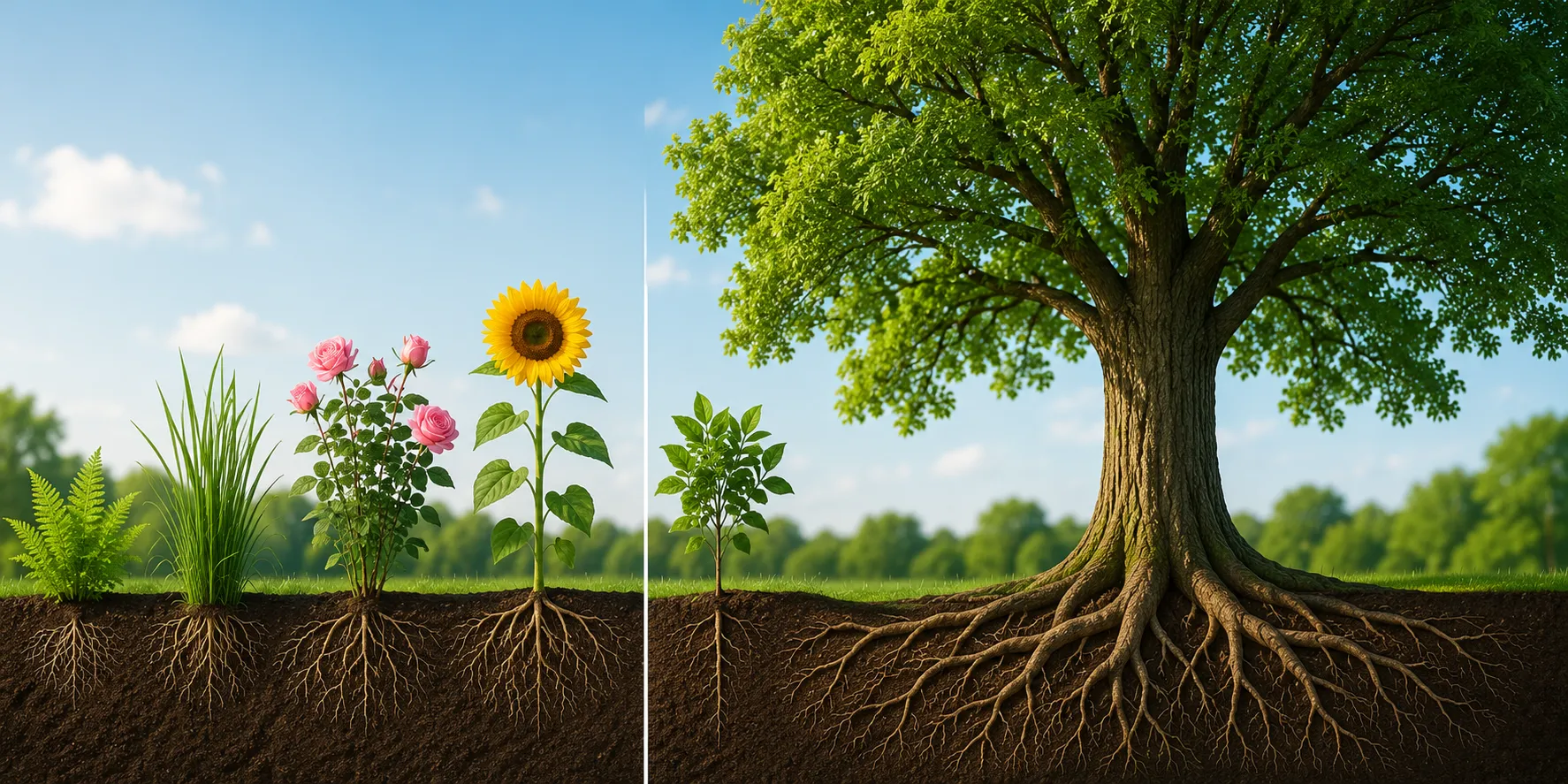
A plant is a broad biological term that refers to any living organism belonging to the Kingdom Plantae, including trees, shrubs, herbs, grasses, climbers, ferns, mosses, and flowering plants. A tree, on the other hand, is a specific type of plant that is typically large, perennial, and has a single woody stem called a trunk, supporting branches and leaves above the ground. In simple terms, all trees are plants, but not all plants are trees.
The main difference lies in size, structure, lifespan, and growth habit. Trees usually grow taller, develop thick woody trunks through secondary growth, and can live for decades or even centuries. Many other plants, such as herbs, grasses, and flowering plants, have soft stems and often complete their life cycle within one or two growing seasons.
| Feature | Plant | Tree |
|---|---|---|
| Definition | Any organism belonging to the Kingdom Plantae | A large woody type of plant |
| Classification | Includes trees, shrubs, herbs, grasses, vines, ferns, and more | One category within the plant kingdom |
| Stem | May be soft (herbaceous) or woody | Usually has a thick, woody trunk |
| Size | Can range from tiny mosses to giant trees | Generally much taller than most other plants |
| Lifespan | Annual, biennial, or perennial | Usually perennial and long-lived |
| Branches | May have one or multiple stems | Typically has a single main trunk with branches |
| Growth | Wide variety of growth forms | Upright growth with a well-developed crown |
| Examples | Grass, sunflower, rose, fern, bamboo | Oak, Mango, Neem, Pine, Maple |
What Is a Plant?
A plant is a living organism that belongs to the Kingdom Plantae. Most plants produce their own food through photosynthesis, using sunlight, water, and carbon dioxide. Plants include a vast range of organisms such as trees, shrubs, herbs, grasses, climbers, creepers, mosses, and flowering plants.
What Is a Tree?
A tree is a large perennial woody plant with a strong central stem known as a trunk. It supports branches and leaves high above the ground and generally lives for many years. While there is no single universal botanical definition of a tree, most botanists describe it as a woody plant with a permanent trunk and a well-developed crown.
Similarities
Although plants and trees are different, they share many biological characteristics.
-
Both belong to the Kingdom Plantae.
-
Both perform photosynthesis to produce food.
-
Both contain chlorophyll.
-
Both absorb water and minerals through roots.
-
Both require sunlight, water, air, and nutrients for growth.
-
Both reproduce through seeds, spores, or other reproductive structures, depending on the species.
-
Both play an essential role in maintaining ecological balance by producing oxygen and supporting biodiversity.
Key Characteristics
Characteristics of Plants
-
Include thousands of different growth forms.
-
Can have soft (herbaceous) or woody stems.
-
May be annual, biennial, or perennial.
-
Range from microscopic aquatic plants to giant trees.
-
Include flowering and non-flowering species.
Characteristics of Trees
-
Have a thick woody trunk.
-
Usually grow much taller than other plants.
-
Develop branches that form a crown.
-
Live for many years, often decades or centuries.
-
Produce wood through secondary growth.
-
Store large amounts of carbon and provide habitat for wildlife.
Common Misconceptions
"Plants and trees are different kingdoms."
No.
Trees belong to the plant kingdom. A tree is simply one type of plant.
"Every large plant is a tree."
Not necessarily.
Some large plants, such as banana plants, may look like trees but are botanically classified as large herbaceous plants because they do not produce true woody trunks.
"All plants have soft stems."
Incorrect.
Many plants, including trees and shrubs, develop woody stems, while others remain herbaceous throughout their life.
"A tree is not considered a plant."
No.
Every tree is a plant, but the reverse is not true. Trees are one category within the much larger plant kingdom.
Frequently Asked Questions (FAQs)
1. What is the main difference between a plant and a tree?
A plant is a broad category that includes many types of organisms, while a tree is a large woody plant with a single trunk. In other words, all trees are plants, but not all plants are trees.
2. Is every tree a plant?
Yes.
Every tree belongs to the Kingdom Plantae, making it a type of plant.
3. Can a plant become a tree?
Not usually.
Whether a plant becomes a tree depends on its genetics and species, not simply its age or size. A sunflower, for example, will never grow into a tree, while an oak sapling naturally develops into one.
4. Do trees live longer than most plants?
Generally, yes.
Many trees live for decades or centuries, whereas many herbs and flowering plants complete their life cycle within one or two years.
5. Why are trees important?
Trees provide oxygen, absorb carbon dioxide, reduce soil erosion, support wildlife, regulate local climates, and supply timber, fruits, medicines, and many other natural resources. They are among the most important plants for sustaining ecosystems and human life.
The difference between a plant and a tree is primarily a matter of classification and structure. A plant is any organism belonging to the Kingdom Plantae, while a tree is a specific type of large, woody, perennial plant with a single trunk and a well-developed canopy.
Must Read: Why are plants and trees green?