NEFT and RTGS are electronic payment systems used in India to transfer money from one bank account to another. Both operate under the framework of the Reserve Bank of India (RBI). The main difference is in how transactions are settled and the type of transfer they are commonly used for.
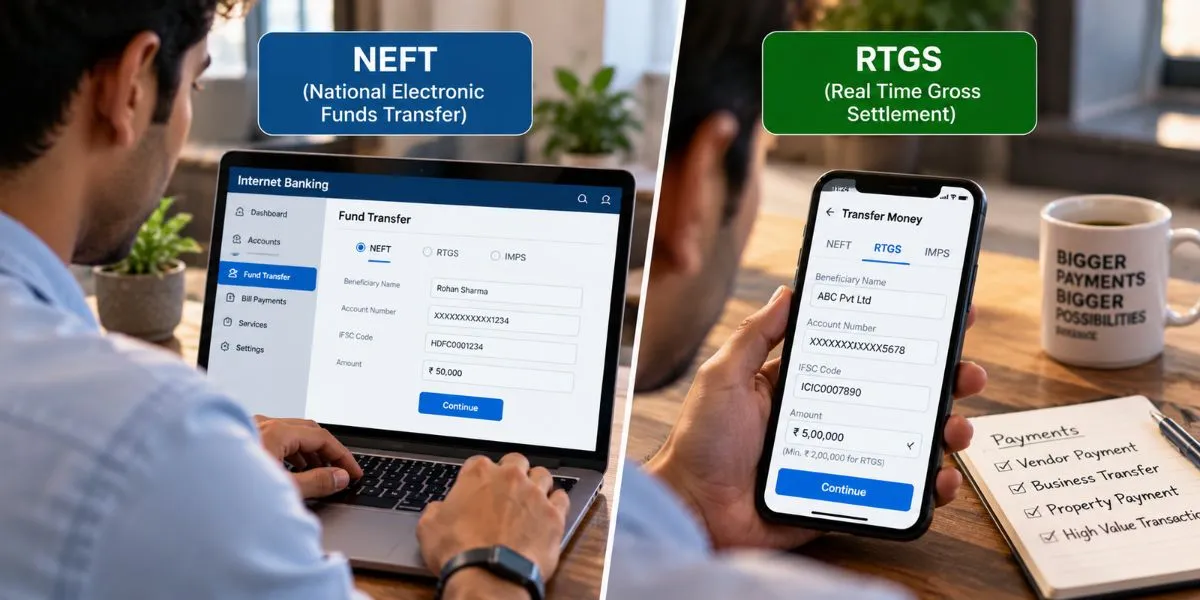
What Is NEFT?
NEFT stands for National Electronic Funds Transfer. It is a nationwide electronic fund-transfer system that allows customers to send money from one bank account to another.
NEFT is available 24 hours a day, 7 days a week, including weekends and bank holidays. The RBI does not prescribe a minimum amount for NEFT transactions, although banks may have their own transaction limits.
Key Features of NEFT
1. Suitable for Different Amounts
NEFT can be used for small, medium, and large-value transfers, subject to the applicable limits of the bank.
2. Available 24×7
Customers can initiate NEFT transfers at any time through supported banking channels.
3. Electronic Transfer
To make an NEFT transfer, the sender generally needs details such as the beneficiary's name, bank account number, bank name, and IFSC.
4. Settlement in Cycles
NEFT transactions are processed through half-hourly settlement cycles, rather than each transaction being settled individually in real time.
What Is RTGS?
RTGS stands for Real Time Gross Settlement. It is an electronic payment system in which transactions are settled individually and in real time.
RTGS is available 24×7 and is mainly used for high-value transactions. The RBI specifies a minimum transaction amount of ₹2 lakh for RTGS. The RBI does not prescribe a maximum amount, although individual banks may set their own limits.
Key Features of RTGS
1. Real-Time Settlement
Each eligible transaction is settled individually rather than being grouped into settlement batches.
2. Mainly for High-Value Transfers
RTGS is generally used when the amount being transferred is ₹2 lakh or more.
3. Electronic Bank Transfer
Like NEFT, RTGS requires appropriate beneficiary and bank-account details to complete the transfer.
Difference Between NEFT and RTGS
Feature | NEFT | RTGS |
|---|---|---|
Full form | National Electronic Funds Transfer | Real Time Gross Settlement |
Settlement | Half-hourly settlement cycles | Individual, real-time settlement |
Availability | 24×7 | 24×7 |
Minimum amount | No minimum prescribed by RBI | ₹2 lakh |
Maximum amount | No maximum prescribed by RBI; bank limits may apply | No maximum prescribed by RBI; bank limits may apply |
Common use | Transfers of different values | High-value transfers |
Settlement method | Transactions settled in batches/cycles | Transactions settled individually |
NEFT vs RTGS: Simple Example
Suppose you want to transfer ₹50,000 to another bank account. You can use NEFT because the RBI does not prescribe a minimum amount for NEFT.
If you need to transfer ₹5 lakh, RTGS can be used because the amount is above the ₹2 lakh minimum. NEFT can also be used for a ₹5 lakh transfer, subject to the applicable bank limits.
Which One Should You Use?
The choice depends mainly on the amount, timing, and settlement method you need. NEFT is suitable for a wide range of transfer amounts, while RTGS is designed for eligible high-value transfers that require individual real-time settlement.
Conclusion
NEFT and RTGS are both electronic money-transfer systems in India, but they differ mainly in how transactions are settled. NEFT uses settlement cycles and has no RBI-prescribed minimum amount, while RTGS settles eligible transactions individually in real time and has a minimum transaction amount of ₹2 lakh.
Both provide important ways to transfer money electronically through India's banking system.
Also Read: What are different types of businesses?