
Online trading is the process of buying and selling financial assets through an internet-based platform provided by a broker or financial service. Depending on the market and jurisdiction, these assets can include shares, bonds, exchange-traded funds (ETFs), currencies, and derivatives.
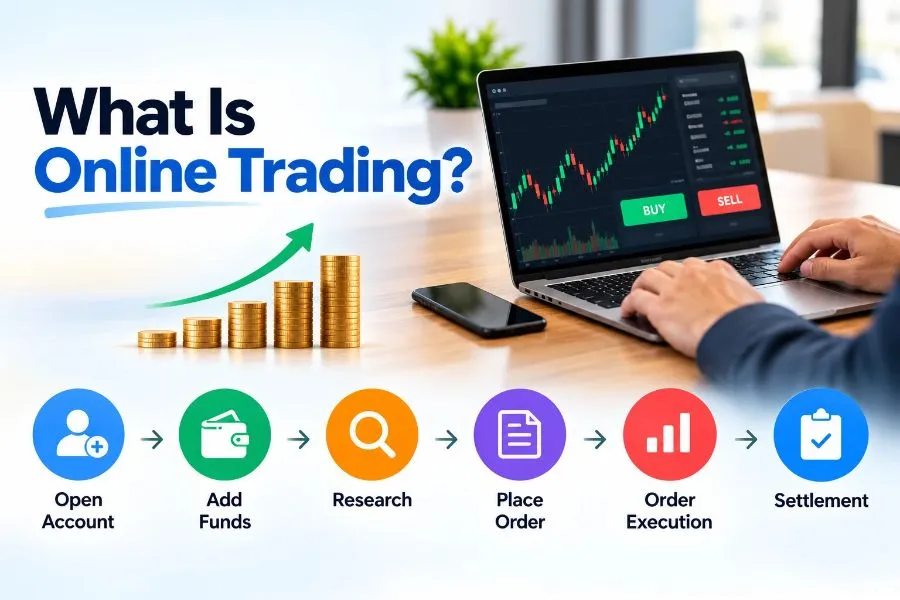
Instead of placing an order through a physical broker, users can access market information and submit orders through a website or mobile application.
Online trading and investing are related but are not always the same. Trading often involves buying and selling assets more actively, while investing may involve holding assets for a longer period based on long-term financial goals.
How Does Online Trading Work?
1. Open an Eligible Trading Account
A person opens an account with a broker or financial service and completes the required identity verification and other eligibility requirements.
2. Add Funds
The user transfers money to the trading account according to the broker's procedures. The amount available for trading depends on the account and applicable rules.
3. Research the Asset
Before placing an order, the user may review information such as the current price, company or asset information, market data, financial reports, and other relevant factors.
4. Place an Order
The user selects an asset and enters a buy or sell order. Common order types include:
Market order: An instruction to buy or sell at the best available price in the market.
Limit order: An instruction to buy or sell only at a specified price or a more favorable price.
The availability and operation of order types can vary between brokers and markets.
5. Order Execution
The broker submits the order to the relevant market or exchange. If the order can be matched according to the market's rules and available prices, it is executed.
An order is not necessarily guaranteed to execute simply because it has been submitted.
6. Settlement
After an order is executed, the transaction goes through the applicable settlement process. The purchased asset and corresponding funds are transferred according to the rules of the relevant market.
Simple Example
Suppose an eligible investor wants to purchase shares of a company.
Trading app → Select company → Choose order type → Enter order → Order reaches market → Order is matched → Transaction settles
The final price can differ from the price displayed when an order is placed, particularly in fast-moving markets.
Common Types of Online Trading
Type | Meaning |
|---|---|
Equity trading | Buying and selling company shares |
ETF trading | Buying and selling exchange-traded funds |
Bond trading | Buying or selling certain debt securities |
Currency trading | Trading currencies in applicable markets |
Derivatives trading | Trading contracts whose value is linked to an underlying asset |
Different financial products have different risks, costs, and eligibility requirements.
Benefits of Online Trading
1. Convenience
Orders can generally be placed electronically without visiting a broker's office.
2. Access to Information
Trading platforms commonly provide prices, charts, account information, and other market data.
3. Electronic Order Placement
Orders can be submitted electronically, although fast submission does not guarantee execution at a particular price.
4. Portfolio Monitoring
Users can generally view their holdings, orders, and transaction history through their accounts.
Risks to Understand
Online trading does not guarantee profits. Asset prices can rise or fall, and some financial products can involve substantial losses. Trading may also involve brokerage fees, taxes, spreads, commissions, and other charges, depending on the product and jurisdiction.
People should understand the financial product, costs, and risks before trading. Account-opening rules and eligibility requirements can also vary by country, broker, and financial product.
Conclusion
Online trading provides an electronic way to buy and sell financial assets through a broker or trading platform. The basic process involves opening an eligible account, adding funds, researching an asset, choosing an order type, placing the order, completing execution, and going through settlement.
Also Read: What is Offshore SMTP Server?