
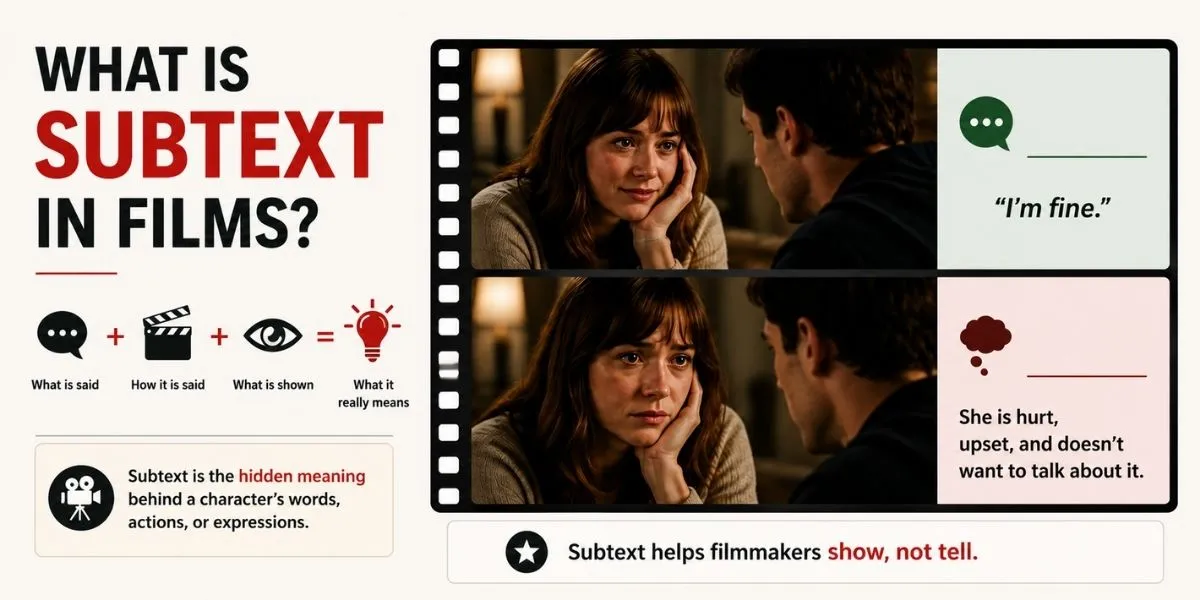
Subtext in films is the hidden or underlying meaning behind a character's words, actions, expressions, or a scene. It is what a character is really thinking or feeling, even when they do not say it directly.
In simple terms, text is what we see and hear, while subtext is what is meant underneath it.
For example, imagine two characters having this conversation:
Character A: “You're home early.”
Character B: “Yes, I finished work.”
On the surface, this is an ordinary conversation. But if Character A sounds surprised and avoids eye contact, the subtext might be that they were not expecting Character B to come home or may be hiding something.
That hidden meaning is the subtext.
Why Is Subtext Important in Films?
Subtext makes a movie's characters, conversations, and stories feel more realistic and interesting. People do not always say exactly what they think or feel in real life, and films can use this idea to create depth.
1. Shows hidden emotions
A character might say, “I'm fine,” while their expression suggests that they are actually upset.
The dialogue is the text, while the character's hidden emotion is the subtext.
2. Creates tension
Subtext can make an ordinary conversation feel tense.
For example, two characters may politely discuss dinner while the audience understands that they are actually arguing about a serious problem. The characters are talking about one thing, but the real conflict is underneath the conversation.
3. Makes characters more complex
Good subtext allows characters to have feelings and motivations that are not immediately explained.
A character may act angry when they are actually frightened, or appear confident while secretly feeling insecure.
This gives the audience something to interpret rather than explaining everything directly.
4. Allows filmmakers to “show, not tell”
Instead of having a character say, “I'm jealous of you,” a filmmaker might show them becoming unusually quiet when another character receives praise.
The audience can understand the jealousy through the character's behavior.
5. Gives audiences something to discover
Subtext encourages viewers to pay attention to facial expressions, pauses, body language, camera shots, music, silence, and word choice.
This can make a film more rewarding because viewers are not simply receiving information—they are interpreting it.
Text vs. Subtext in Films
Element | Meaning | Example |
|---|---|---|
Text | What is directly said or shown | “I'm happy for you.” |
Subtext | The hidden meaning behind it | The character is actually jealous. |
Dialogue | The spoken conversation | “We should talk later.” |
Underlying meaning | What the character really wants or feels | They are avoiding the conversation. |
How Do You Identify Subtext in a Movie?
When watching a film, ask yourself a few simple questions:
What is the character saying?
What does the character actually want?
Does their behavior match their words?
What emotions are being hidden?
Why did the filmmaker include this particular scene or pause?
What does the silence or body language suggest?
These questions can help you notice meanings that are not directly explained.
Subtext vs. Symbolism
Subtext and symbolism are related, but they are not the same thing.
Subtext usually refers to an underlying meaning, emotion, intention, or conflict beneath the surface of a scene.
Symbolism occurs when an object, image, color, place, or action represents another idea or meaning.
For example, a character repeatedly avoiding another character may have the subtext of fear or resentment. A recurring broken clock might be used as a symbol of lost time.
Subtext in Screenwriting
Subtext is particularly important in screenwriting. Writers often avoid making characters explain everything directly because realistic conversations contain things that remain unsaid.
A strong scene can therefore have two layers:
What the characters say + what they actually mean.
This allows actors and directors to communicate additional meaning through performance, timing, camera work, and editing.
What Is Subtext in Films?
Subtext in films is the hidden meaning beneath a character's dialogue, actions, or a scene. It communicates what characters really think, feel, or want without stating it directly.
Bottom Line
If someone asks “What is subtext in films?”, the easiest answer is:
Subtext is the meaning beneath the surface of a film—the thoughts, feelings, intentions, or conflicts that are not directly spoken but can be understood through dialogue, acting, body language, silence, and visual storytelling.
It is one of the techniques filmmakers and screenwriters use to make stories feel deeper, more realistic, and open to interpretation.
Also Read: Suspense, Shock & Twist: What’s the Difference?