
SWOT analysis is a simple strategic planning tool used to understand the strengths, weaknesses, opportunities, and threats related to a business, project, product, or decision.
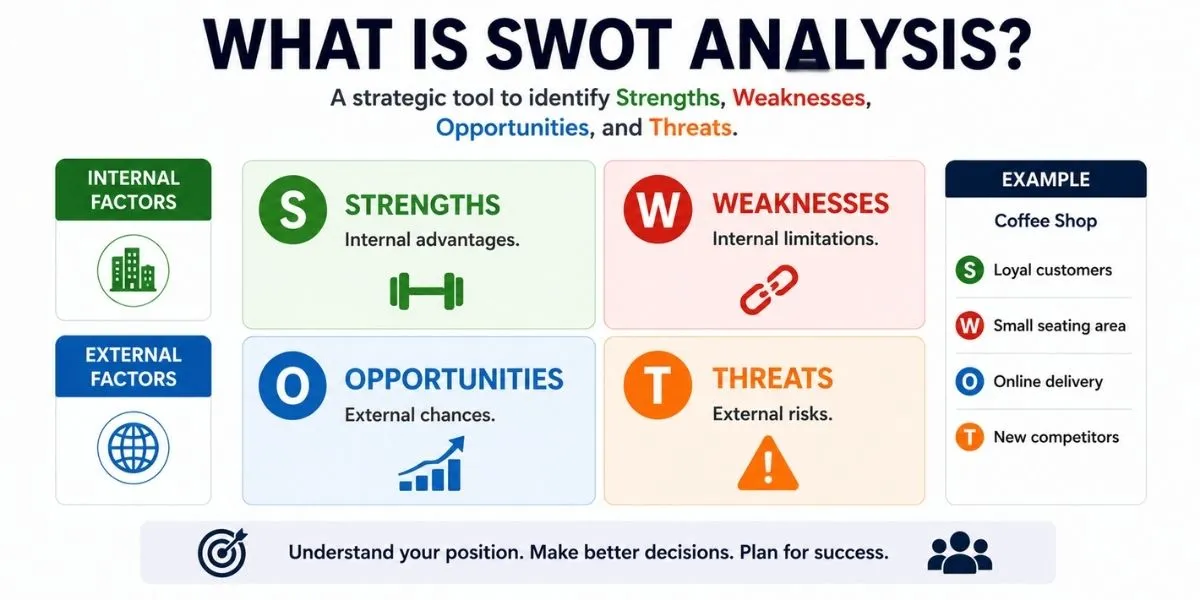
The word SWOT stands for:
S – Strengths
W – Weaknesses
O – Opportunities
T – Threats
In simple terms, a SWOT analysis helps you look at what you are doing well, where you need to improve, what opportunities you can take advantage of, and what challenges or risks you may face.
It is widely used in business, marketing, management, education, project planning, and personal decision-making.
What Does SWOT Stand For?
Each part of SWOT analysis focuses on a different area.
1. Strengths
Strengths are the internal advantages that help a business, project, or individual perform well.
Examples include:
Strong brand reputation
Skilled employees
Loyal customers
Good product quality
Strong financial resources
Unique technology
For example, a company with a well-known brand and loyal customers may consider these factors as its strengths.
2. Weaknesses
Weaknesses are internal limitations or disadvantages that may prevent an organization or project from reaching its goals.
Examples include:
Limited financial resources
Lack of skilled employees
Poor customer service
Outdated technology
Weak online presence
High operating costs
Identifying weaknesses allows an organization to understand where improvements are needed.
3. Opportunities
Opportunities are external situations or trends that could benefit a business, project, or organization.
Examples include:
Entering a new market
Growing customer demand
New technology
Changes in consumer preferences
Partnerships
New government policies or incentives
For example, if demand for online shopping is increasing, an offline retailer may see e-commerce as an opportunity.
4. Threats
Threats are external factors that could create problems or negatively affect future performance.
Examples include:
Increased competition
Economic downturns
Changing regulations
Rising costs
New competitors
Changes in customer preferences
Recognizing threats early can help an organization prepare for possible problems.
SWOT Analysis Example
Imagine a small coffee shop wants to expand its business.
SWOT Category | Example |
|---|---|
Strengths | Loyal local customers and high-quality coffee |
Weaknesses | Small seating area and limited advertising |
Opportunities | Online delivery and a growing local market |
Threats | New coffee shops opening nearby and rising ingredient costs |
This simple analysis can help the coffee shop decide what to improve and where to focus its resources.
Internal vs. External Factors
One of the easiest ways to understand SWOT analysis is to divide the four factors into internal and external factors.
Internal factors:
Strengths
Weaknesses
These are factors that are generally within the organization's control.
External factors:
Opportunities
Threats
These come from the surrounding environment and are generally less directly controllable.
Why Is SWOT Analysis Important?
SWOT analysis can help people and organizations make more informed decisions.
It can be used to:
Understand the current situation
Identify competitive advantages
Find areas that need improvement
Discover potential opportunities
Prepare for possible risks
Support strategic planning
Compare different business or project options
The main benefit is that it brings important internal and external factors together in one simple framework.
How to Conduct a SWOT Analysis
A basic SWOT analysis can be completed in four steps:
Step 1: Identify your strengths.
Step 2: Identify your weaknesses.
Step 3: Look for external opportunities.
Step 4: Identify external threats and risks.
After listing these factors, you can use the findings to develop a strategy or make a better-informed decision.
SWOT Analysis vs. PESTLE Analysis
SWOT and PESTLE are both strategic planning tools, but they serve different purposes.
Tool | Main Focus |
|---|---|
SWOT Analysis | Strengths, weaknesses, opportunities, and threats |
PESTLE Analysis | Political, economic, social, technological, legal, and environmental factors |
SWOT provides a broader overview of an organization's internal and external position, while PESTLE focuses specifically on external environmental factors.
What Is SWOT Analysis?
SWOT analysis is a strategic planning framework used to identify an organization's strengths, weaknesses, opportunities, and threats.
It helps businesses and individuals understand their current position and make better strategic decisions.
If someone asks “What is SWOT analysis?”, the simple answer is:
SWOT analysis is a strategic planning tool that examines Strengths, Weaknesses, Opportunities, and Threats to help a person or organization understand its current position and plan for the future.
By looking at both internal factors and external factors, SWOT analysis provides a straightforward way to identify advantages, improve weaknesses, take advantage of opportunities, and prepare for potential threats.
Also Read: why SWOT analysis is important for any business enterprise?
